
The Fierce Protector of the Kagyu Lineage and Dharma Transmission in Tibetan Buddhism
Mahakala is a key deity of Tibetan Buddhism, who is considered the protector of the Dharma and manifests in many ways in the traditions of Buddhism. All variations of Mahakala share the same purpose of protecting the teachings of Buddha, but represent different images and meanings. Mahakala is a figure of transformative power and compassion, representing the necessity of defeating ignorance and negative forces, usually depicted as a fierce, wrathful figure. In addition to being a defender of the teachings, he is also directly involved in making spiritual progression possible among the practitioners by clearing their path. Among these is the Mahakala Bernagchen, which is important in the Kagyu tradition as a guardian of its lineage and teachings. Bernagchen, the six-armed and dark one, is closely associated with the continuation of Kagyu Dharma, ensuring its transmission through generations. His special position is the removal of particular barriers, hence his significance in the practice of Tibetan Buddhism.
Who is Mahakala?

In Tibetan Buddhism, Mahakala is a wrathful deity who embodies the Buddha's fierce compassion. He is usually depicted as a dark figure with many arms, a crown of skulls, and a fierce expression. The main purpose of Mahakala is to defend the Dharma (the teachings of the Buddha) by conquering the obstacles and negativities that impede spiritual growth.
Although Mahakala is present in various Buddhist traditions, such as in the Nyingma school, Gelug school, and Sakya school, the forms and functions of Mahakala differ among various Buddhist schools.
Kagyu Mahakala: The Emanation of Avalokiteshvara
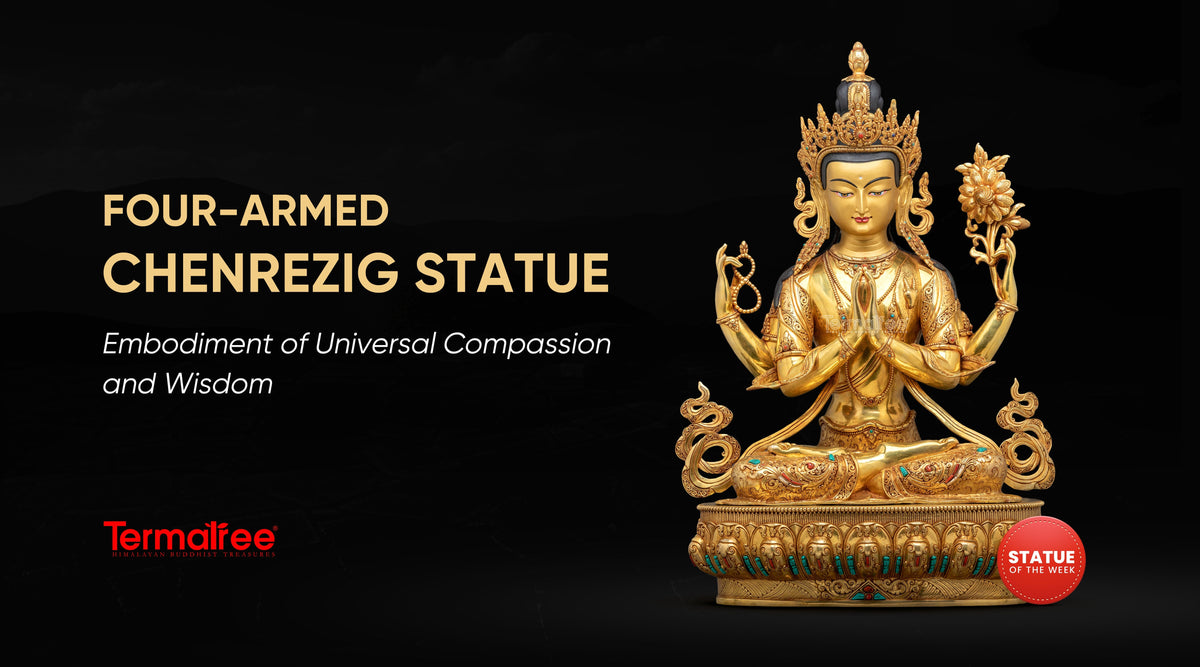
The origin of Kagyu Mahakala is deeply embedded in the tradition of the connection of this tradition with Avalokiteshvara, the Bodhisattva of Compassion, called Chenrezig in Tibetan. The Mahakala is an incarnation of Avalokitevara, as the Kagyu teaching explains. This association highlights the primary role of Mahakala as a god who brings caring protection in a vindictive manner. In conventional Avalokiteshvara images, the being is peaceful, but the wrathful Mahakala adds a more human aspect.
In the Kagyu tradition, Avalokiteshvara's boundless compassion manifests as the powerful and protective form of Mahakala, whose purpose is to protect the Dharma from external threats and to assist practitioners in overcoming internal obstacles that obstruct their spiritual progress. This emanation is not only symbolic but also a practical part of the spiritual journey. The anger and fierceness of Mahakala, similar to the fierce compassion of Avalokiteshvara, are also aimed at eliminating ignorance, attachment, or any other impurity that can stand on the path of the enlightenment of a practitioner. The special position of Mahakala as a protector of Kagyus is due to the loving nature of Avalokiteshvara.
Historical and Lineage Context of Mahakala Bernagchen in the Kagyu Tradition

Mahakala Bernagchen (Black Cloak Mahakala) has an important role in the Kagyu tradition, specifically in protecting the teachings and lineage. It was the 2nd Karmapa, Karma Pakshi (1206-1283 CE), who introduced the practice into the Karma Kagyu tradition. His influence on the Kagyu school goes as far back as the establishment of the early days, when the need to invoke wrathful gods like Mahakala became essential in ensuring the integrity of teachings. In contrast to other Mahakalas, Bernagchen is concerned with the preservation of the Kagyu tradition and the continuity of the teaching.
The Kagyu Lineage Mahakala Bernagchen Protects
Mahakala Bernagchen belongs mainly to the Karma Kagyu tradition, which led its lineage back to the Karmapas, the first being the Dusum Khyenpa. Bernagchen, as the guardian of this lineage, ensures that the Dharma is transmitted orally, and this teaching is the main activity of the Kagyu tradition. This transmission is said to be guarded by his fierce compassion against external and internal barriers and to preserve the teachings for the generations.
In addition to the Karma Kagyu, there are other sub-lineages under the Kagyu school, including Drukpa Kagyu and Trogon Kagyu. Mahakala Bernagchen oversees the teachings and practices of these schools.
The Transmission of Kagyu Teachings

The Kagyu school strongly emphasizes passing the teachings orally from master to disciple so that there are no modifications to the teachings. The contribution of Mahakala Bernagchen to the process is critical since he is the one who guarantees the continuity of the line and avoids the interference in the conveyance of the sacred teachings. Through his assistance, the wisdom of the Karmapas and the successive leaders is still alive today, and they help future generations of students.
Iconography of Mahakala Bernagchen
Mahakala Bernagchen is frequently portrayed as a very fierce god whose skin is dark blue-black because of his affiliation with the strong and protective power of the universe. However, what distinguishes him from other Mahakala forms is his specific iconography. He is generally portrayed with two arms (rather than the eight-armed or more common depictions seen in other Mahakala forms).
The iconography of Mahakala Bernagchen includes:
- Three eyes: The vision of the truth beyond perception.
- Arms: In every arm, there is a symbolic implement, a fresh heart with a bow and arrow, a trident, a sword, a curved knife, and a skull cup depicting the various tools employed in the defense of the Dharma.
- A crown of skulls: The victory of knowledge over ignorance and the annihilation of the barriers to enlightenment.
- A wrathful expression: It does not mean anger but is a sign of the intense compassion needed to remove the hindrances and clear the way to spiritual development.
Differences between Mahakala Bernagchen and other variations of Mahakala
The Buddhist traditions manifest Mahakala in various forms, but Mahakala Bernagchen stands out in the following aspects:
|
Aspect |
Mahakala Bernagchen |
Other Forms of Mahakala |
|
Iconography |
The sculpture has two arms, representing the different protective elements, each holding various weapons and implements. |
They often portray multiple arms, 8 or more, with various weapons and an emphasis on more general protection. |
|
Purpose |
Mainly a guardian of the Kagyu school, making sure to preserve its teachings and their transmission. |
Guarantees the protection of the Dharma in general and, in particular, the protection of the Buddha's teachings of all traditions. |
|
Wrathful Compassion |
Expresses wrathful compassion, which dissipates the path to the continuous transmission of Kagyu teachings through the generations. |
Offers kindness in a wrathful way, but not always linked to a particular lineage or tradition. |
|
Connection to Avalokiteshvara |
The individual is directly linked to Avalokiteshvara in the Kagyu school, expressing compassion through a protective, fierce form. |
Also related to Avalokiteshvara in other aspects, not necessarily with the particular interest shown towards the Kagyu school. |
|
Ceremonial Role |
It serves as the focus of protection rituals for practitioners, the lineage, and the Kagyu Dharma teachings. |
Applied in multiple protection rituals of the many branches of Buddhism, without particular emphasis on any particular lineage. |
Role of Mahakala Bernagchen in the Kagyu Lineage
The peculiar feature of Mahakala Bernagchen in the Kagyu tradition is that he is the protector of the lineage. He is a Mahakala who has the specific role of preserving the Kagyu lineage and Kagyu teachings, as opposed to other Mahakala figures who primarily focus on protecting the Dharma.
He is invoked to protect the teachings of the Kagyu masters and to ensure the unbroken transmission of the lineage. This Mahakala is especially respected in the Kagyu school, where the continuation and transmission of oral teachings between master and disciple are regarded as venerable.
One such figure is Mahakala Bernagchen, who is said to safeguard the religious transmission of the doctrines of the Karma Kagyu lineage and whose lineage traces to the renowned Buddhist instructor, the Karmapa. His protection, then, is not over all teachings of Dharma, but only over the lineage and its transmission.
Mahakala Bernagchen and Daily Practice

According to the Kagyu tradition, Mahakala Bernagchen is a very important part of the spiritual world of those who safeguard and preserve the lineage's teachings. His protection is invoked in certain rituals, especially by those who are deeply involved in studying and practicing Kagyu Dharma: monks, nuns, and laypeople.
Mahakala Bernangchen practice consists of some important elements:
- Visualization: Mahakala Bernangchen is visualized by the Mahayana practitioners in his fury form, whose power is invoked to defeat ill forces and obstacles.
- Mantra Recitation: When reciting some mantras, it is an essential part of calling his strength and connecting him with his protecting and transformative power.
- Ritual Offerings: It entails the ceremony practitioners bringing various ritual objects to show their devotion towards enhancing their identification with Mahakala Bernangchen.
The ultimate purpose of the practices is to secure the protection of Mahakala Bernangchen, who ensures that the Dharma thrives in the Kagyu school. This effective ritual practice preserves the teachings and assists the spiritual journey of the practitioner to overcome the internal and external barriers he or she may meet on the path.
Conclusion
Mahakala is universally revered across all Tibetan Buddhist traditions as a fierce protector of the Dharma; Mahakala Bernagchen occupies a unique and critical role in the Kagyu tradition. His particular emphasis on protecting the Kagyu family and on guaranteeing the preservation and transmission of their doctrines, in contrast with other forms of Mahakala, makes him distinct.
His wrathful, benevolent dynamism is an essential element that helps clear the path and make sure that the sacred doctrine of the Kagyu tradition is not hampered. The significance of him in the Kagyu school gives us the feeling of the richness of the practices in Tibetan Buddhism and the way the various forms of Mahakala can help adherents on their spiritual journey and protect them. The invocation of Mahakala Bernangchen in the Kagyu school is not just about protection; it also implies a deep commitment to the teachings and lineage that will ensure the Dharma remains alive into future generations.