
A Guide to the Meaning, Vow, and Famous Figures Behind the Term
The term "Bodhisattva" is one of the most important concepts in Mahayana Buddhism, representing the ideal of compassion, wisdom, and selfless dedication toward the liberation of all sentient beings. Used extensively in Buddhist teachings, Buddhist scriptures, and Buddhist art, it is much more than just a term for an enlightened person. A bodhisattva is a person who has developed the desire to reach enlightenment for themselves and also for the sake of all beings.
The Bodhisattva ideal has imbued numerous Buddhist practices and is particularly prominent in Mahayana and Vajrayana Buddhist traditions, where they are revered as compassionate beings who assist practitioners in freeing themselves from suffering and advancing on the path to enlightenment.
The Meaning of the Word Bodhisattva

Bodhisattva is derived from Sanskrit, where "bodhi" means "awakening" or "enlightenment," and "sattva" means "being". In simple terms, a bodhisattva is a person who is progressing toward nirvana. It is a stage through which one travels on the way to full spiritual awakening, not a stage in which one has achieved full spiritual awakening.
But the implication is more of a sense of commitment. They seek enlightenment not for personal salvation but for the benefit of all beings. This intention is known as bodhicitta, the awakened mind of compassion and wisdom. The arising of bodhicitta marks the beginning of the its path.
Bodhisattva in Theravada Buddhism
In Theravada Buddhism, the tradition most widely practiced across Southeast Asia, the term "bodhisattva" is used exclusively to refer to Siddhartha Gautama, as the Buddha was known before he attained enlightenment. It's also used to describe Gautama in his previous rebirths, across countless lifetimes as animals, people, or other kinds of beings, as he gradually worked his way toward enlightenment.
According to tradition, Gautama was born as the crown prince of a kingdom in far northeastern India, and he gave up his throne and his wealth to pursue enlightenment. Once he succeeded, he moved from being a bodhisattva, one who is still on the path to becoming a fully enlightened Buddha. In this tradition, it refers to a very specific, singular figure and his earlier lives, not a broader category of beings.
Bodhisattva in Mahayana Buddhism

Mahayana Buddhism, widely practiced across East and Central Asia, takes a broader view. While the term can still be used in the same way as in Theravada Buddhism, Mahayana teaches that there are many more than just one Buddha, and the ultimate goal for all sincere followers of this path is to become a Buddha themselves. Because of this, most serious practitioners of Mahayana Buddhism take what's known as the bodhisattva vow, formally committing themselves to this path.
This means that, in Mahayana proception, bodhisattva is not reserved for one historical figure; it can describe any devoted practitioner striving toward enlightenment for the benefit of all beings.
Celestial Bodhisattvas
In addition, Mahayana Buddhism also incorporates the concept of very advanced, almost superhuman bodhisattvas. This teaching holds that some bodhisattvas have lived through countless lives and have attained the status of divine and celestial beings who have great spiritual merit and power. It is their willingness to postpone the ultimate step toward Buddhahood that makes them of particular importance: to wait to devote themselves to compassionately assisting others.
These celestial bodhisattvas have gained the power to become fully enlightened Buddhas, but they have elected to remain in active compassion, helping those who are continuing to make their way in the world at large.
Bodhicitta: The Motivation Behind the Path

The core of the bodhisattva path is a particular motivation, or intention, called bodhicitta, the awakened mind of compassion and wisdom. This moment is when the practitioner changes his or her intention from seeking liberation for himself or herself to seeking liberation for all beings. In Mahayana proception, the arising of bodhicitta is considered the real starting point of its path. More than any single accomplishment, that marks someone as being on the way to becoming a bodhisattva in the fullest sense.
The Bodhisattva Vow
Closely tied to bodhicitta is the bodhisattva vow, a formal commitment many serious Mahayana practitioners take to continue working for the benefit of all beings. The vow is whatever the school or tradition chooses, but it usually focuses on some common commitments: to help all beings end suffering, to develop compassion and wisdom, to embody the qualities necessary for enlightenment, and to never let go of others in the process. The bodhisattva, which is to say, one whose spiritual progress has advanced, does not stop coming back to the world to help and guide those who are yet in the process of making spiritual advancement.
Core Qualities of a Bodhisattva

Bodhisattvas are usually said to have possessed numerous excellent attributes. These are some of the most significant:
-
Compassion (Karuna)
Compassion is the basis of the Bodhisattva path. The realization of the suffering of others and forms the desire to alleviate it. This compassion extends beyond family, friends, or groups to all living beings. -
Wisdom (Prajna)
A Bodhisattva also acquires wisdom, an understanding of reality. Their ignorance and attachment are conquered by wisdom, and they are seen as the roots of suffering. -
Patience and Dedication
It's said to be a long road, in need of patience, perseverance, and commitment. These are bodhisattvas who practice without getting discouraged, for their motivation is about others. -
Skillful Means (Upaya)
The merit of skillful means, the ability to instruct and guide beings according to their needs and situations. Different people have various levels of understanding, so a Bodhisattva employs various means to guide them to spiritual development.
The Eight Great Bodhisattvas (Ashta Mahabodhisattvas)
1. Manjushri: Bodhisattva of Wisdom
Manjushri personifies prajna, the transcendent wisdom that cuts through ignorance and confusion. He's typically shown wielding a flaming sword in one hand, symbolizing wisdom's power to sever the root of delusion and a lotus supporting a scripture in the other, representing the perfection of wisdom teachings. Manjushri is invoked especially by students, scholars, and anyone seeking clarity of mind.
2. Avalokiteshvara: Bodhisattva of Compassion
Known as Chenrezig in Tibet and Guanyin in China, Avalokiteshvara embodies karuna, boundless compassion for all suffering beings. He is often depicted with multiple arms to represent his limitless capacity to reach out and help, or with a lotus and a mala. Arguably the most widely venerated figure in all of Mahayana Buddhism, Avalokiteśvara's popularity spans nearly every Buddhist culture in Asia.
3. Vajrapani: Bodhisattva of Power
Vajrapani represents the Buddha's spiritual power and protective strength, embodying the energy needed to overcome obstacles and inner resistance on the path. He's usually shown holding a vajra and sometimes appears in a wrathful form not out of anger, but as a fierce expression of compassion meant to cut through stubborn negativity.
4. Kshitigarbha: Bodhisattva of the Earth and Great Vows
Kshitigarbha made one of the most extraordinary vows in Buddhist literature: not to achieve full Buddhahood until every being trapped in the hell realms has been liberated. He embodies the richness and fertility of the earth, as well as steadfast determination. He's usually depicted as a monk holding a staff and a wish-fulfilling jewel.
5. Maitreya: The Future Buddha
Maitreya is unique among the eight: he's the bodhisattva prophesied to become the next Buddha of our world, once the teachings of Shakyamuni Buddha have faded from memory. He currently resides in Tushita Heaven, awaiting the right moment. He embodies loving-kindness and the Buddha's ongoing activity in the world.
6. Samantabhadra: Bodhisattva of Universal Virtue
Samantabhadra represents the practice side of enlightenment: making offerings, dedicating merit, and setting vast aspirational prayers in motion. He's closely tied to the Avatamsaka (Flower Garland) Sutra's famous "Ten Great Vows," and is often shown riding a six-tusked white elephant, a symbol of strength, patience, and steady effort in practice.
7. Akashagarbha: Bodhisattva of Infinite Space
Akashagarbha embodies boundless generosity and the purification of transgressions. Just as space has no limits, his capacity to bestow blessings and remove negativity is considered inexhaustible. He's a less commonly depicted figure in popular imagery but plays a significant role in esoteric practice and ritual.
8. Sarvanivaranavishkambhin: Bodhisattva Who Removes All Obstacles
As his name suggests, this bodhisattva's specialty is clearing away hindrances mental, emotional, and karmic that block a practitioner's progress. He embodies the purified qualities of the Buddha and is invoked specifically to dissolve obstacles standing between a practitioner and awakening.
Bodhisattvas in Buddhist Art
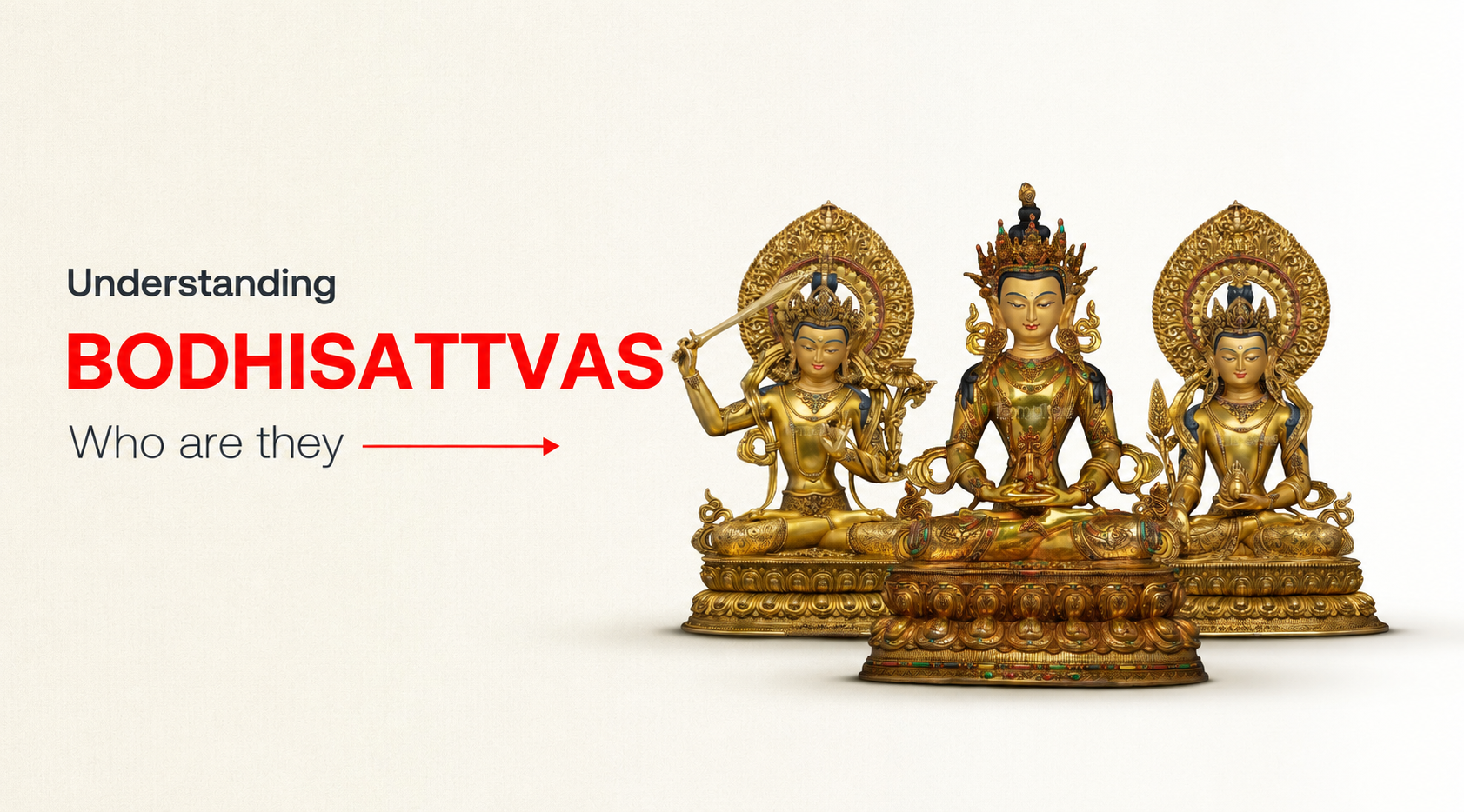
Bodhisattvas also have a characteristic appearance in Buddhist art, separate from that of the Buddhas. A Buddha is usually depicted in simple monastic clothes, whereas the depiction of a bodhisattva is usually in royal attire, ornaments, and jewelry symbolizing the fact that even as he works for the benefit of others, the bodhisattva remains connected to the world.
These are some common elements in Bodhisattva imagery:

- Crowns: Symbols of insight and awareness.
- Jewelry: Represents fullness of enlightened attributes.
- Lotus flowers: Symbolizing purity and not becoming entangled in the suffering of the world.
- Sacred Objects: The objects carried by each Bodhisattva symbolize their teachings and attributes.
In addition, many bodhisattvas are depicted with particular sacred items, which each symbolize a specific teaching or quality of that bodhisattva.
How Is a Bodhisattva Different From a Buddha?
These two terms are used interchangeably, but they refer to two different points on the same continuum. A Buddha is a fully awakened one who has no ignorance at all and who has completely understood reality. A bodhisattva is still on the way to that same complete enlightenment, but has already made the commitment to work for the liberation of others throughout the journey. In Mahayana Buddhism, the bodhisattva path is ultimately expected to lead to Buddhahood, but what defines a bodhisattva specifically is this ongoing, compassionate dedication to others along the way, rather than the destination itself.
 Here's a quick side-by-side comparison of the two:
|
Aspect |
Buddha |
Bodhisattva |
|
Stage on the path |
Fully awakened; has completely overcome ignorance |
Still on the path toward complete enlightenment |
|
Understanding of reality |
Has fully realized the ultimate nature of reality |
Working toward that same realization |
|
Primary focus |
Has already attained liberation |
Dedicates their efforts to helping others achieve liberation |
|
Relationship to others |
Teaches from a place of complete realization |
Actively works alongside others still on the path |
|
Position in Mahayana Buddhism |
The eventual destination of the bodhisattva's journey |
The defining stage of compassionate commitment before reaching Buddhahood |
Why Do Bodhisattvas Matter?

Celestial bodhisattvas occupy a central place in everyday Buddhist worship and devotion. Eight Great Bodhisattvas are regularly prayed to and offered devotion, with related texts and mantras chanted in temples around the world. These figures are worshipped by followers who believe their compassion will bring fortune, health, and happiness into their lives. Buddhist cosmology also teaches of the existence of celestial bodhisattvas in heavenly realms called Pure Lands, which exist in distant dimensions of the universe. The Bodhisattva Maitreya is one that is widely known: He is said to be present in the Tusita Heaven and waiting until he is reborn as the next Buddha of our world.
One of the most compelling things about celestial bodhisattvas is that they can manifest in multiple forms simultaneously. Bodhisattvas are shown in multiple incarnations at once, so they can often be seen on earth as human, animal, or other forms. In Tibetan Buddhists believe that the Dalai Lama is a living representation of Avalokiteśvara or Chenrezig.
Conclusion
At its core, the idea of a bodhisattva reflects one of Buddhism's most enduring lessons: that genuine spiritual growth is rarely, if ever, a solitary pursuit. In Theravada tradition, the term is anchored to a single figure, Siddhartha Gautama, and the long chain of lives he lived before becoming the Buddha. In Mahayana tradition, that same idea widens into something far more personal and universal, describing anyone who has taken up bodhicitta and made the conscious choice to walk toward enlightenment while carrying others along with them.
What ties these interpretations together is not a fixed destination, but a disposition patience paired with wisdom, and compassion sustained even when the path grows difficult. Eight Great Bodhisattvas take this a step further, choosing to remain in the world rather than stepping beyond it, because their work among suffering beings still feels unfinished. It's this willingness to stay engaged, rather than the promise of eventual Buddhahood, that gives the bodhisattva its lasting significance. Centuries after the concept first took shape, it continues to offer a quiet but powerful reminder that wisdom means little without compassion to guide it, and that the most meaningful progress is often the kind made alongside others, not apart from them.


