
From Medicine Buddha to Living Healers, Tracing Buddhism's Path of Compassionate Care
Long before “holistic health” became a modern expression, Buddhist traditions had developed a rich understanding of suffering, healing, compassion, and the care of the sick. In the Buddhist monastic tradition, medicine was treated as an important practical necessity, and the Buddha is repeatedly associated with caring for sick monks. The Vinaya also preserves the story of Jīvaka Komārabhacca, a renowned physician who became the Buddha’s personal physician and treated members of the monastic community. Buddhist teachings consequently developed both a practical concern for physical illness and a deeper understanding of the mind as a source of suffering.
Over the centuries, this concern for healing developed into a vast religious and medical landscape. Buddhist traditions came to include Medicine Buddha, longevity deities, protective figures, and revered physicians whose lives became intertwined with the history of Tibetan medicine. At the same time, Tibetan and Himalayan communities developed living medical traditions in which diagnosis, medicinal knowledge, diet, behavior, external therapies, prayer, ritual, and meditation could exist alongside one another.
Sowa Rigpa: The Roots of Buddhist Medicine

Sowa Rigpa, or Traditional Tibetan Medicine, was developed in the 8th century under King Trisong Detsen, who convened an international medical council at Samye Monastery, bringing together physicians from Greece, Persia, India, China, and Central Asia to combine the era's best medical knowledge with Tibet's own indigenous healing practices. The resulting treatise, the Gyü Zhi or Four Medical Tantras, was compiled and later revised in the 12th century by Yuthok Yonten Gonpo the Younger, whose edited version remains the core curriculum of Tibetan medical study today. It was from this same tradition and from a wider Mahayana devotion to the "Healing Buddha" that Vajrayana Buddhism in Nepal and Tibet developed its own systems of ceremonial healing, still practiced by Newar priests and Tibetan lamas using mantra, meditation, and ritual gesture (mudra).
Medicine Buddha

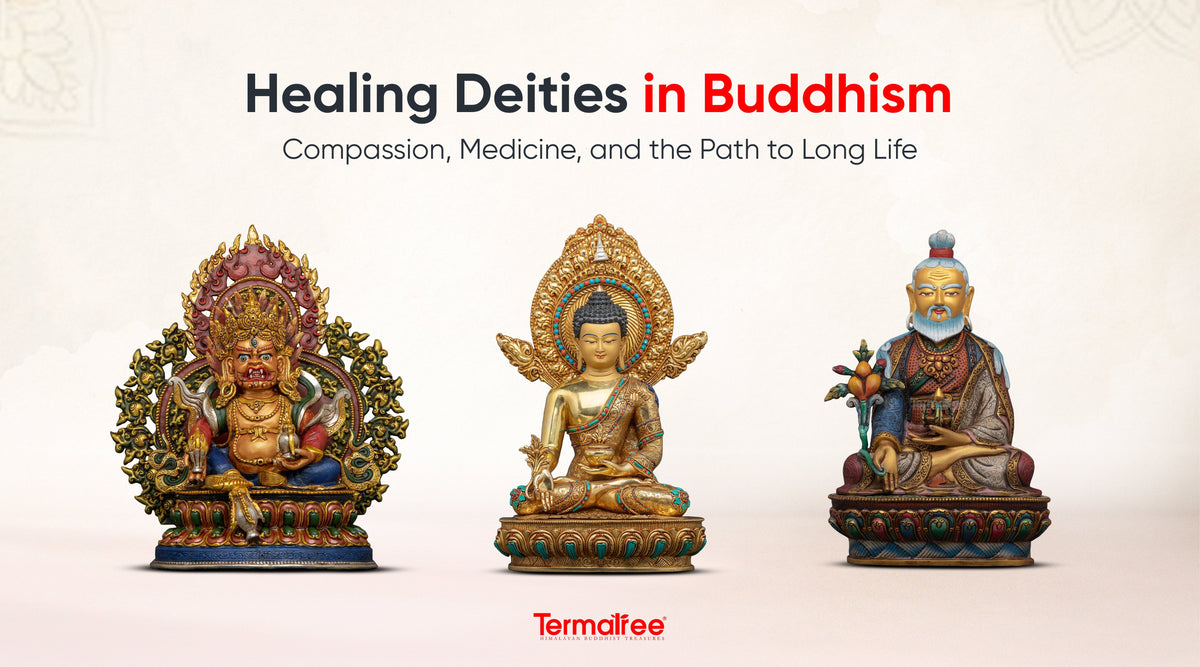
At the heart of Buddhist healing sits Bhaisajyaguru, the Medicine Buddha, known as Vaiduryaprabharaja, the "King of Vaidurya Light," for the sapphire-blue rays radiating from his body. He holds a stem of the medicinal myrobalan plant in his right hand and an alms bowl of blue beryl in his left, and is understood as the very aspect that Shakyamuni Buddha assumed to reveal the medical tantras. His practice is performed to cure disease, ease mental and emotional suffering, and clear obstacles to health and longevity. His own Pure Land, Sudarshana, is identified with Indra's heavenly realm of the Thirty-Three atop Mount Meru, the same Trayastrimsha heaven that Śakra rules over in Buddhist cosmology.
The Medicine Buddha's Assembly
He is rarely pictured alone. Himalayan Buddhist art preserves compositions showing him together with seven other Medicine Buddhas, including Shakyamuni, a group Himalayan Art Resources identifies as the Eight Medicine Buddha Brothers.
The larger assembly can extend well beyond this central group. Depending on the particular textual and artistic tradition, surrounding figures may include bodhisattvas, guardian kings, directional deities, and yaksha protectors, together creating a complete sacred environment centered on the alleviation of suffering. This matters because Buddhist healing is never represented as the activity of one isolated figure, the assembly communicates a broader network of wisdom, compassion, protection, and enlightened activity. In Himalayan Buddhist art, it therefore functions as both an object of devotion and a visual representation of the Buddhist understanding of healing itself.
Yuthok Yonten Gonpo the Elder

Remembered as an 8th-century physician and royal healer to King Trisong Detsen, said to have lived 125 years, Yuthok the Elder anchors Tibetan medicine's hereditary lineage at its legendary root. Modern scholars largely regard his biography as a later construction modeled on his more historical successor, which doesn't lessen his devotional weight, only shifts it from history into myth. Statues of Yuthok the Elder are also notably rare compared to depictions of the Younger, making a well-crafted piece a distinctive and uncommon addition to any collection or altar.
Yuthok Yonten Gonpo the Younger

The genuinely historical founder of Tibetan medicine, Yuthok the Younger (1126–1202), compiled and edited the Four Medical Tantras into the form still studied today. Trained from age eight by his father and nine lineage-holding physicians, he also left behind the Yuthok Nyingthig, a guru-sadhana practice cycle regarded across Tibetan Buddhism as an unusually swift path to realization. He's typically depicted seated on a moon-disc lotus, holding a lotus in each hand.
Shanglon Dorje Dudul: Guardian of the Medical Tradition

Shanglon Dorje Düddul occupies a different role from Medicine Buddha and the Yuthok physicians. He is regarded within the Yuthok Nyingthig tradition as a protector, particularly associated with safeguarding its spiritual practices. His role represents the protective dimension of the healing tradition rather than the practice of medicine itself. He appears in a seated wrathful form with three levels (Outer, Inner, and Secret Accomplishment) and in a more dramatic mounted form tied to the Yuthok Nyingthig, riding a horse with a retinue of eight deities. He's classified as an emanation of Mahakala, tasked specifically with safeguarding the Four Medical Tantras.
The Three Long-Life Deities

Click Here To View Our Three Long-Life Deities
The Three Long-Life Deities are invoked directly for the health and lifespan of the practitioner. Amitayus, White Tara, and Namgyalma are known together as the three long-life deities, each possessing distinct powers invoked through dedicated mantra and ritual for longevity, a grouping that is itself a distinctly Tibetan cultural development.
Amitayus is the Buddha of Infinite Life and one of the most recognizable figures associated with longevity in Tibetan Buddhism. He is generally portrayed as a peaceful, richly adorned Buddha seated in meditation, holding a vase containing the nectar of immortality. His practices are traditionally performed with the aspiration for long life and the removal of obstacles to longevity. The deeper purpose of such practices is to use one's extended life meaningfully to practice the Dharma and benefit others.
White Tara and Drolma Karmo in Tibetan represent the maternal and compassionate face of the trio. Her completely white appearance represents purity, and she is known specifically for healing physical and mental illness and dispelling obstacles on the way to enlightenment.
Namgyalma (Ushnishavijaya) is the trio's most visually distinctive member, depicted with three faces and eight arms in contrast to the single-faced, two-armed forms of the other two. She represents purification, invoked for overcoming karmic obstacles standing in the way of a long, healthy life.
Read More: The Three Long-Life Deities: Symbols of Longevity, Health, and Vitality
From Myth to Practice: Living Healing Traditions in Nepal
These deities aren't confined to statues and thangkas; they're invoked daily by real healers across Nepal, and this is where devotion becomes visible, hands-on practice.
In the Kathmandu Valley, Newar Buddhist priest-healers, called gubhaju or guruju, come mainly from the Vajracharya and Shakya castes and practice a form of ceremonial healing considered a lasting extension of the Buddha's own encouragement of medicine for his followers. Central to their practice is jal, holy water empowered through mantra and given to patients as a kind of spiritual medicine, alongside the vajra and ghanta, the same ritual implements seen throughout Vajrayana art used to help realign a patient's body and spirit. Many of these healers are simultaneously Ayurvedic physicians and astrologers, since illness is often understood to arise from graha dosa, or planetary misalignment, alongside physical causes.

These healers have their patron deities, too. Female healers and mediums often look to Hariti Mata Temple, the goddess enshrined near Swayambhu Stupa, herself once a fearsome spirit, before the Buddha compassionately guided her toward becoming a protector of children's health. Meanwhile honor Kumari, the Living Goddess, as their patron. Among Tibetan communities in Nepal, shamanic healers known as Lhapa and Lhamo practice a related but distinct tradition, drawing on trance and ritual to help clear illness from their patients, a lineage that blends Buddhist devotion with older Himalayan and Bon spiritual practices.
What unites every one of these Buddhist healers, priestly or shamanic, ancient or living, is the same underlying belief that runs through the deities above them: that healing the body and healing the spirit were never really two different tasks.
The Buddha, Medicine, and the Deeper Meaning of Healing
Buddhist literature frequently uses medical imagery to explain the Dharma, structured much like a physician's diagnosis through the Four Noble Truths:
Suffering (dukkha) exists: the illness itself.
Suffering has a cause: craving and attachment.
Suffering can end: the prognosis of recovery.
There is a path to that end: the treatment, followed through ethical conduct, meditation, and wisdom.
This metaphor is especially powerful because it places responsibility on the practitioner. Buddhist teachings offer a path which must be followed by the individual, and as with medicine, the physician cannot prescribe and make the patient take it. Healing, then, is an active process and requires ethical behavior, meditation, wisdom, and the change of unhelpful thoughts. Buddhism also does not imply that routine sickness, old age, and death are absent when people practice. These are still the nature of conditioned life. Healing practices are important because they involve bringing about a reduction in suffering, helping to maintain good health, developing compassion, and establishing good conditions for spiritual growth.
Compassion: The Common Thread

Although each of them plays a different role, Medicine Buddha, Yuthok physicians, Shanglon Dorje Dudul, and the Three Long-Life Deities are bound by one common theme of compassion. Medicine Buddha represents the compassionate activity of healing. The Yuthok lineage represents the preservation and transmission of medical knowledge. Shanglon represents protection of the spiritual tradition, while the longevity deities embody aspirations for the preservation of life and the removal of obstacles. This perspective also changes the meaning of longevity. The longer the lifespan is not just appreciated for the number of years it offers. The value of longevity, however, lies in how those years are spent in Buddhist practice; how they can be spent in helping others, practicing generosity, and working toward liberation.
Healing Deities in Himalayan Buddhist Art
The visual language of Himalayan Buddhist art makes these distinctions visible. The healing association is indicated by Medicine Buddha's blue body, medicinal plant, and medicine bowl. Both Yuthok the Elder and Younger are depicted as learned physicians and familiar with the historical memory of Tibetan medicine and sacred art. The figure of Shanglon Dorje Dudul is a protector, symbolizing strength and protection. Amitayus is recognized through his longevity vase, White Tara through her seven eyes, and Uṣṇīṣavijayā through her three faces and multiple arms. In Medicine Buddha assemblies, multiple Buddhas and surrounding figures create a visual representation of an entire sacred field devoted to healing and protection. These images therefore function on several levels. They preserve iconographic traditions, communicate Buddhist teachings, inspire devotion, and connect contemporary practitioners to centuries of medical and spiritual heritage.
Conclusion: Healing as a Spiritual Path
Taken together, the deities and the healers who call on them map out one continuous idea. Bhaisajyaguru offers the archetype of the healer-Buddha, radiating light that dispels disease and ignorance alike. The Yuthok physicians ground medicine in lived history even as legend elevates it into something sacred. Shanglon Dorje Dudul guards that knowledge fiercely, precisely because compassion sometimes needs protection. The Three Long-Life Deities turn longevity into spiritual practice, and the Medicine Buddha's vast assembly shows healing is never solitary. And in Nepal today, that same compassion still moves through gubhaju priests, Hariti's mediums, and Tibetan shamanic healers, carrying an ancient promise forward: in Buddhism, to heal the body is inseparable from healing the mind and spirit, and every path to long life is, at its heart, a path toward compassion and awakening.


