
Decoding the Silent Language of Enlightenment Carved in Form
Stand before a Buddhist statue long enough, and you begin to sense that it is saying something. The hands are not resting casually. The eyes are not closed by accident. The crown, the throne, the halo, and the objects held in each hand are none of them decorative in the ordinary sense. Every element is a deliberate choice, drawn from a visual language developed over two thousand years and transmitted across dozens of cultures with remarkable consistency.
Buddhist statues were never meant to be portraits of historical persons. Buddhist statue iconography is a unified visual language built from posture, mudras, facial expression, and sacred symbols that communicate specific spiritual teachings across all traditions. A worshipper in seventh-century Tibet and a devotee in twenty-first-century Bangkok are reading the same grammar, even if the artistic accent differs.
The good news is that this language is learnable. Once you know what to look for and in what order, a statue you once found beautiful but difficult to understand begins to tell you exactly who it is, what it is doing, and what it is inviting you to recognize within yourself. Here is how to read it.
The Silhouette: Buddha or Bodhisattva

Before looking at any specific detail, step back and take in the overall silhouette. This single observation will immediately narrow down what you are seeing. First, to look at the silhouette. A monk-like robe and little jewelry usually indicate a Buddha, while crowns and ornaments suggest a bodhisattva.
1. Buddha
A simple depiction of an enlightened being who has given up all material possessions. The robes are plain and monastic. There is no crown, no necklace, no armlets. The body is serene and unadorned, reflecting the teaching that enlightenment has nothing left to acquire or display.
2. Bodhisattva
A compassionate being, actively helping others to attain liberation, is portrayed as ornately dressed with a crown, jeweled necklaces, scarves, armlets, and elaborate garments. This decoration is not a sign of vanity but is meant to make Bodhisattvas different from the historical Buddha and includes elements such as the lotus flower belonging to Avalokiteshvara or the flaming sword of Manjushri. The jewelry symbolizes their engagement with the world and readiness to support all beings.
3. Wrathful deities and protectors
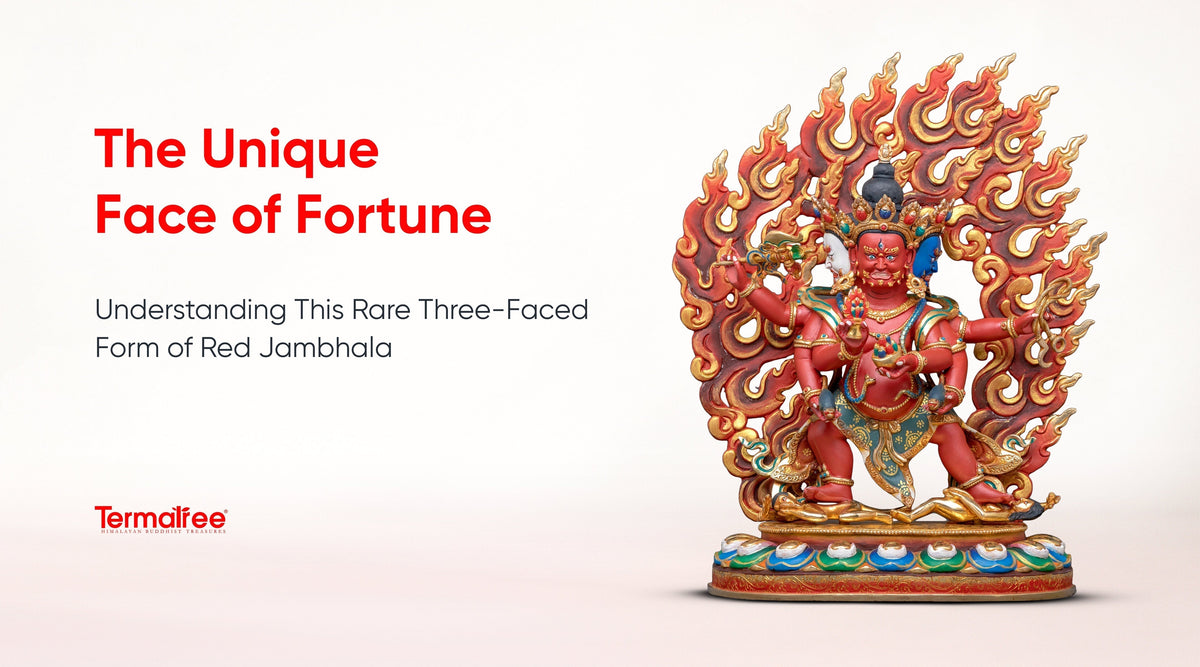
Fierce-faced, dynamic in stance, often surrounded by flames, sometimes multi-armed, with bulging eyes and bared fangs. Wisdom Kings may have fierce expressions, dynamic stances, and symbolic weapons or ropes. These are not "angry deities" but visualizations of determined wisdom that cuts through harmful habits.
Posture: What the Body Is Doing

Having established the category, turn to posture. The four postures of the Buddha found in Buddhist art are sitting, reclining, standing, and walking. The most common of these by far is the seated Buddha.
Seated
The seated figure is the most universally recognizable. The classic lotus position, with both legs fully crossed, signals deep, stable meditation and inner completeness. The figure is settled and immovable, like a mountain. Seated meditation posture signals inner stability.
A variation called lalitasana, where one leg hangs down from the throne while the other is bent, is typical of bodhisattvas and communicates a different quality: relaxed accessibility, a figure ready to step down and engage with the world at any moment.
Standing
The standing statue is identified simply by its posture: the Buddha is erect, either standing still or in mid-stride (walking). Standing Buddha statues are common across all Buddhist traditions: the great bronze standing Buddhas of Thailand, the colossal standing Buddhas of Sri Lanka, and the elegant standing Amida Buddhas of Japan all belong to this category. Standing often signals active compassion, a figure in motion, reaching toward beings.
Reclining
The reclining Buddha is unlike all other Buddha poses it does not depict a mudra at all. Instead, it depicts a physical posture: the historical Buddha lying on his right side, right hand supporting his head. This is the image of the Parinirvana, the final passing of the Buddha from the earthly realm.
Walking
Walking Buddhas are a distinctly regional development, particularly associated with the Sukhothai period in Thailand. The walking posture generally represents the Buddha returning from a teaching or moving actively between communities, embodying the living transmission of the Dharma.
Hands: Mudras or Gestures

Each of the Buddha statues has meaning in its hand gestures (mudras) as these are essential to Buddhist iconography. Raised palm means protection, clenched fingers point to the earth, which is a symbol of enlightenment, and hands placed in the lap represent deep meditation. The knowledge of these Mudras makes a statue from a mere decoration into a whole picture, teaching.
These are the most significant mudras you will come across:
1. Dhyana Mudra (Meditation)
The Dhyana mudra is shown with both hands resting in the lap with palms up; this signifies deep contemplation. This may be the right hand, the left hand, or both, the left hand being wisdom. A variation featuring an alms bowl held in the cupped hand represents the scene in which Buddha receives a golden alms bowl from his wife, named Sujata, and rejects it, representing the middle way between luxury and austerity.
2. Bhumisparsha Mudra (Earth Touching)
In Buddhist art, the right-hand-on-the-earth symbol is Mudra, and the left-hand-in-lap symbol is Dharma Chakra. It refers to Buddha attaining nirvana under the Bodhi tree, and asks the earth goddess to serve as a witness to this event. The earth-pressing mudra (grounding mudra) and the dhyana mudra (meditation mudra) are both used in this pose, signifying harmony of method and the wisdom, the samsara, and the nirvana.
3. Abhaya Mudra (Fearlessness)
The right hand is lifted upwards with the palm out and fingers up. The Sanskrit term "Abhaya" translates as "fearlessness. Thus, this mudra symbolizes protection, peace, and the dispelling of fear. When you see this gesture, the statue is, in effect, saying, "Do not be afraid. I am here.
4. Varada Mudra (Generosity and Giving)
The arm hangs naturally at the side or extends downward, palm open and facing outward. This mudra symbolizes charity, compassion, and boon-granting. It is the mudra of the accomplishment of the wish to devote oneself to human salvation.
5. Dharmachakra Mudra (Teaching)
Both hands are held at chest height, the fingers forming circles with thumbs and index fingers touching. The Dharmachakra mudra signifies teaching and is usually interpreted as "the turning of the wheel" of the Dharma. This gesture also represents a great and revolutionary change with universal consequences. When you see it, the figure is actively teaching.
6. Vitarka Mudra (Discussion and Transmission)
Similar to Abhaya, but with the thumb and index finger touching to form a circle. The Vitarka mudra is the gesture of discussion and transmission of Buddhist teaching. This mudra has many variants in Mahayana Buddhism. In Tibetan Buddhism, it is a ritual gesture of Taras and bodhisattvas.
Read More: Buddhist Statues: History, Meaning, Types and Spiritual Significance
The Head: Ushnisha, Urna, Eyes, and Expression

The Ushnisha
In Buddhist art, the ushnisha is a prominent feature and refers to the round or conical form on the Buddha's head, which signifies complete awakening. It was originally designed to depict a crown and took on its new purpose and meaning. It is represented in various ways in South Asian countries, such as intricate curls, and in Southeast Asian countries as a flame or lotus flower with ornaments, symbolizing the Buddha's superior wisdom.
The Urna
The urna is the small dot on the forehead of the Buddha, representing a white hair tuft, one of his 32 marks. It is often confused with a third eye. It represents a specific physical mark of a great being, one of the thirty-two major and eighty minor marks of a Mahapurusha, or Great Being, described in the earliest Sanskrit and Pali texts.
The Eyes
Half-closed eyes show a state of meditation: looking inward into the self as well as outward. This downward, half-closed gaze communicates a being simultaneously present in the world and absorbed in boundless inner awareness, the perfect balance of compassion and wisdom. Fully closed eyes indicate deep meditative absorption. Wide-open eyes, particularly in wrathful figures, express fierce, unblinking, penetrating awareness.
Long Earlobes
Long earlobes indicate the Buddha's great willingness and ability to hear the cries of other sentient beings. They also reference his royal origin; Prince Siddhartha would have worn heavy earrings as a sign of his noble birth, and their removal left the earlobes elongated.
Crowns and Ornaments

A crown immediately identifies a bodhisattva or deity rather than a Buddha. But the type and style of the crown further specify who you are looking at.
The five-pointed crown, or pancha-mukuta, is widely associated with Dhyani Buddhas in their sambhogakaya, or enjoyment-body, form, appearing adorned rather than plain to communicate their availability across all realms of existence. Each of the Five Wisdom Buddhas has a distinct iconographic color, mudra, direction, and associated symbolism; when depicted with crowns, these additional attributes help confirm which of the five you are encountering.
Bodhisattvas such as Avalokiteshvara, Manjushri, and Tara wear elaborately jeweled crowns that speak to their royal, compassionate authority. Avalokiteśvara's crown often contains a small image of the Buddha Amitabha, a detail that immediately identifies him regardless of how many arms or heads he has been given in a particular artistic tradition.
Other adornments, such as necklaces, armlets, anklets, and the flowing celestial scarves, uttarasang, also convey status, spiritual richness, and interaction with the world. The more elaborate the ornamentation, the more fully the figure expresses its bodhisattva or deity nature.
Implements and Held Objects
 What a figure holds in its hands is often the fastest way to identify a specific deity when other features are ambiguous.
A lotus flower
Held at the side or carried in one hand indicates purity and the capacity to arise from difficult circumstances without being stained by them. Avalokiteshvara holds a lotus; Tara is often depicted seated upon one.
A sword
A flaming sword belongs almost exclusively to Manjushri, the bodhisattva of wisdom. Swords are used to cut down disruptive passions and desires. The flaming sword cuts through ignorance with the precision of a surgeon.
A vajra
The ritual thunderbolt scepter represents indestructible wisdom, the diamond-like quality of enlightenment that cuts through all illusions without itself being cut. It is one of the most widespread implements in Vajrayana Buddhist iconography and appears in the hands of Vajrasattva, Vajrapani, and many other figures.
A bell
Often held in the left hand alongside the vajra in the right, it represents wisdom (feminine/emptiness), while the vajra represents method (masculine/compassion). They represent the principle of wisdom and compassionate action, which is the main teaching in Vajrayana practice.
A medicine bowl
Medicine Buddha is usually represented in deep blue and is a round vessel with herbs or nectar inside, whose main job is to heal all suffering, both physical and spiritual.
A book
Identifies Prajnaparamita, the personification of the Perfection of Wisdom texts, or sometimes Manjushri, indicating scriptural wisdom.
A water vase
Often identifies Avalokiteshvara in certain forms or Green Tara, whose vase contains the nectar of compassion.
The Throne: Seat of Authority

The backrests of the thrones of gurus or the holders of a lineage might feature more sophisticated designs, like the Prabhamandala, which indicates the spiritual esteem and teaching heritage of the person.
The lotus throne is the most universal base in Buddhist sculpture. A fully open lotus, its petals spreading outward from a central communicates purity, awakening, and the capacity to rise above the mud of samsara. A lotus pedestal suggests purity and awakening.
A lion throne raised platform supported by carved lions indicates royal and spiritual sovereignty. The lion's roar is a traditional metaphor for the Buddha's teaching voice, fearlessly proclaiming truth in all directions. This throne type is particularly common for figures of the historical Buddha in their most majestic form.
A vajra throne represents the indestructible ground of enlightenment, the seat upon which the Buddha sat at the moment of his awakening under the Bodhi tree in Bodh Gaya, which is still called the Vajrasana today.
Wrathful deities such as Mahakala and Vajrayogini are generally placed on sun-disc lotus bases, stepping on maras, their primary iconographic features. A figure stepping on a prostrate human form is typically a protector deity subduing ego, ignorance, or harmful forces, not an act of cruelty but of transformation.
The Halo: Light Made Visible

In India, the head halo is termed Prabhamandala or Siras-cakra, while the full-body halo is known as Prabhavali. These elements combine to form the aureole, the shining halo of light that surrounds an enlightened person, revealing the light of awakened consciousness. A simple circular head halo indicates radiance of an enlightened mind, and a mandorla (a pointed or almond-shaped aureole) that it has total unobstructed luminosity. In Asian art, the nimbus is sometimes filled with flames, representing the transforming power of wisdom, which destroys ignorance without destroying the essential. The size and complexity of the halo help to convey rank: a simple circular disk denotes simplicity, while a multi-layered, jewel-encrusted, flame-bordered mandorla denotes the most important figure.
Putting It All Together
The next time you are facing a Buddhist statue, attempt to read the statue in this order:
1. Absorb the silhouette – robed and simple (Buddha) or crowned and ornamented (bodhisattva/deity)?
2. Record the position of the body – sitting, standing, walking, or lying down?
3. Look at the hands — what mudra is being formed, and with which hands?
4. Move to the head — is there an ushnisha? An urna? What are the eyes doing?
5. Check for crown and ornaments — what style of crown, if any?
6. Identify any implements — what objects are held, and in which hands?
7. Look at the throne or base — lotus, lion, vajra, or sun disc?
8. Finally, take in the halo — simple disk, full mandorla, or flames?
When you encounter a statue you cannot immediately identify, start with the posture, then move to the hands, then the face. That sequence mirrors how iconographers themselves analyze figures.
By the time you have worked through all eight steps, the statue will have told you a great deal about its identity, its primary spiritual quality, the specific teaching it embodies, and the invitation it is extending to whoever stands before it.
Conclusion: Beyond Identification
Learning to read Buddhist statues is genuinely rewarding, but the deeper invitation is to move past pure identification into something more contemplative. The more useful frame is to treat symbols as pointers rather than labels. A lotus on a statue base does not just mean "purity." It asks you to consider what purity means in the context of a figure rising from difficult conditions. The endless knot does not just mean "interdependence." It is a visual argument about the nature of reality that Buddhist philosophy spent centuries developing.
A Buddhist statue, read carefully, is a complete teaching on the nature of mind, the qualities of awakening, and the path from confusion to clarity. The artisans who made these figures understood this, which is why they worked with such care on every detail, down to the precise angle of a finger, the exact curve of a half-closed eye, the number of petals on a lotus throne. They were not decorators. They were, in their own way, writing.