The Mahayana Bodhisattva of Great Vows, Steady Practice, and Compassionate Action
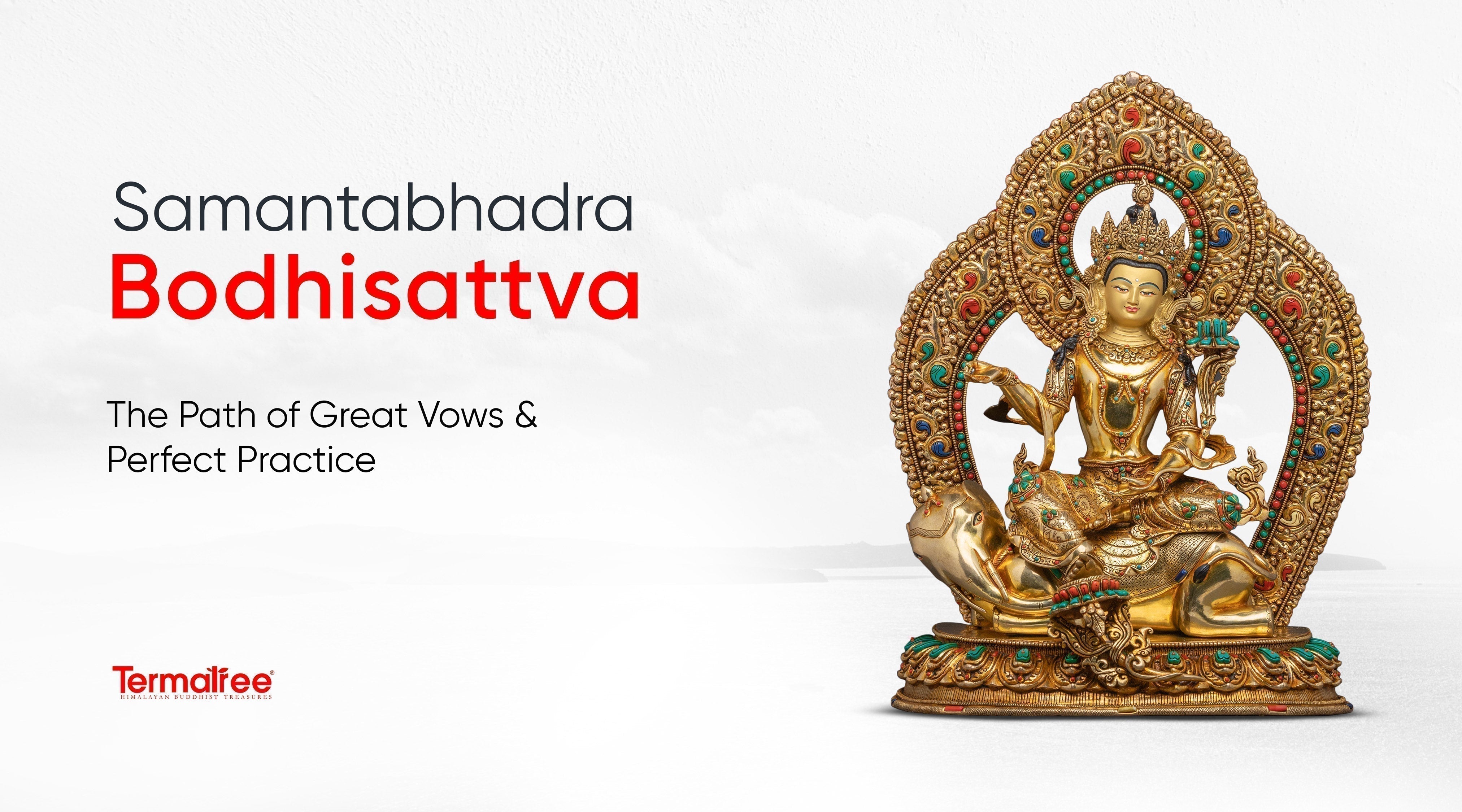
In the vast and intricately populated world of Mahayana Buddhist art, most bodhisattvas are identified by what they carry: Manjushri by his flaming sword, Vajrapani by his vajra, and Avalokiteshvara by his lotus. Samantabhadra Bodhisattva is identified by what he rides. The great white elephant, moving with power beneath a fully ornamented celestial figure seated in perfect meditative stillness, is one of the most immediately recognizable images in all of Buddhist iconography and one of the most philosophically precise. His image is not merely a portrait of a sacred being. It is an instruction in how to live.
One distinction must be made clearly because it is among the most common points of confusion in Tibetan Buddhist art. The name Samantabhadra belongs to two entirely different figures. The one seated on the white elephant is the Bodhisattva Samantabhadra: active, ornamented, a being on the path. The other naked, dark blue, stripped of every attribute, is the primordial Buddha Samantabhadra, the dharmakaya ground of all existence at the summit of Nyingma Dzogchen teachings. Same name, but profoundly different meanings.
Who Is Bodhisattva Samantabhadra?

The Bodhisattva Samantabhadra is one of the eight principal bodhisattvas of the Mahayana, counted among the closest attendants of Shakyamuni Buddha and sometimes called one of the "eight close sons." He appears centrally in two of the most significant Mahayana scriptures: the Avatamsaka Sutra (Flower Garland Sutra), where his famous Ten Great Vows are expounded in the concluding chapter known as the Samantabhadra Conduct Prayer, and the Lotus Sutra, where his role as a protector of the dharma is elaborated.
His name in this tradition is translated as "Universal Virtue" or "All-Good Conduct," and everything about his iconography reflects this meaning. He is the bodhisattva of devoted, unceasing practice of putting the aspiration to liberate all beings into tireless action, offering by offering, prayer by prayer, across infinite lifetimes. He is not the ground of existence or the nature of mind. He is a being on the path, the most diligent, most devoted being imaginable on that path.
The Ten Great Vows
The Bodhisattva Samantabhadra's defining teaching is his Ten Great Vows, which together form one of the most comprehensive frameworks for bodhisattva conduct in all of Mahayana Buddhism: to venerate and respect all Buddhas
To praise the Thus-Come Ones
To make abundant offerings
To repent misdeeds and evil karma
To rejoice in others' merits and virtues
To request the Buddhas to continue teaching
To request the Buddhas to remain in the world
To follow the teachings of the Buddhas at all times
To accommodate and benefit all living beings
To transfer all merits and virtues to benefit all beings
These vows move from internal attitudes of reverence, rejoicing, and repentance outward to action: offering, requesting, following, serving, and finally to the complete giving away of all accumulated merit for the benefit of all beings without exception. They describe a complete moral and compassionate life, and they remain among the most recited aspirational prayers in East Asian and Tibetan Buddhist practice today.
Iconography of the Bodhisattva Samantabhadra
The Bodhisattva Samantabhadra is depicted in the full ornamental style of a great Mahayana bodhisattva, the visual opposite of the Primordial Buddha who shares his name.
1. The White Elephant: He is characterized by his mount, a white elephant, usually shown with six tusks in Tibetan art and twelve tusks in some Chinese traditions. This elephant symbolizes strength, royalty, and gentle power in Indian and Buddhist cosmology, similar to the one that appeared in a dream to Queen Maya prior to Shakyamuni Buddha's birth. The elephant represents his enormous practice, boundless and sincere, and the purity of mind that great stability of mind is needed for dedicated activity.
 2. Bodhisattva Ornaments: He wears the complete set of ornaments appropriate to a celestial bodhisattva: a five-leafed jeweled crown, earrings, necklaces, bracelets and armlets, silk robes, and a flowing scarf. These ornaments signal his sambhogakaya dimension, a being of luminous celestial form who teaches advanced practitioners. Where the Primordial Buddha's nakedness signals the formless dharmakaya, the Bodhisattva's ornaments signal the richly adorned enjoyment body of a being who has devoted countless lifetimes to the perfection of virtue.
 3. Dhyana Mudra or Anjali Mudra: Holding a vase in the right hand and the emblem of the sun atop a flower bud in the left hand. This is a gesture of profound absorption into meditation, of the mind in samadhi. It points to the stability that is gained in meditation, and all outward devotional acts, like offerings and prayers, are based on this stability.
 4. Color: The Bodhisattva Samantabhadra is usually portrayed in white, green, or gold. He is frequently portrayed in Chinese Buddhist art wearing a glowing halo, symbolizing the purity and brightness of his nature, and is typically depicted in white, highlighting his tranquility and purity. Each color connects him to the broader symbolic vocabulary of the tradition: white for purity, green for compassionate activity, and gold for the incorruptible quality of perfect virtue.
5. Lotus and Sutra: In many depictions, a lotus rises beside him on a long stem, bearing the Avatamsaka Sutra, the text that contains his ten great vows. The lotus placed at his side locates the source of all his activity in the dharma itself. He does not act from personal inclination or accumulated preference. He acts from the deepest wisdom the tradition holds, expressed in the sutra that carries his vows.

Samantabhadra and the Great Bodhisattva Triad
In the iconographic and devotional tradition of Mahayana Buddhism, Samantabhadra is most fully understood not in isolation but in relationship. He forms one-third of the most significant bodhisattva triad in the entire pantheon alongside Manjushri, the bodhisattva of wisdom, and Avalokiteshvara, the bodhisattva of compassion. Together, the three represent a complete map of the enlightened life.
Manjushri carries the flaming sword that cuts through ignorance. He embodies the quality of discriminating awareness: the capacity to see reality with absolute clarity, without distortion or projection. Avalokiteshvara carries the lotus and responds to the suffering of every being without exception. He embodies the quality of compassion, the heart that opens without condition toward all that lives. Samantabhadra, seated in meditation on his white elephant, embodies the third quality without which the other two cannot fully function: the disciplined, sustained, inexhaustible practice that translates wisdom and compassion into actual conduct across a lifetime and beyond. He is the figure who holds the vow to keep going not just to understand and feel, but to act, again and again, in alignment with the deepest aspirations of the bodhisattva path. This triad appears throughout Chinese, Japanese, Korean, and Tibetan Buddhist art, most commonly placing Shakyamuni Buddha in the center, Manjushri to the left, and Samantabhadra to the right, their positions communicating the teaching that the Buddha's enlightenment is expressed outward through wisdom and inward through devoted practice, with compassion as the active bridge between the two.
How to Tell Them Apart at a Glance
|
Feature |
Bodhisattva Samantabhadra |
Primordial Buddha Samantabhadra |
|
Tradition |
Mahayana-Avatamsaka Sutra |
Vajrayana-Nyingma Dzogchen |
|
Nature |
A being on the bodhisattva path |
Enlightenment itself never fell into delusion. |
|
Mount |
White elephant |
Seated in open space or on the lotus pedestal |
|
Ornaments |
Full bodhisattva crown, jewels, and silks |
Completely naked with no ornaments |
|
Hands |
The Dhyana Mudra or Anjali Mudra often holds symbolic items like a lotus, book, or vase. |
Right-hand meditation with the palm upwards and the right hand, thumb, and index finger pressed together, or in yab-yum embrace |
|
Color |
Red, white, or gold |
Dark blue or blue-black |
|
Consort form |
Samantabhadri with a curved knife and skull cup |
Samantabhadri, colored white, naked, attribute-free |
|
Key text |
Ten Great Vows |
Kunjed Gyalpo Tantra (Dzogchen) |
|
What he represents |
The perfection of devoted universal practice |
The dharmakaya ground of all existence |
Read More: Samantabhadra and Samantabhadri: Symbols of Dharmakaya and Enlightened Union
Why Both Matter and Why They Share a Name
 These two figures stand for two entirely different questions that every Buddhist practitioner eventually faces.
The Bodhisattva Samantabhadra represents, "How should one practice?" His ten great vows are an exhaustive answer: to venerate, praise, offer, repent, rejoice, request, follow, serve, and give everything away. His white elephant embodies practice with the strength of an elephant. His gesture symbolizes, "resting all of that activity in deep meditative stillness." His very existence is an instruction about how to fill a lifetime, and many lifetimes, with meaningful spiritual work.
The Primordial Buddha Samantabhadra depicts a different question entirely, "Who are you?" His dark blue body embodies, "You are not separate from space." His nakedness represents your nature, which carries no attribute that can be named. His gesture says about, "You already hold everything that matters." His union with Samantabhadri symbolisms wisdom and awareness were never two things. Recognize this, and the recognition itself is liberation. A practitioner who cultivates the ten great vows without any recognition of the ground from which they arise has action without depth. A practitioner who rests in the recognition of rigpa without structure, conduct, or devoted activity has insight without direction. The tradition, in its wisdom, gave both figures the same name, perhaps because the most complete practitioner is the one who has understood the ten great vows.
Conclusion
Bodhisattva Samantabhadra embodies the practice of great vows, steadfast practice, and compassionate action. His white elephant is a symbol of strength, patience, and purity while his Ten Great Vows are the path for the practitioners to live their lives with devotion, wisdom, and service. Through his knowledge of the difference between Primordial Buddha Samantabhadra and himself, he came to understand two potent aspects of the Buddhist teachings: one to practice and the other to understand the nature of reality. They are a reminder that in order to be enlightened, one must have wisdom and do something about it for the benefit of all. This dual approach encourages practitioners to integrate their insights into everyday actions, fostering a harmonious balance between inner realization and outward compassion. By embodying these principles, individuals can contribute to a more enlightened society, inspiring others to embark on their own journeys toward awakening.