The Promise, the Practice, and the Path to Amitabha's Western Paradise
Pure Land Buddhism is one of the most widely practiced traditions within Mahayana Buddhism, and one of its most accessible. Rather than demanding years of solitary meditation or advanced philosophical training, it centers on faith, devotion, mindfulness, and a simple but profound aspiration: to be reborn in Amitabha Buddha's Pure Land, Sukhavati, where the conditions for reaching enlightenment are ideal. For over a millennium, this promise has offered practitioners from every walk of life, scholars and farmers, monastics and laypeople alike, a spiritual path they could actually walk, anchored in Amitabha's own symbols of compassion, wisdom, and liberation.
What is Pure Land Buddhism? Understanding its core teachings

A "Pure Land" in Buddhist cosmology is an enlightened realm brought into being through the vows and accumulated virtue of a particular Buddha. Mahayana Buddhism describes many such realms, each associated with a different Buddha, but none has captured devotional imagination quite like Sukhavati, the Western Pure Land of Amitabha.
The central belief of Pure Land practice is that ordinary beings, who may struggle to reach enlightenment amid the distractions and difficulties of this world, can instead aspire to be reborn in a pure realm specifically designed to support their continued spiritual cultivation. Once reborn there, practitioners are no longer at risk of falling back into confusion or lower states of existence; they can progress steadily, toward full Buddhahood.
Four elements sit at the heart of the practice:
-
Recitation of Amitabha Buddha's name, a devotional and meditative practice in which the practitioner calls upon him with sincere faith.
-
Faith and devotion, as confidence in the real possibility of awakening, made accessible through Amitabha's vows.
-
Compassionate living, expressed through ethical conduct in daily life.
-
Generating the aspiration for enlightenment (bodhicitta), the sincere wish to awaken not only for oneself but also for the benefit of all beings.
The Difference Between Pure Land and Ordinary Ideas of Heaven
Sukhavati is often compared to "heaven" in other religious traditions. Pure Land is understood as a realm for spiritual cultivation rather than a place of eternal reward or enjoyment. Nothing about rebirth in Sukhavati is the final goal; it's a supportive stepping stone. The actual goal of Pure Land practice remains what it is throughout Mahayana Buddhism: the attainment of full Buddhahood, for the benefit of all beings, not indefinite residence in a blissful realm.
Origin and evolution of Pure Land Buddhism
Early development in India
Pure Land concepts emerged from within Mahayana Buddhist scripture in India, developed and transmitted through a core group of texts known as the three Pure Land sutras: the Larger Sukhavativyuha Sutra (Infinite Life Sutra), the Smaller Sukhavativyuha Sutra (the Amitabha Sutra), and the Amitayurdhyana Sutra (Contemplation Sutra). Some scholars trace the Larger Sutra's origins to the Kushan Empire period, around the 1st to 2nd centuries CE, with its ideas becoming popular in the Gandhara region, placing Amitabha devotion at a genuine crossroads of early Buddhist preceptive.
These Sutra narrates about a bodhisattva named Dharmakara, who inspires by the Buddha Lokeshvararaja, made forty-eight vows expressing his aspiration to create a realm where any being who sincerely called upon him could be reborn. Having fulfilled these vows, Dharmakara became the Buddha Amitabha, and his vows culminated in the creation of Sukhavati. Devotion toward Amitabha and the aspiration for rebirth in his Pure Land developed steadily within Indian Mahayana communities before spreading further afield.
The Spread of Pure Land Teachings Across Asia
From India, Pure Land ideas moved through Central Asia into China, where, as explored in more detail below, they rooted as a major, independent tradition. From China, Pure Land teachings and practices spread onward into Korea and Japan, adapting to each region's existing Buddhist culture while preserving their central devotional core. Along the way, Pure Land philosophy left a deep and lasting mark on Buddhist art, temple architecture, meditation practice, and popular devotional culture across East Asia, visible today in countless statues, paintings, and chanting halls dedicated to Amitabha.
Amitabha Buddha and His Pure Land in The Western Paradise
Who is Amitabha Buddha?

The name Amitabha combines meanings often translated as "Infinite Light" and, in a closely related form (Amitayus), "Infinite Life." He is counted among the Five Dhyani Buddhas recognized in Mahayana and Vajrayana traditions, associated in particular with compassion, discerning wisdom, and liberation from suffering. Unlike Buddhas more closely tied to abstract cosmological or philosophical principles, he is often described as strikingly approachable and relational, a Buddha whose compassion is described as all-accepting, responding not to perfection but to the sincere wish to awaken, even from those who feel unworthy, lost, or incapable of following a more demanding path.
The Western Pure Land of Sukhavati
Sukhavati, meaning roughly "Land of Bliss" or "Land of Ultimate Bliss," is described across the Pure Land sutras as a realm entirely free from suffering and spiritual obstacles. Its imagery is rich and consistent across texts and traditions:
-
Lotus flowers, from which beings are said to be born into the Pure Land, symbolizing purity untouched by worldly defilement.
-
Pure waters, calm and clear, reflecting the clarity of mind cultivated through practice.
-
Celestial music, said to continuously proclaim the Dharma throughout the realm.
-
Enlightened beings, including bodhisattvas and other practitioners, all progressing steadily toward Buddhahood.
At the center of Sukhavati's promise are Amitabha's Forty-Eight Vows, made while he was still the bodhisattva Dharmakara. Each vow expresses a specific aspiration to help beings toward liberation, and each concludes with the same pledge: that Dharmakara would not accept full enlightenment for himself unless the vow could be fulfilled. The most celebrated of these is his eighteenth vow, promising rebirth in Sukhavati to anyone who sincerely calls upon his name, even as few as ten times, with his nineteenth vow further promising that he will personally appear, together with an assembly of bodhisattvas, to welcome sincere practitioners at the moment of death.
Amitabha Buddha in Buddhist art and iconography
Amitabha's traditional representations follow a recognizable set of conventions across most Buddhist artistic traditions:
-
A red-colored body, symbolizing both his compassionate, magnetizing quality and his association with the lotus family of enlightened qualities.
-
The dhyana mudra (meditation gesture), with hands resting together in the lap, signifies deep meditative absorption.

-
A lotus throne, on which he is typically seated, reflects the same purity symbolism found throughout Sukhavati's imagery.
These conventions recur across statues, thangka paintings, and temple murals throughout the Buddhist world, from Chinese and Japanese temple halls to Tibetan monasteries, making Amitabha one of the most immediately recognizable Buddhas in Buddhist art.
Pure Land Traditions across Different Countries
In China
China became the center where Pure Land Buddhism developed into a fully independent major tradition, rather than remaining a devotional current within broader Mahayana practice. The monk Huiyuan, active in the fourth and fifth centuries, is traditionally credited as an early and influential figure in organizing devotion to Amitabha, and is often associated with the founding of what later tradition regarded as the first Pure Land society in China. Over the following centuries, the practice of chanting Amitabha's name (Nianfo) became a central devotional and meditative practice for millions of Chinese Buddhists, and Pure Land teachings developed a close, often complementary relationship with Chan (Zen) Buddhism, with many temples and practitioners combining chanting practice with Chan meditation rather than treating the two as separate paths.
In Japan

Japan developed some of the most influential and doctrinally distinct Pure Land schools anywhere in the Buddhist world. Jodo-shu ("The Pure Land School"), founded by the monk Honen in the twelfth century, taught that sincere recitation of Amitabha's name was, on its own, a sufficient and complete path to rebirth in the Pure Land. His student Shinran further developed this teaching by founding Jodo Shinshu, or "The True Pure Land School," which places even greater emphasis on Amitabha's compassion and "other-power,” the idea that liberation comes through reliance on the power of Amitabha's vows rather than the practitioner's own effort or self-power. Jodo Shinshu remains one of the largest Buddhist denominations in Japan today.
In Korea
In Korea, Pure Land practice developed in close integration with Seon Buddhism, rather than as a fully separate school. Amitabha devotion has remained popular among both monastics and lay practitioners for centuries, commonly expressed through chanting practice and visualization meditations focused on Amitabha and Sukhavati, often woven directly into the broader meditative training offered within Seon monasteries.
In India
As noted above, Amitabha devotion has roots in early Indian Mahayana Buddhism, developed through the Pure Land sutras before the tradition's center of gravity shifted eastward into China, Korea, and Japan. This Indian origin situates Pure Land thought firmly within the broader philosophical currents of Indian Mahayana Buddhism, rather than as a later East Asian innovation, even though its fullest institutional development happened outside of India.
In Tibet and Himalayan traditions
Amitabha holds a significant place within Tibetan Buddhism as well, though the emphasis differs somewhat from the vow-centered devotionalism found in China and Japan. Amitabha is closely connected with teachings on death and the transitional state between death and rebirth known as the Bardo, and with Phowa, the practice of consciousness transfer at the moment of death, in which practitioners aim to direct their consciousness toward Amitabha's Pure Land. Amitabha also holds an important place within Vajrayana meditation practice more broadly and within thangka painting traditions, where he is a common and much-loved subject.
Myths and Truths about Pure Land Buddhism
"It's just blind faith."
In reality, Pure Land practice combines devotion with ethical conduct, mindfulness, compassion, and a genuine aspiration toward enlightenment. Faith here is better understood as confidence in the real possibility of awakening, not an unreflective or uncritical belief.
"It's basically the same as heaven in other religions."
Sukhavati isn't a permanent place of eternal enjoyment. It's a supportive spiritual environment where beings continue their cultivation until they reach enlightenment.
"It's a path meant only for ordinary, less capable practitioners."
Pure Land teachings have been practiced by scholars, monks, and advanced practitioners throughout Buddhist history, not only by lay devotees looking for a simpler alternative.
"Chanting Amitabha's name doesn't really mean anything spiritually."
The recitation of Amitabha's name is a meditation practice in its own right, one that builds sustained concentration, devotion, and present-moment awareness, alongside its devotional value.
Pure Land Buddhism and its Influence on Buddhist Art and Culture
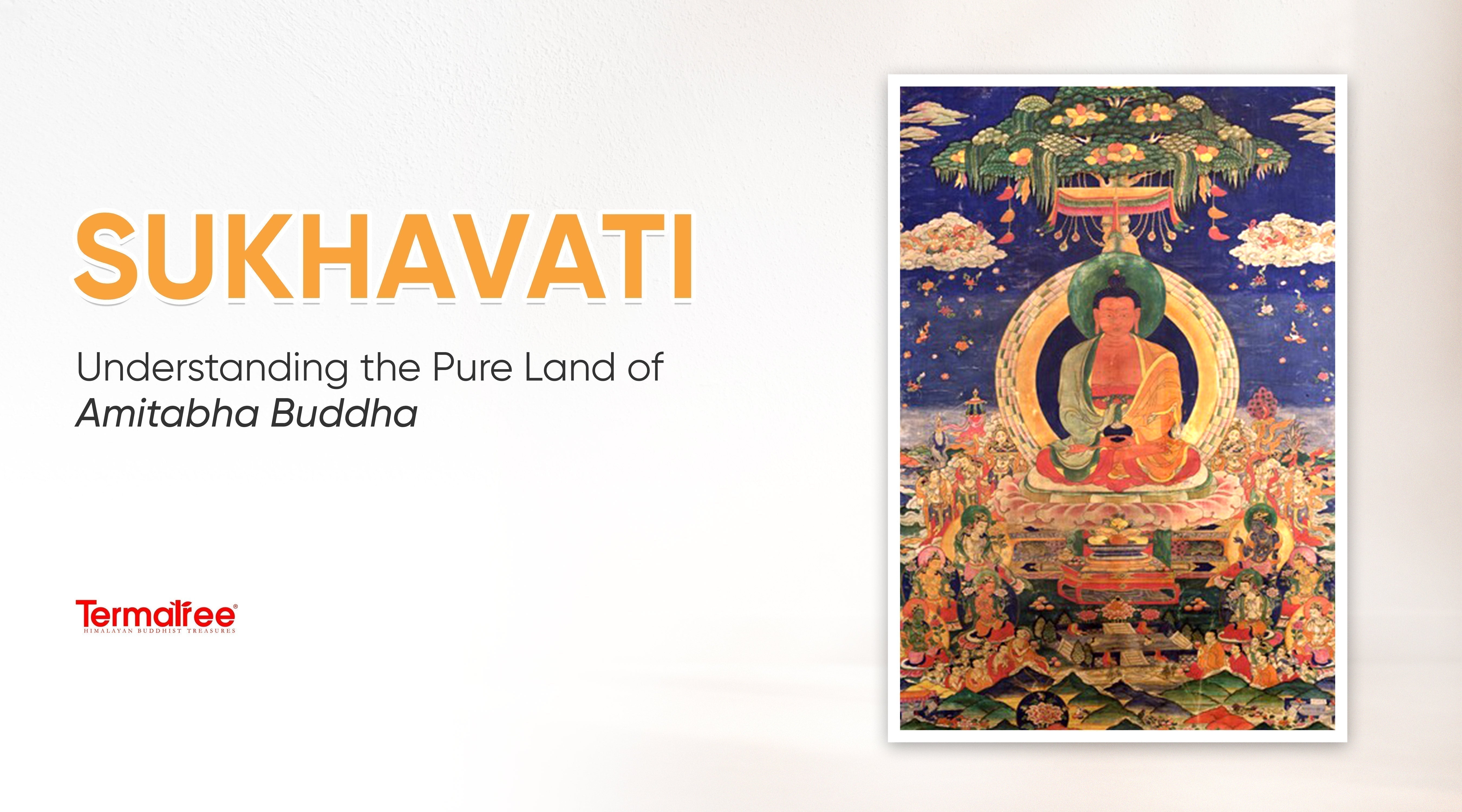
 Amitabha Buddha Pure Land (Photo from Enlightenment Thangka)
Amitabha plays a central role in Buddhist visual culture, prominently featured in statues, thangka paintings, temple murals, and mandalas across various traditions influenced by Pure Land teachings. Particularly in China and Japan, entire temple halls have been designed around the monumental Amitabha triad, flanked by Avalokiteshvara and Mahasthamaprapta, known as the "Three Holy Ones of the West." These installations create an immersive environment for devotees, enhancing their chant practice by evoking a direct connection to the Buddha of the Western Paradise. Japanese raigo-zu paintings further illustrate this concept by depicting Amitabha and his bodhisattvas descending to welcome the dying, embodying his vow to assist them at death.
Beyond mere representation, Amitabha imagery serves a devotional and meditative purpose. Artistic depictions of Sukhavati transform into visual focal points for contemplation and faith cultivation. In Tibetan and Himalayan traditions, detailed thangka paintings of it, showcasing lotus ponds and bodhisattvas, facilitate visualization practices, allowing practitioners to experience the Pure Land in meditation rather than observing it from a distance. Mandalas that include Amitabha also play a crucial role, merging the qualities of his Pure Land into structured symbols used in tantric practice. Overall, the art surrounding Amitabha transcends decoration, acting as a vital tool for guiding practitioners toward their aspirations and practices concerning Sukhavati.
Conclusion:
Pure Land Buddhism represents one of the most accessible and influential expressions of Mahayana Buddhism. Its promise traces back to the bodhisattva Dharmakara, whose Forty-Eight Vows, most famously his pledge to welcome anyone who sincerely calls his name, culminated in Sukhavati, a realm built to support beings toward Buddhahood rather than reward them with permanent paradise. Amitabha himself, recognizable through his red form, dhyana mudra, and lotus throne, embodies that same accessible compassion, responding to sincerity rather than perfection. As these teachings spread from India through China, Japan, Korea, and Tibet, each region contributed its own character to the tradition, including unique chanting practices; Honen's and Shinran's schools of faith, Seon integration, Phowa, and the Bardo, while maintaining devotion to Amitabha at the center.
Throughout, Buddhist art has served as more than decoration, giving practitioners a real tool for contemplation and visualization rather than mere imagery to admire. Pure Land Buddhism offers a vision of transformation open to scholars and ordinary devotees alike when understood correctly and free of myths that reduce it to blind faith or a mere copy of heaven, reminding practitioners that the journey toward awakening can begin wherever one stands.