Beyond the Smiling Wealth God: Inside the Flame-Wreathed Red Jambhala
Most people who encounter Jambhala for the first time meet him in his most common guise: a plump, smiling, single-faced figure seated comfortably, holding a wish-fulfilling jewel in one hand and a mongoose spitting gems in the other.
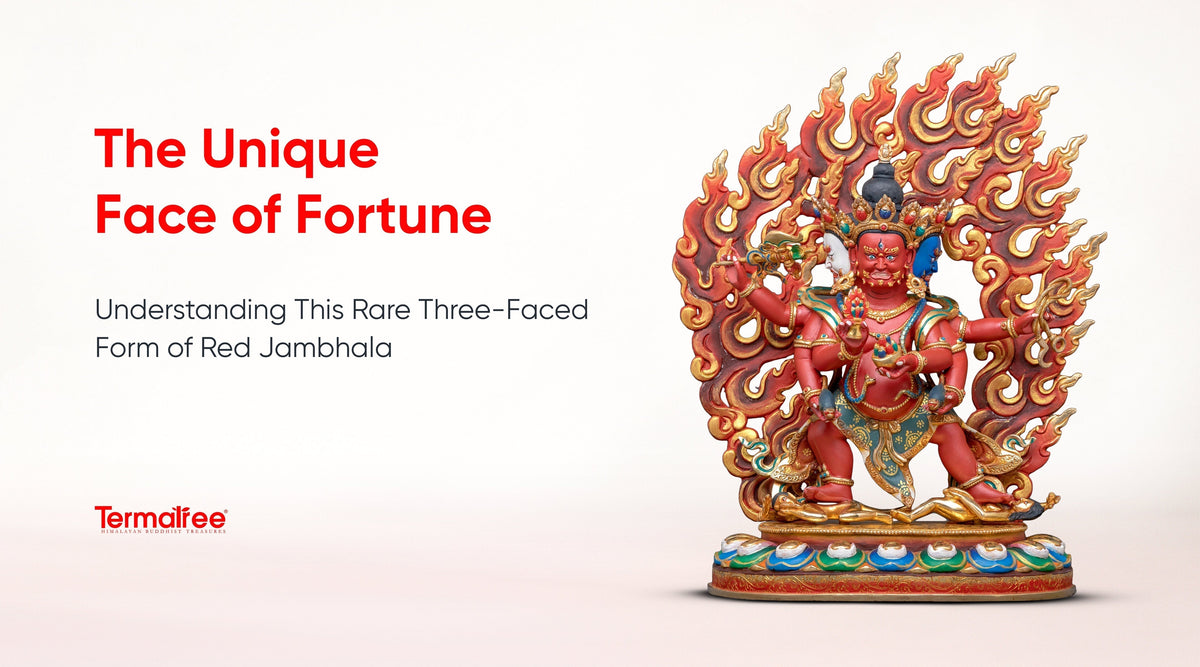
The statue pictured here belongs to a very different, far rarer branch of the same wealth-deity family. Among the many forms of Jambhala in Vajrayana Buddhism, Red Jambhala is one of the more distinctive and complex manifestations, appearing not with one face and two arms but with three faces, six arms, and four legs. Historical examples identify this iconography with the Three faced Red Jambhala tradition associated with Trapa Ngonshe and the Tibetan treasure-teaching (Terma) tradition. The sculpture shows an unusual multi-armed type: the body and central face are red, with the two additional faces appearing white and blue, and a dramatic aureole of flames rises behind the whole figure, reinforcing its energetic, commanding character. Rather than presenting prosperity as passive accumulation, the imagery communicates activity, attraction, protection, and the overcoming of conditions that obstruct abundance, depicting a wrathful-leaning wealth protector whose visual intensity, from the crown of flame to the trampled figures underfoot, sets him apart from every other Jambhala most practitioners will ever see.
Who Is Jambhala, and Why Is There More Than One?

Jambhala is the principal wealth deity of Vajrayana Buddhism, understood as an emanation of enlightened generosity rather than simple material greed; his role is to remove poverty and material obstacles for practitioners on the path. Jambhala appears in a whole spectrum of forms across Tibetan Buddhist tradition, catalogued by color and lineage: white, yellow, green, black, multicolored, and the subject here. Within the Red category alone, there are further distinct sub-traditions, the two most prominent being the Sakya lineage's simple one-faced Red Jambhala embracing his consort and a much more elaborate three-faced, six-armed form associated with two closely related transmissions: the Gayadhara lineage from India and a Nyingma terma tradition traced to the 11th-century treasure-revealer Trapa Ngonshe Wangchug Bar.
A Deity of Wealth, but Not Simply of Money
It's tempting to describe Jambhala simply as a "god of money," but that definition is too narrow. Within Buddhist traditions, wealth practices are connected to obtaining supportive conditions for religious practice, maintaining communities, making offerings, exercising generosity, and overcoming the kind of scarcity that prevents beneficial action in the world. Red Jambhala, in this light, represents a relationship with resources rather than unrestricted material desire.
This distinction is reflected in the art itself. The deity may hold jewels, wealth symbols, and overflowing abundance, yet he appears within a ritual and contemplative framework rather than as a secular symbol of financial success. The jewels pouring from the mongoose's mouth aren't an image of accumulation for its own sake; they're an image of resources flowing outward, toward practice, community, and generosity.
Where Three-Faced Red Jambhala Form Comes From

The three-faced Red Jambhala lineage shown here traces back to Trapa Ngonshe Wangchug Bar (1012–1090), a celebrated Nyingma "terton," or treasure-revealer, credited with uncovering both this wealth-deity practice and the influential Four Medical Tantras as "earth treasures" texts said to have been hidden centuries earlier and rediscovered at the right moment for their teachings to take root again. According to the tradition's own account, this particular Red Jambhala practice was extracted from above the door of the central shrine at Samye Chokhor Ling, one of Tibet's earliest and most significant monasteries. Scholars of Himalayan iconography note that the Trapa Ngonshe transmission of Red Jambhala appears to be rooted in the earlier Gayadhara lineage of practice originating in India, meaning the two "different" three-faced Red Jambhala traditions found in Himalayan art are closely related branches of the same root teaching rather than unconnected inventions.
Reading the Iconography
Classical liturgical descriptions of this deity, preserved in Nyingma treasure literature, give a precise picture of what every element of the statue represents:
1. Three Faces, Three Colors
 The central face is red, the right face is white, and the left face is blue, each described as having three eyes, giving the deity a total of nine eyes surveying every direction. The three-color, three-face form is common in tantric iconography, generally read as an expression of a deity's expanded, multidirectional awareness and power, well beyond what a single peaceful face could convey.
2. Serpents and Ornaments
Some descriptions state that the three-faced Red Jambhala is adorned with the eight great snakes, jewel ornaments, and fluttering ribbons; across Indian and Himalayan mythology alike, nagas guard hidden treasure and the earth's wealth, tying the deity even more explicitly to the theme of protected, revealed abundance.
3. Six Hands, Paired Attributes
 The classical description assigns specific objects to each of the six hands: a precious wish-fulfilling jewel and a jewel-filled skullcup in the first pair, a hook and a lasso in the middle pair, and two mongooses spewing forth various jewels in the lowest pair. Every one of these objects reinforces the deity's core function: the jewel and skullcup represent wealth held and offered outward; the hook and lasso represent the active work of drawing in and securing prosperity; and the paired mongooses, expelling jewels from their mouths, are the single most recognizable emblem across all forms of Jambhala, a visual shorthand for inexhaustible wealth pouring continuously into the world.
4. The Blazing Aureole
The dramatic flames surrounding the entire figure, in rich red and gold, are a standard visual marker of wrathful and semi-wrathful deities throughout Tibetan Buddhist art, signaling transformative, purifying energy fire that burns away obstacles rather than fire that simply destroys.
5. Trampling the Lords of Wealth
 Beneath the deity's feet lie two prone figures, described in the source texts as the male and female "lords of wealth," wealth yakshas, minor deities or spirits from classical Indian mythology associated with the greed and attachment that can accompany them. A wrathful or semi-wrathful deity trampling a subordinate figure is a recurring visual in Himalayan art, generally read not as literal violence, but as the deity's mastery over and transcendence of a lower, more compromised expression of the same power the deity itself represents here: wealth pursued through fear or hoarding, brought under the control of wealth offered through Buddhist generosity.
Why This Form Is Genuinely Unusual

Most wealth-deity statues that circulate widely are the smiling, single-faced Yellow or White Jambhala figures, which are peaceful in demeanor and iconographically simple: one face, two hands, and a straightforward seated posture. This three-faced, six-armed Red Jambhala breaks from that mold in three specific ways.
First, its iconographic complexity (three faces, six arms) places it in the same visual category as major tantric meditation deities rather than the comparatively modest wealth-deity subclass most people picture.
Second, its semi-wrathful to overtly fierce presentation a laughing but forceful main face, a body described as "blazing with light," and feet planted on subjugated wealth spirits gives it a very different emotional register than the benign, generous figures usually associated with prosperity practice.
Third, its specific origin as a Nyingma earth-treasure, physically recovered from a hidden location at Samye Chokhor Ling rather than transmitted continuously through an unbroken teaching lineage, gives it a distinct textual and historical pedigree compared to the Sakya tradition's own, simpler Red Jambhala.
Conclusion
The three-faced Red Jambhala represents one of the most visually compelling forms within Buddhist wealth-deity iconography. His three-faced form distinguishes him sharply from the more familiar manifestations of Jambhala, and, more importantly, these unusual details have a documented lineage behind them, preserved within Tibetan Buddhism.
What makes this statue worth pausing over isn't just that striking visual drama the layered flames, the trio of watchful faces, and the six hands each doing separate symbolic work it's own representation. This is wealth imagined as an active, disciplined force: drawn in with a hook, secured with a lasso, offered outward through an inexhaustible mongoose, and finally proven by its dominance over the very spirits it stands upon. Where the familiar smiling Jambhala offers wealth as simple generosity, this rarer three-faced form insists that real abundance has to be actively won, held, and transformed a genuinely distinct statement from one of Buddhism's most recognizable wealth deities.
For collectors, practitioners, and students of Himalayan art, this form offers an especially rich example of how Buddhist sculpture combines ritual history, symbolic objects, lineage transmission, and sophisticated artistic craftsmanship within a single image.