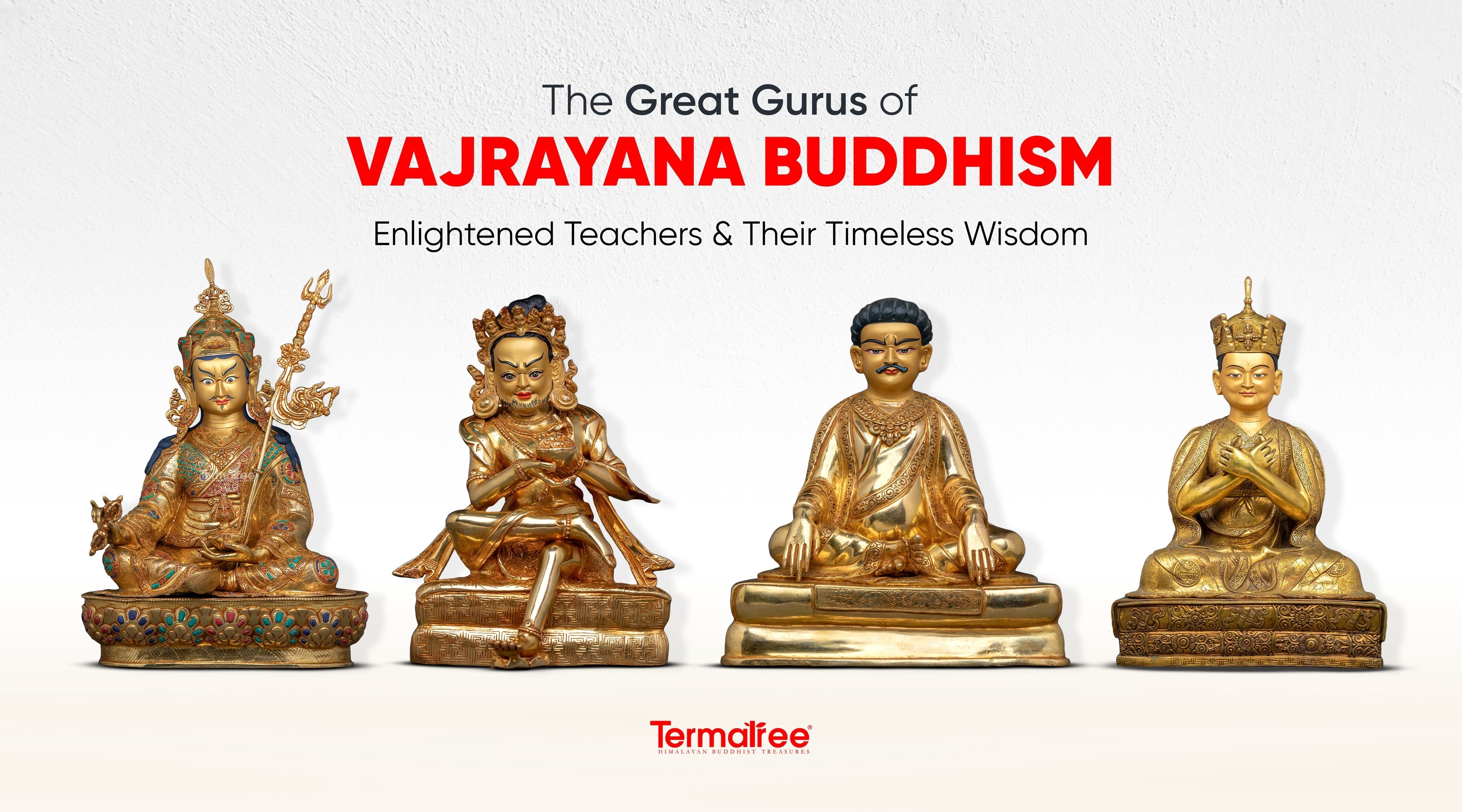
Tracing the Lineage, Teachings, and Living Wisdom of Vajrayana’s Most Revered Masters
Vajrayana Buddhism, often called the "Diamond Vehicle," which is a tantric tradition that flourished across India, Tibet, and the Himalayan regions. The experience of realization is achieved through advanced meditative practices, rituals, and the support of a qualified teacher or guru. At the heart of this tradition is a continuous chain of masters whose wisdom, difficulties, and leaps forward still influence the spiritual lives of millions. Not just scholars, many of these teachers were wandering yogis, fierce debaters, reformers, and mystics who turned their personal suffering into wisdom. In the following pages, we delve into eight of the most esteemed masters in the history of Vajrayana and the teachings they have bestowed.
Who Are the Great Gurus of Vajrayana Buddhism?
The great gurus of Vajrayana Buddhism teachings, practices, and realizations shaped the development and continuity of the tantric Buddhist tradition. They aren't only historical figures, but they are also spiritual models who are filled with wisdom, compassion and practice discipline. These masters imparted their knowledge to their students without a break in the chain, and this legacy lives on to this day among practitioners.
Some of the most prominent Vajrayana gurus include:
1. Guru Padmasambhava

Guru Padmasambhava, is credited with introducing Vajrayana Buddhism to Tibet in the 8th century and with his use of tantric methods in defeating the local spirits and obstacles and laying the foundations of the Nyingma, or "Ancient," lineage. According to legend, he was born miraculously from a lotus flower and was not born normally, and then he traveled across the Himalayan region, killing the demons and making them protectors of the Dharma. He is also said to have scattered many "termas," which are treasure teachings, all over Tibet and beyond, to be realized by future generations of practitioners in a time and place when it is appropriate for their transmission. Nowadays, Padmasambhava is regarded as a focal point of devotion among all Tibetan Buddhist schools and is depicted in iconography with a lotus hat and a vajra and skull cup, representing the skillful means and the wisdom.
2. Nagarjuna

The Madhyamaka or "Middle Way" school, a key school of Buddhism for the Vajrayana practice, was founded by a pivotal 2nd century CE Buddhist philosopher named Nagarjuna. His main achievement was to elucidate the concept of emptiness, that everything arises dependently and that there is a lack of an inherent nature in phenomena. This is a concept that he thoroughly explored in his writings, especially in the Mūlamadhyamakakārikā. He is reputed to have recovered scriptures of Mahayana Buddhism, among which the Perfection of Wisdom, from the nagas, mythical beings that had preserved them, traditionally. The Vajrayana takes a line that is based on the interrelatedness of emptiness and dependent origination, as emphasized by Nagarjuna, and their relationship implies that ordinary experiences and ultimate reality are connected. This basic knowledge is the basis of tantric techniques and visualization of deities without falling into either nihilism or substantialism.
3. Atisha

An important 11th-century Indian master, Atisha Dipankara, helped rejuvenate the Buddhist faith in Tibet when it was at a low and launched the 'later spread' of Buddhism there. In his masterpiece, "Lamp for the Path to Enlightenment," he systematically presented the Buddhist practice in a progressively advanced series of steps that would be accessible to each of a range of practitioners, and he introduced sutra ethics and tantric techniques to protect against misinterpretation or misuse. Atisha highlighted the bodhicitta and seamlessly combined monastic practice with tantric methodology, which greatly influenced the Kadam tradition and the Gelug school founded by Tsongkhapa. His teachings brought the realization that such radical insight and slow practice can move together in harmony, and the lam-rim, or "stages of the path" approach, is an integral part of the Tibetan Buddhist educational system today.
4. Naropa

Naropa, born around 1016 CE in either Bengal or Kashmir, was a high-caste scholar and senior gatekeeper at Nalanda, one of India's leading monastic universities. He renounced his prestigious life to follow his guru Tilopa after realizing that intellectual knowledge alone could not facilitate liberation. Enduring symbolic trials, Naropa’s teachings emphasized the dissolution of ego and attachment. He is recognized for founding the "Six Yogas of Naropa," a set of advanced tantric practices integral to the Kagyu lineage, transmitted to Tibet via Marpa. His legacy persists through the Naropa Institute in Colorado, which embodies the integration of intellectual training and meditative experience in modern education.
5. Marpa

An 11th-century Tibetan layman named Marpa Lotsawa made great journeys to India to study and return important tantric texts, translated into Tibetan. Marpa was a householder and a spiritual teacher; he was a person who showed that it was possible to attain enlightenment without living in a monastery. He is particularly known for his intense training of his pupil, Milarepa, for the purification of his negative karmas. His work laid the ground, and serving as a spiritual guide, Marpa illustrated that one could achieve enlightenment in the teacher-student transmission tradition of Kagyu practice.
6. Milarepa

The 11th-12th century Tibetan yogi-poet Milarepa symbolizes a path from suffering to nirvana. He was motivated by revenge and practiced black magic, inflicting harm, and then his remorse. He wanted to redeem himself and went to learn with Marpa, suffering to make his karma clear. He lived in caves in remote locations, meditating for enlightenment, and he was a hermit, composing deep songs of his attainments. His life is a testament to the Vajrayana teaching that negative actions can be transmuted with hard work, and his compilation, "Hundred Thousand Songs of Milarepa," is a cornerstone of Tibetan Buddhist literature.
7. Tsongkhapa

The 4th Dalai Lama, Je Tsongkhapa, was a major figure in 14th-century Buddhism and was the founder of the Gelug school, which became the predominant Tibetan tradition and the lineage from which the Dalai Lamas draw their lineage. Tsongkhapa was an expert on Buddhist studies and wanted to bring together the analysis of Madhyamaka with the practical aspects of tantra. He stressed the relationship of moral behavior, wisdom, and meditation. His masterpiece, "Great Treatise on the Stages of the Path to Enlightenment," on the basis of Atisha's lam-rim structure, deals with the subject of emptiness and valid reasoning. His emphasis on monastic discipline and his teachings on studying tantra after mastering sutra are responsible for the strict discipline in Gelug monasteries and for the Tibetan Buddhist scholarship tradition over the past centuries.
8. Sakya Pandita

Kunga Gyaltsen also known as Sakya Pandita, a 13th-century Tibetan master and an important contributor to Tibetan scholarship in logic, poetry, grammar, and tantric philosophy, was the head of the Sakya tradition. He was also well known for his work "Treasury of Logic on Valid Cognition" concerning Indian Buddhist epistemology, which inspired him to preserve the authenticity of tantric practices in Tibet. In the political sphere, he helped consolidate the relationship between Tibet and the Mongol Empire, having an impact on Tibetan politics. In his capacity as a meditator and scholar, his legacy lives on in the devotion of the Sakya lineage to the practice of tantra alongside rigor in scholarship.
Comparative Table of Key Gurus
|
Guru |
Lineage |
Teachings |
Symbolic Items |
Famous Student |
|
Padmasambhava |
Nyingma |
Tantric mastery, termas |
Vajra, Lotus hat, Skull cup |
Disciples of Nyingma |
|
Nagarjuna |
Madhyamaka |
Emptiness, dependent origination |
Scrolls, Manuscripts |
Various Indian disciples |
|
Atisha |
Kadam |
Lam-rim, bodhichitta |
Lamp for the Path |
Tibetan monks |
|
Naropa |
Kagyu |
Six Yogas of Naropa |
Mala, Tibetan texts |
Marpa |
|
Marpa |
Kagyu |
Translation, tantric transmission |
Texts, Vajra |
Milarepa |
|
Milarepa |
Kagyu |
Meditation, ascetic practice |
Cave retreat, Songs |
Various Yogis |
|
Tsongkhapa |
Gelug |
Lam-rim, ethical and tantric integration |
Scripture, Stupa |
Gelug monks |
|
Sakya Pandita |
Sakya |
Scholarship, tantric integrity |
Manuscripts, Rituals |
Sakya lineage |
Lineage, Transmission, and Famous Students
The teachings of the Vajrayana masters were kept and handed on within a direct student-teacher transmission, which meant that there were no breaks in the transmission lines. The Nyingma lineage was started by Guru Padmasambhava, who passed on the teachings to monks in Tibet who went on to create monasteries throughout the country. Marpa learned the yogic practices from Naropa, who passed them on to Milarepa, highlighting the power of such lineage in spiritual continuity. Atisha's lam-rim teachings had an impact on the Kadam school, which was to become the basis for the school of Je Tsongkhapa, and Sakya Pandita ensured the Sakya lineage was kept rigorous in both dharma and tantra.
There were also some famous students, such as Milarepa under Marpa, who turned suffering into realization through meditation and asceticism; Marpa under Naropa, who preserved and translated key tantric texts; the students of Padmasambhava, who propagated the Nyingma teachings and discovered the hidden termas; and the students of Atisha, who propagated lam-rim and bodhichitta knowledge. These relationships between students and teachers played a crucial role in preserving the practical and philosophical tradition of Vajrayana Buddhism, enabling each group to retain the authentic tradition while also incorporating local influences.
Historical and Cultural Context of Great Gurus

Political, social, and geographical realities of the time which cannot be changed from the lives and teachings of the great masters of the Vajrayana tradition. For instance, Sakya Pandita negotiated with the Mongol Empire and found the balance between religion and worldly affairs to ensure the survival of Tibetan religious practices in the face of external pressures. In Tibet, Atisha encountered a time of religious stagnation and dilapidation, and he worked diligently to resurrect and rejuvenate Buddhist practice, incorporating the gradual method with tantric teachings, while responsibly passing on the monastic discipline and tantric practices. The story of Milarepa's life in the remote caves of the Himalayas highlights how isolation influenced his practice of meditation and the profound transformations that occurred in his personal life, making it legendary. Knowing the context of the times helps appreciate the social relevance of their teachings, the extraordinary efforts that were needed to maintain Vajra yoga, and the way the masters responded to the challenges faced by their time.
Miracles and Legends of Great Gurus
The stories about those masters are no mere historical but are great narrative that reveal spiritual truths. Padmasambhava is renowned for his ability to tame the spirits of the land and turn them into guardians of the Dharma, a testament to the power of enlightened action to reconcile and redirect negative forces towards positive and beneficial outcomes for spiritual development. Even in extreme conditions of nature, everything he did in the past becomes a great realization for him due to his life of austere living and minimal sustenance; his life is a testimony of dedication, and constant devotion. Under Tilopa's guidance, Naropa underwent seemingly impossible trials, making him undergo hardships such as experiences that helped him to detach from the world and from his own self and learn that disciplined effort and faith in the Guru are necessary for attaining spiritual mastery. Such stories provide a lesson for practitioners to learn to be brave, resilient and to understand that radical change is possible through an impassioned practice and perseverance.
Influence on Art and Literature
The teachings of these masters are not just spiritual; they have given rise to a wealth of artistic and literary creations. The Padmasambhava, Milarepa, and Atisha are rendered in vivid detail as thangkas and statues to guide us in meditation and devotion. Monastics and lay practitioners are still being educated by manuscripts and commentaries like Nagarjuna's philosophical works or Sakya Pandita's epistemological works. The “Hundred thousand Songs” of Milarepa provide deep insights in poetic and spiritual terms, and the termas of Padmasambhava contain esoterica for future generations. These pieces of art and literature enable practitioners to directly connect with the lineage to contemplate, be inspired by, and learn from it for a millennium.
Modern Relevance of Great Gurus
The wisdom of these great teachers continues to inform practitioners today worldwide. Courses on lam-rim, tantric meditations, yogic exercises, and historical tantric traditions are available at retreat centers, monasteries and digital platforms. Their lives are a constant reminder of the practice of ethics, the power of their spirit, and the application of wisdom in their everyday lives. Modern practitioners learn to apply discipline, mindfulness, compassion and realization to their contemplative practice, and in every aspect of their lives, by engaging with the teachings. These gurus' lives serve as a reminder that Vajrayana Buddhism is not merely a historical tradition but a living path, adaptable and yet rooted in centuries of authentic experience, offering guidance, inspiration, and practical tools for spiritual growth in the modern world.
Conclusion
The Great Gurus of Vajrayana Buddhism are a testament to the integration of wisdom, compassion, and disciplined practice, and they will continue to inspire practitioners for generations to come. Each of these gurus has his own approach and style of realization, ranging from the tantric powers and wondrous teachings of Padmasambhava to the austere meditation and poetic wisdom of Milarepa. Their teachings are passed through uninterrupted lineages and through close student-teacher bonds and have influenced the thinking, meditation, and ritual practices of people for centuries. Their lives, in addition to their doctrine, are an inspiration of resilience, courage, and ethics, and an example that the life of spiritual realization can change one's own suffering into great insight. Their legacy lives on today, not just in the monasteries, retreat centers and rituals but in our art, literature, and communities of Vajrayana practitioners globally, a legacy of a way of life that is living and practical, a way that guides each practitioner towards awakening, compassion, and meaningful engagement with the world.