The Eight Great Bodhisattva Who Clears the Mind's Hidden Obstacles
Every practitioner on the Buddhist path runs into obstacles. Some come from outside: a noisy environment, an unsupportive circumstance, or plain bad timing. But far more come from inside the mind itself: ignorance, doubt, restlessness, craving, pride, and fear. Buddhist teaching is fairly blunt about this: clearing these inner obstacles isn't just a matter of willpower. It takes wisdom, compassion, and steady, patient effort.
Among the Eight Great Bodhisattvas of Mahayana and Vajrayana Buddhism, one figure is devoted almost entirely to this problem: Sarvanivaranavishkambhin is the one who removes all hindrances. He is less famous than Avalokiteshvara or Manjushri, and his image is not seen outside temples and thangka paintings. But within meditation practice specifically, his role is considered essential.
What Does the Name Mean?

Sarvanivaranavishkambhin is one of the Eight Great Bodhisattvas (Ashta Mahabodhisattvas) who frequently accompany Shakyamuni Buddha in Mahayana Buddhist scriptures and iconography. These eight Bodhisattvas each embody a particular enlightened quality that practitioners seek to cultivate.
The name is Sanskrit, built from three parts:
-
Sarva — all, every
-
Nivarana — hindrance, obstacle, obscuration
-
Vishkambhin — one who blocks, suppresses, or clears away
Together, his name means "He Who Removes All Obstacles." He's often called Vishkambhin for short. Some old texts call him "effacer of all sins" instead. Either way, his job is the same: clear away whatever is blocking a practitioner's path.
Among the Eight Great Bodhisattvas

The Eight Great Bodhisattvas (Ashta Mahabodhisattvas) are the principal attendants who accompany Buddha Shakyamuni in Mahayana scripture and art, each embodying a different facet of enlightened activity:
|
Bodhisattva |
Embodies |
|
Avalokiteshvara |
Compassion |
|
Manjushri |
Wisdom |
|
Samantabhadra |
Great conduct/practice |
|
Kshitigarbha |
Compassion for beings in the lower realms |
|
Maitreya |
Loving-kindness; the future Buddha |
|
Akashagarbha |
Boundless generosity and merit |
|
Vajrapani |
Spiritual power and protection |
|
Sarvanivaranavishkambhin |
Removal of obstacles |
The tradition treats enlightenment as something built from all eight qualities working together, not any one virtue in isolation.
Read More: Understanding Bodhisattvas: Who Are They?
What Obstacles Does He Actually Remove?
The word "nivarana" has a fairly specific meaning in Buddhist concepts: mental hindrances that block clarity and concentration. In earlier Theravada teaching, five are named directly:
-
Sensory desire (kamacchanda): craving toward pleasant experience
-
Ill will (vyapada): anger, aversion, hostility
-
Sloth and torpor (thina-middha): dullness, low energy, laziness
-
Restlessness and worry (uddhacca-kukkucca): an agitated, unsettled mind
-
Doubt (vicikiccha): uncertainty about the practice, the teacher, or the path itself
Mahayana and Vajrayana sources build on this same foundation but widen the frame. Sarvanivaranavishkambhin is invoked against the following:
-
Ignorance (Avidya)
Ignorance is considered the root cause of suffering because it prevents beings from seeing reality as it truly is. Through wisdom and compassionate guidance, he helps dispel this fundamental confusion.
-
Doubt
Spiritual uncertainty can weaken confidence in practice and delay progress. The Bodhisattva encourages practitioners to develop trust through study, reflection, and meditation.
-
Mental Distractions
A wandering mind prevents meditation and insight. He refers to the elimination of distractions in order to help practitioners practice mindfulness and concentration.
-
Emotional Afflictions
The mind is polluted by greed, hatred, jealousy, attachment, pride, and anger, which cause suffering. His radiant being is the instrument that aids in their progressive purification.
-
Karmic Obstructions
One can encounter impediments in spiritual practice due to past harmful actions. Buddhist traditions describe him as assisting practitioners in purifying negative karma through sincere practice and virtuous conduct.
The common thread across all of these: the biggest barriers to awakening aren't out in the world. They're patterns in the mind.
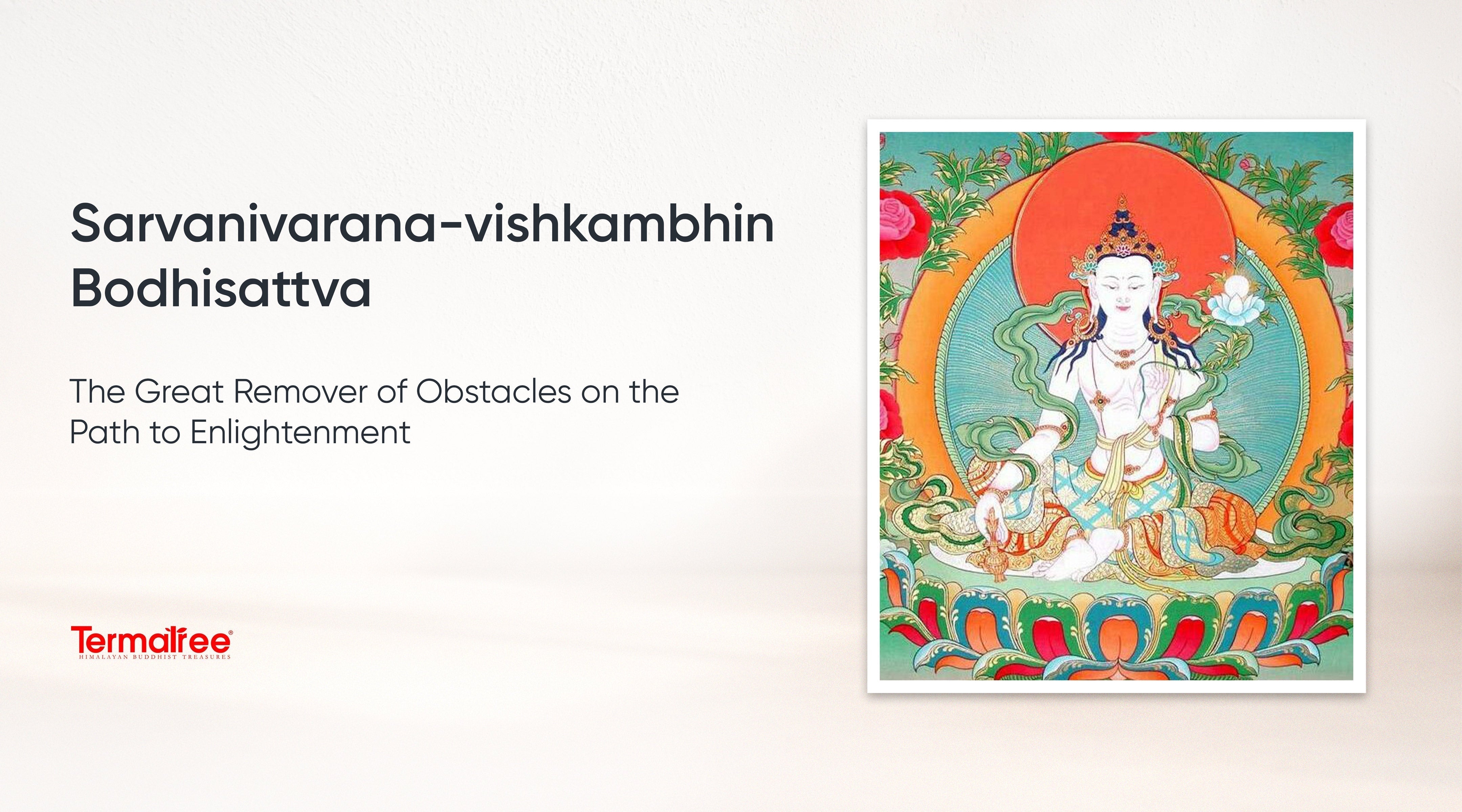
Iconography of Sarvanivaranavishkambhin

-
Crown and hair
He wears an ornate five-pointed jeweled crown, a common feature of peaceful bodhisattva iconography, with dark hair falling in loose locks over the shoulders, a sign of youthful, princely status rather than monastic renunciation.
-
Facial expression
His eyes are gently lowered, and his expression is calm, almost meditative, in keeping with the serene, compassionate demeanor typical of the Eight Great Bodhisattvas.
-
Ornaments
Large circular earrings, a beaded necklace, armlets, and bracelets adorn his body, representing the "perfection of qualities" accumulated through countless acts of compassionate activity, a standard convention in bodhisattva iconography.
-
Right hand gesture
His right hand is raised near the chest in a teaching or blessing-type mudra, a gesture associated with the transmission of the Dharma.
-
Left hand and attribute
His left hand holds the stem of a flower that blossoms at shoulder height into a lotus, which supports a small round jewel that most likely represents the Chintamani (wish-fulfilling jewel) frequently associated with this bodhisattva and symbolizes the granting of spiritual benefit and the clearing away of misfortune.
-
Seated posture
He sits in full vajra/lotus posture atop a multicolored lotus throne, its petals rendered in green, teal, and orange, the lotus that symbolizes purity and rises untouched from ordinary conditions.
-
Scarves and drapery
Flowing scarves wrap around his upper arms and shoulders, a stylistic device common in Tibetan thangka painting used to suggest movement and the dynamic, active quality of an enlightened being still engaged with the world.
Sarvanivaranavishkambhin in Buddhist Literature

Sarvanivaranavishkambhin shows up across a wide range of Mahayana and tantric texts, not just one isolated source:
-
The Lotus Sutra, where he is present in the assembly and pays homage to Avalokiteshvara
-
The Mahavairocana Tantra, which includes a specific mantra attributed to him for removing obstacles and disturbances during practice
-
The Ratnamegha Sutra and the Tathagata-guna-jnana-acintya-vishayavatara-nirdesha, where he serves as the primary dialogue partner receiving teaching
-
The 11th-century Nishpannayogavali, an important source for his formal iconographic description in tantric ritual texts
-
Some secondary sources also place him within the broader Mahasamnipata Sutra collection and the Avatamsaka Sutra as a questioner seeking teachings that benefit all beings. These attributions appear consistently in popular Buddhist writing, though readers interested in primary textual confirmation should treat them as less firmly documented than his appearances in the Lotus Sutra and Vairocanabhisambodhi Sutra
In Vajrayana lineages, he is typically placed within the retinue of Amoghasiddhi, one of the Five Dhyani Buddhas, linking him to the Buddha family associated with fearless, enlightened activity.
The Bodhisattva You Call On Mid-Meditation
What sets Sarvanivaranavishkambhin apart from the other seven Great Bodhisattvas is how operational his role is. He is not mainly a figure to admire from a distance; practitioners invoke him in the moment, right when a hindrance actually shows up: the mind drifting toward craving, flaring into irritation, going foggy with fatigue, spinning with anxiety, or stalling out in doubt about whether the practice is even working.
Tantric teaching makes it clear that the practice remains relevant even for experienced practitioners. Even advanced practitioners run into subtler versions of these same five hindrances. Meditating on him is treated as a method for gradually purifying these patterns, not a shortcut or a magic fix, but a steady, repeated practice of ethical conduct, concentration, and honest self-observation.
Four Questions Worth Sitting With
Because Sarvanivaranavishkambhin's whole purpose points inward, his symbolism naturally suggests some direct questions for practitioners to sit with:
-
What attachments are clouding my judgment right now?
-
What fears are keeping me from acting with compassion?
-
Which habits are quietly weakening my mindfulness?
-
Where could wisdom replace confusion, if I looked honestly?
Sarvanivaranavishkambhin in Buddhist Art

In Himalayan Buddhist art, statues and thangkas of Sarvanivaranavishkambhin serve as visual reminders of the Bodhisattva's enlightened activity. Artists depict him with a calm face, precious jewels, and symbols of purity, wisdom, and compassionate action.
He is often depicted with the eight great Bodhisattvas around Shakyamuni Buddha, underlining that many complementary qualities pave the path to enlightenment. The careful iconographic details of these sacred artworks encourage the practitioner to think of how to remove obscurations from the mind and how to attain inner purity.
Why His Teachings Matter Today
Distractions and stresses in modern life are obstacles to focus and clarity, reflecting internal obstacles, such as attachment and fear, as emphasized in Buddhist teachings. The teachings of Sarvanivaranavishkambhin are on the need for consciousness rather than automatic responses. Practitioners are asked to release frustration and confusion and cultivate patience and wisdom. His teachings emphasize the need to engage the mind and cultivate a gentle, thoughtful response to the difficulties of life, thus bringing about true spiritual transformation. Today, he reminds us that wisdom can arise from our limitations and that these limitations can guide us in transforming our barriers into pathways through careful practice.
Conclusion
Bodhisattva Sarvanivaranavishkambhin embodies one of the most fundamental principles of the Buddhist way of life: the elimination of factors that block awakening. He is one of the Eight Great Bodhisattvas, embodying the activity of compassion, freeing from ignorance, doubt, distraction, and karmic obscurations, to allow natural wisdom to emerge. His image is not as popular as Avalokiteshvara's or Manjushri's, but he can not be ignored in Mahayana and Vajrayana Buddhism. In his teachings, he reminds us that enlightenment isn't achieved by doing nothing but by overcoming the mental obstacles that prevent us from seeing our true nature.
From sacred texts to meditation exercises, statues to thangka paintings, he remains a source of inspiration for Buddhists. The image of Buddha is a reminder that every challenge encountered on the way to enlightenment can be transformed into an opportunity for insight when mindful and with sincere practice.
Explore Our Collection of Bodhisattvas from Termatree.