
A Guide to the Symbols, Postures, and Ornaments That Turn Sculpture into Sacred Teaching
A Buddhist statue is not merely a representation of a Buddha, Bodhisattva, or deity; it is a visual expression of profound spiritual teachings. The placement of the hands, the ornaments, the lotus seat, and even the expression on the face all have symbolic significance.
Buddhist artists have adhered to long-standing iconographic conventions to produce sacred images representing wisdom, compassion, protection, and enlightenment for centuries. These details enable practitioners to identify each of the various enlightened beings and their teachings. Mudras, attributes, postures, and ornaments are a symbolic language and communicate part of Buddhist philosophy, which cannot be fully expressed with words. With this symbolic language, we can see Buddhist statues not just as beautiful artworks but as aids to meditation and depictions of the Dharma.
Why Every Detail in Buddhist Statues Has Meaning

Buddhist statues were never meant to be portraits. They are teaching tools, meditation aids, and devotional objects, and their forms are governed by centuries-old canons of proportion and symbolism rather than individual artistic whim. Ancient texts such as the Indian Shilpa shastras and later Tibetan, Chinese, and Southeast Asian iconometric manuals laid out precise rules for how a Buddha or bodhisattva should be depicted: the length of the earlobes relative to the nose, the angle of the eyes, the number of curls in the hair, and the placement of the hands.
This precision exists because the statue is meant to function almost like a diagram of enlightenment itself. A practitioner looking at the image should be able to "read" which qualities of an awakened mind are being emphasized, which Buddha or bodhisattva is depicted, and even which specific teaching or life event is being referenced, all without a single word of text. In this sense, a Buddhist statue works less like a sculpture in the Western tradition and more like a mandala or a sutra rendered in bronze or stone.
The Meaning of Crowns and Hairstyles
The head of a Buddhist figure carries some of the densest symbolism in the entire image.

The ushnisha, the raised bump or dome on top of the head, represents the expanded wisdom and spiritual attainment that comes with full enlightenment. It's often described as a cranial protrusion that appeared naturally once the Buddha achieved awakening, and in later art it's sometimes topped with a flame-like finial symbolizing the radiant energy of enlightened knowledge.
The urna, a small dot or curl of hair between the eyebrows, represents a third eye of spiritual insight, the ability to perceive truths hidden from ordinary sight. It is often rendered as a raised dot, a small gem, or a spiral of hair.

Tight curls of hair, arranged in small clockwise spirals covering the head, are traditionally explained as a sign of the Buddha's renunciation: having cut off his princely locks, his hair grew back in these disciplined curls rather than long, flowing tresses tied up royally.
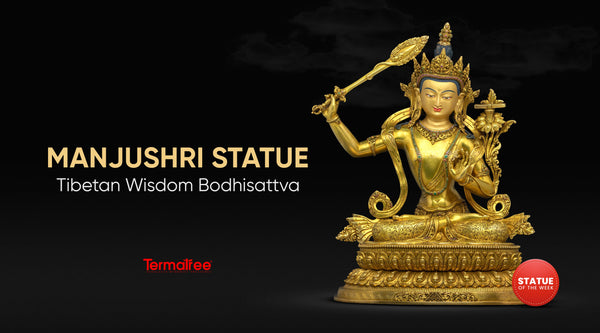
Crowns generally appear on bodhisattvas rather than on Buddhas. Because bodhisattvas are enlightened beings who choose to remain engaged with the world to help others, they're often shown still wearing princely ornamentation, a visual reminder that compassion operates within the world of form and beauty rather than apart from it. An elaborate five-pointed crown, common in Tibetan and Newari art, frequently depicts the Five Dhyani Buddhas, tying the wearer's identity to the broader cosmology of enlightened wisdom.
The Meaning of Jewelry and Ornaments
Where a historical Buddha figure is typically shown unadorned, bare-chested, without rings, necklaces, or bracelets, bodhisattvas and certain tantric deities are often dripping in ornamentation: necklaces, armbands, anklets, earrings, and sashes. The unadorned Buddha represents the state after renunciation and full awakening, where nothing further is needed. The bejeweled bodhisattva represents skillful engagement with the world using beauty, wealth, and worldly forms as tools (upaya) to guide beings toward liberation rather than rejecting the world outright.
Specific ornaments carry their own meanings:
-
Long earlobes, often stretched and empty of any actual earring, recall the heavy gold earrings the historical Buddha wore as a prince before he renounced his wealth; the stretched lobes remain even after the jewelry is gone, a permanent trace of what was given up.

-
Necklaces and torques in tantric Buddhist art can symbolize the transformation of desire and attachment into ornaments of wisdom rather than obstacles to it.
-
Ritual objects held in the hands, a alms bowl represent non-attachment and simplicity, a vajra symbolizing indestructible truth, a bell representing wisdom, a lotus representing purity, and a sword cutting through ignorance function almost like labels, identifying exactly which figure or quality is being represented.

The Meaning of Robes and Garments
The drape of cloth across a Buddhist figure is far from incidental.
The three-robe set (Skt. trichivara) worn by monastic images reflects the actual robes of Buddhist monks: an inner robe, an upper robe, and an outer wrapping robe, all traditionally sewn from patched fragments of cloth to symbolize humility and detachment from material wealth.
How the robe covers the body carries regional and doctrinal significance. In much Theravada art from Southeast Asia, the robe covers only the left shoulder, leaving the right shoulder bare, a style associated with the Buddha actively teaching or in ordinary monastic life. In many Mahayana and Himalayan traditions, both shoulders are covered, sometimes read as a more formal or cosmic presentation of the Buddha.
 The thinness and cling of the fabric, especially in Gandharan and Gupta-period Indian sculpture, was often rendered so the folds trace the contours of the body beneath a technique meant to convey the physical and spiritual perfection of the Buddha's form through the drapery rather than through nudity, respecting monastic modesty while still suggesting an idealized body.
Flame-like patterns or gold coloring on robes in later Southeast Asian and Himalayan art elevate the garment beyond ordinary cloth, marking the figure as a transcendent, almost cosmic being rather than a historical monk.
The Meaning of Lotus Seats
Almost every Buddha and bodhisattva sits or stands upon a lotus, and this single image carries some of Buddhism's most important teachings.
 The lotus grows rooted in muddy water, yet rises above the surface to bloom clean and untouched by the mud below. The lotus is read directly as a metaphor for enlightenment: an awakened being originates in and remains connected to the ordinary, often difficult conditions of worldly existence (the mud), yet is not stained or limited by them (the bloom). Sitting on a lotus signals that the figure has achieved this state of purity amid impurity.
The number of petals and their arrangement can carry further meaning in more esoteric traditions, sometimes corresponding to specific teachings, chakras, or cosmological structures, particularly in Tibetan Vajrayana art.
The color of the lotus matters too in certain iconographic systems: a white lotus often signals purity and spiritual perfection, a pink lotus is associated with the supreme Buddha, a red lotus with compassion and the heart, and a blue lotus with wisdom and the victory of spirit over the senses.
The Meaning of Halos and Aureoles
The translucent figures around the head or the entire body of a Buddhist figure are not just frames but are intended to represent the living light energy. The halo symbolizes the wisdom of the enlightened mind and the light of spiritual insight emanating outward.

The aureole or mandorla is an expression of the Buddha's aureole, or the total radiance of an enlightened person's presence; it is sometimes described as the Buddha's aura of compassionate energy that radiates into the world.
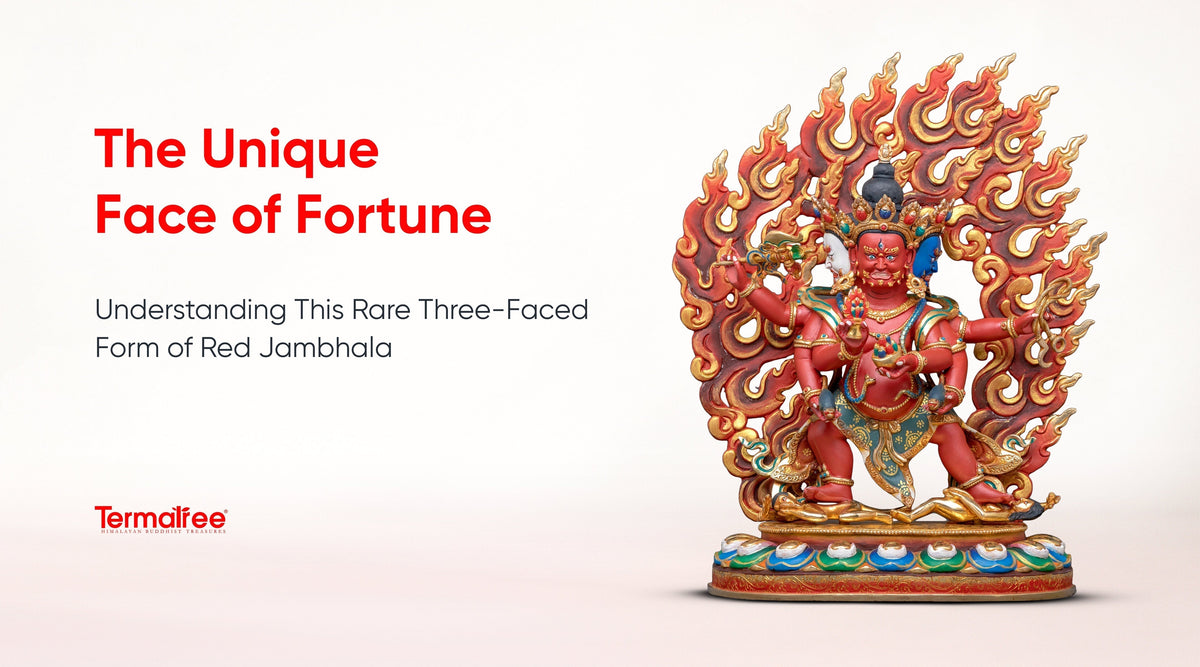
Patterns of flame that surround the edge of a halo or aureole are especially found in art in Southeast Asia and East Asia and enhance this interpretation of fire as a symbol of transformative spiritual energy, burning away ignorance.
Multiple concentric rings, sometimes seen in more elaborate images, can represent different qualities emanating outward together, such as wisdom, compassion, and skillful means radiating simultaneously from the awakened figure.
The Meaning of Throne Designs

The base or throne upon which a seated Buddha stands is just as significant as the Buddha's seat and is frequently ignored in favor of the better-known lotus seat that sits atop the base.
Lion thrones, on which carved lions stand or sit, symbolize royal power, fearlessness, and the Buddha's teaching voice, which is also known as the "lion's roar," so as to pierce through delusion.
Elephant motifs at the throne base can allude to the Buddha's mother's dream of a white elephant before his birth or, more broadly, to steadiness, strength, and auspiciousness.
Architectural, palace-like thrones, especially in Tibetan and Newari art, situate the figure within an implied cosmic palace, reinforcing the idea that the enlightened being presides over a realm of pure perception even while the statue itself sits in an ordinary temple.
Empty or simple platforms, by contrast, in some early and Theravada traditions, emphasize austerity and the Buddha's rejection of worldly grandeur, letting the figure's own posture and gesture carry the full symbolic weight.
How Artists Follow Sacred Iconographic Guidelines
 None of these details are left to the sculptor's imagination. In the tradition of Buddhist statues, strict canonical texts and master-apprentice transmissions determine the style of the statues so that a Kathmandu, Bangkok, or Kyoto-made statue shares a recognizable visual vocabulary with one made a thousand years ago.
Traditional artists are carefully schooled in sculptural form but also in the symbolic significance of each size and pose. Iconometric grids establish exact proportional relationships among body parts, such as the width of the face relative to the length of the torso and the specific curve of the eyebrows, because getting these proportions "wrong" isn't just an aesthetic failure but is understood to compromise the spiritual efficacy of the image.
In many traditions, the making of a statue is itself considered a devotional and even ritual act. Before a statue is considered a proper object of worship, it typically undergoes a consecration ceremony in some traditions called "eye-opening," where the pupils are painted in as a final step, symbolically bringing the image to life as a vessel for enlightened presence. This also means that the statue is never simply an art object, but rather a functional aid to practice, and details of the crown to the lotus are all there for their purpose.
Conclusion
Buddhist statues are not only beautifully made, but they also hold a lot of meaning in each detail. The elements of the crown, lotus, mudra, expression, ornaments, and sacred objects form a visual language that speaks for centuries of Buddhist knowledge. Through recognizing this inner code, we can gain a deeper insight into Buddhist statues, recognizing them not only as art but as symbols of compassion, wisdom, and the path to enlightenment. Every detail has a purpose. Every symbol carries a teaching. Every statue becomes a silent guide on the path of awakening.