
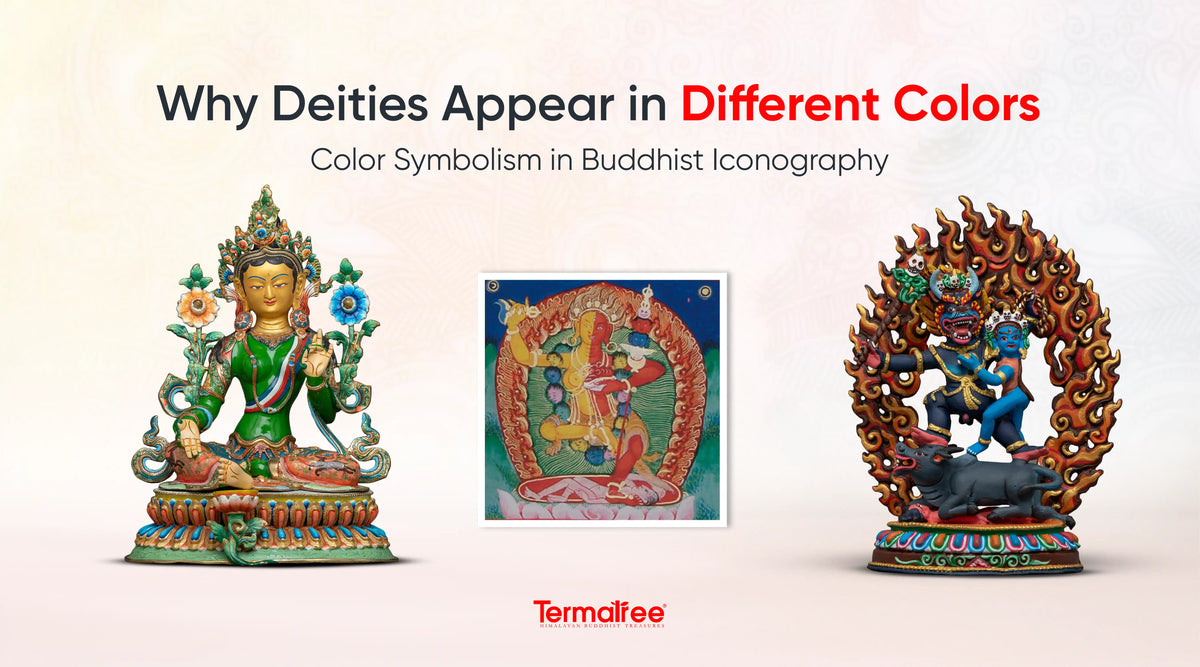
How Color Reveals a Deity’s Identity, Activity, and Wisdom in Tibetan Buddhist Art
In Buddhist art, color is not used merely for decoration. Every color applied to a deity’s body, clothing, ornaments, or surrounding elements carries symbolic meaning connected with enlightened qualities, spiritual activities, and aspects of wisdom. In Tibetan Buddhist iconography, the color of a deity often provides important clues about their identity, function, and the type of enlightened activity they represent. A deity’s color is part of a carefully developed visual language that allows practitioners to recognize and contemplate different forms of awakened qualities. White may express purification and peace, blue may represent vast wisdom and the transformation of anger, yellow may symbolize abundance and stability, red may represent magnetizing activity and compassion, while green often expresses active compassion and swift enlightened action.
However, these meanings should not be understood as fixed rules that apply identically to every deity. The interpretation of color depends on the specific deity, lineage, tantric tradition, and context in which the image appears. Buddhist iconography combines color with other identifying elements such as hand gestures (mudras), implements, posture, ornaments, companions, and the surrounding mandala.
The Five Families: Color as a Map of the Mind

The foundation of the whole system is the Five Buddha Families, also called the Five Dhyani Buddhas. Each one is associated with a color, a particular kind of wisdom.
-
Vairochana, white, embodies the wisdom of reality itself, transforming ignorance.
-
Akshobhya, blue, carries mirror-like wisdom, the mind's capacity to reflect things exactly as they are, countering anger and aggression.
-
Ratnasambhava, golden yellow, holds the wisdom of equality, working against pride.
-
Amitabha, red, represents discriminating wisdom, the antidote to attachment and craving.
-
Amoghasiddhi, green, embodies all-accomplishing wisdom, transforming jealousy.
Every deity in the Tibetan pantheon is understood to belong to one of these five families, which means their color symbolism indicates which affliction that deity helps a practitioner.
Color as Activity: What a Deity Is For
In tantric ritual, four or five core activities each get their color:
-
White for pacifying, calming illness, conflict, and disturbance.
-
Yellow for increasing wealth, merit, lifespan, and knowledge.
-
Red for magnetizing, drawing in positive influence, love, and favorable circumstances.
-
Black or dark blue for wrathful activity forcibly clearing away obstacles that won't budge through gentler means.
The well-known set of 21 Taras splits into white, yellow, red, and dark forms, each color signaling which of the four activities that particular emanation of Tara is invoked for.
White: Purification, Peace, and Compassion

White is traditionally associated with purification, clarity, peace, and the removal of obstacles. It represents the transformation of ignorance and negative conditions into awakened wisdom. White deities are often connected with peaceful activities, healing, longevity, and purification practices. The color suggests the qualities of calmness, openness, and the cleansing of harmful karma.
Examples of White Deities
White Tara
White Tara is one of the most well-known white-colored deities in Tibetan Buddhism. Her white body symbolizes purity, compassion, and healing activity. She is associated with longevity practices and the compassionate protection of beings from suffering. Her seven eyes, including those on her forehead, palms, and soles, represent her ability to perceive the suffering of beings in all directions and respond with compassion.
Shakyamuni Buddha
Shakyamuni Buddha is often depicted with golden or warm-colored skin rather than white; however, white Buddha forms in Buddhist art generally represent qualities connected with purity and awakened clarity.
Yellow and Gold: Abundance, Stability, and Wisdom

Yellow and golden colors are associated with richness, generosity, increase, and the earth element. They symbolize qualities that nourish spiritual development, including wisdom, prosperity, and stability. In Vajrayana Buddhism, yellow is connected with increasing activities, where enlightened beings help expand positive qualities such as merit, longevity, knowledge, and resources.
Examples of Yellow Deities
Yellow Dzambhala
Yellow Dzambhala is one of the most recognized wealth deities in Tibetan Buddhism. His golden-yellow appearance represents abundance, generosity, and the accumulation of resources that support spiritual practice. His symbolism does not represent attachment to material wealth but rather the transformation of resources into compassionate activity.
Ratnasambhava Buddha
Ratnasambhava, one of the Five Dhyani Buddhas, is associated with the color yellow. His name means “Source of Jewels,” and his yellow color represents the wisdom that transforms pride into the wisdom of equality. He is connected with generosity, equanimity, and the recognition of the value of all beings.
Red: Compassion, Magnetizing Activity, and Transformative Energy

Red is associated with magnetizing activity, compassion, desire transformed into wisdom, and the power to attract positive qualities. In Buddhist symbolism, red does not represent ordinary attachment but the transformation of emotional energy into awakened awareness. Red deities are often connected with practices involving compassion, communication, and the ability to gather favorable conditions.
Examples of Red Deities
Amitabha Buddha
Amitabha Buddha, the Buddha of Infinite Light, is traditionally represented with a red body. His color is connected with discriminating wisdom and the ability to recognize the unique qualities of phenomena without confusion. He is the central Buddha of the Lotus Family (Padma), associated with compassion and the Pure Land of Sukhavati.
Kurukulla
Kurukulla is a red-colored female deity associated with magnetizing enlightened activity. Her red appearance symbolizes powerful compassionate energy that brings beings toward wisdom and liberation.
Blue: Vast Wisdom and Transformation

Blue is one of the most significant colors in Tibetan Buddhist iconography. It represents vastness, depth, and the transformation of anger and aggression into mirror-like wisdom. The color blue is often associated with space, clarity, and the limitless nature of an awakened mind.
Examples of Blue Deities
Akshobhya Buddha
Akshobhya Buddha is traditionally depicted with a blue body. His color represents the transformation of anger and hatred into mirror-like wisdom. He embodies unwavering awareness and the ability to remain undisturbed by emotional disturbances.
Medicine Buddha
Medicine Buddha (Bhaisajyaguru) is commonly depicted with a blue body, symbolizing healing, purification, and the removal of suffering caused by illness and afflictive emotions. His blue color reflects the vast healing qualities of enlightened awareness.
Vajrapani
Many forms of Vajrapani are shown with a blue or dark blue body. This form represents powerful enlightened energy and the transformation of anger into protective wisdom.
Green: Active Compassion and Swift Enlightened Action

Green represents activity, movement, and the dynamic expression of compassion. It is often connected with enlightened action that responds quickly to the needs of beings. Unlike peaceful colors that emphasize stillness, green expresses active engagement with the world.
Example of Green Deity
Amoghasiddhi
Amoghasiddhi is the one most closely tied to the color green, and his name itself translates roughly as "unfailing" or "infallible accomplishment," which points directly to the quality he represents: all-accomplishing wisdom, the capacity to complete actions and intentions without obstruction.
Green Tara
Green Tara is the most famous green-colored deity in Tibetan Buddhism. Her green body symbolizes her active compassion and readiness to assist beings. Her posture, with one leg extended, expresses her willingness to rise immediately to help those who call upon her. Green Tara represents protection, fearlessness, and compassionate action.
Black and Dark Colors: Powerful Protection and Transformation

Dark blue, black, and deep colors are commonly associated with wrathful deities and powerful protective activities. These colors do not represent negativity but the forceful transformation of obstacles, ignorance, and harmful tendencies. Wrathful appearances symbolize compassion expressed in a powerful form, removing conditions that prevent awakening.
Examples of Dark-Colored Deities
Mahakala
Mahakala is commonly depicted with a dark blue or black body. His appearance represents the destruction of obstacles, protection of the Dharma, and the transformation of negative forces. His fierce expression symbolizes the intensity of enlightened wisdom confronting ignorance.
Vajrakilaya
Vajrakilaya is often depicted with a dark blue body and is associated with overcoming spiritual obstacles and removing harmful influences.
Color and the Five Buddha Families

The symbolism of color especially connects with the Five Buddha Families, an important framework in Vajrayana Buddhism. Each Buddha family represents the transformation of a particular negative emotion into a specific wisdom.
|
Buddha Family |
Color |
Wisdom |
Transformation |
|
Vairochana |
White |
Wisdom of Dharmadhatu |
Ignorance |
|
Akshobhya |
Blue |
Mirror-like Wisdom |
Anger |
|
Ratnasambhava |
Yellow |
Wisdom of Equality |
Pride |
|
Amitabha |
Red |
Discriminating Wisdom |
Attachment |
|
Amoghasiddhi |
Green |
All-Accomplishing Wisdom |
Jealousy |
Through meditation on these forms, practitioners contemplate the transformation of ordinary emotions into enlightened qualities.
The Exception That Proves the Rule: Multi-Colored Deities

(Photo from Himalayan Art Resources)
According to Himalayan Art Resources (HAR), a well-regarded specialist archive for Tibetan and Himalayan Buddhist iconography, a deity will generally have one dominant body color; single-color figures are the convention, not the exception. But there are rarer cases that break this rule, and they form their own distinct subcategory rather than being minor variations on the norm:
-
Some deities have bodies split vertically down the middle, with each side rendered in a different color.
-
A smaller number go further still, with the body broken into an entire patchwork of colored sections closer to a mosaic than a single figure.
Examples include the multi-hued form of Garuda known as Shabala, certain wrathful retinue figures tied to Chakrasamvara and Vajrayogini practice, and the Bon deity Zhangzhung Meri. Because these figures are genuinely uncommon, encountering one is usually a signal worth pausing on. This particular deity carries a more complex identity than a single color alone could convey.
Conclusion
The colors of Buddhist deities represent more than artistic choices. They express qualities of awakened consciousness and provide a visual method for understanding the path from ordinary experience to enlightenment. It tells you which of the Five Buddha Families they belong to and therefore which affliction ignorance, anger, pride, attachment, or jealousy their particular wisdom is suited to transform. It tells you which activity they're associated with: pacifying, increasing, magnetizing, or forcefully clearing obstacles. It signals, at a glance, whether you're looking at a peaceful or wrathful form, and by extension, what kind of energy that figure is meant to embody. And it locates them spatially, within the directional and elemental logic that structures a mandala. Multi-colored deities sit outside all of this as a genuine exception rare enough that when you spot one, it's worth treating as a deliberate signal rather than an accident of the artist's palette. Taken as a whole, color in Buddhist iconography isn't decoration laid over a finished image; it's one of the primary ways the image communicates in the first place.


