Understanding their Shared Essence, Iconography, and spiritual meanings
Few figures in Buddhist art carries devotional weight across as many cultures as the Buddha known as Amitabha, venerated as Amituofo in China, Amida in Japan, Amita in Korea, and Öpakmé in Tibet. Yet within the vast popular figure lies a quiet complexity: Amitabha and Amitayus are the same enlightened being, depicted in two deliberately different forms. One appears as a humble monk; the other as a crowned and bejeweled celestial deity. Understanding why requires understanding one of Mahayana Buddhism's most elegant doctrinal frameworks and seeing how Himalayan artists translated abstract philosophy directly into the visual language of paint and bronze.
One Being, Two Bodies: The Trikaya Concept
 In Mahayana Buddhist philosophy, a fully enlightened buddha is understood to manifest through three bodies, known as the Trikaya: the dharmakaya, or ultimate truth body, formless, without description, and never depicted in art; the sambhogakaya, or enjoyment body, in which a buddha appears in radiant celestial form to teach advanced bodhisattvas; and the nirmanakaya, or emanation body, in which a buddha appears in the world in ordinary, accessible human form, as the historical Buddha Shakyamuni did.
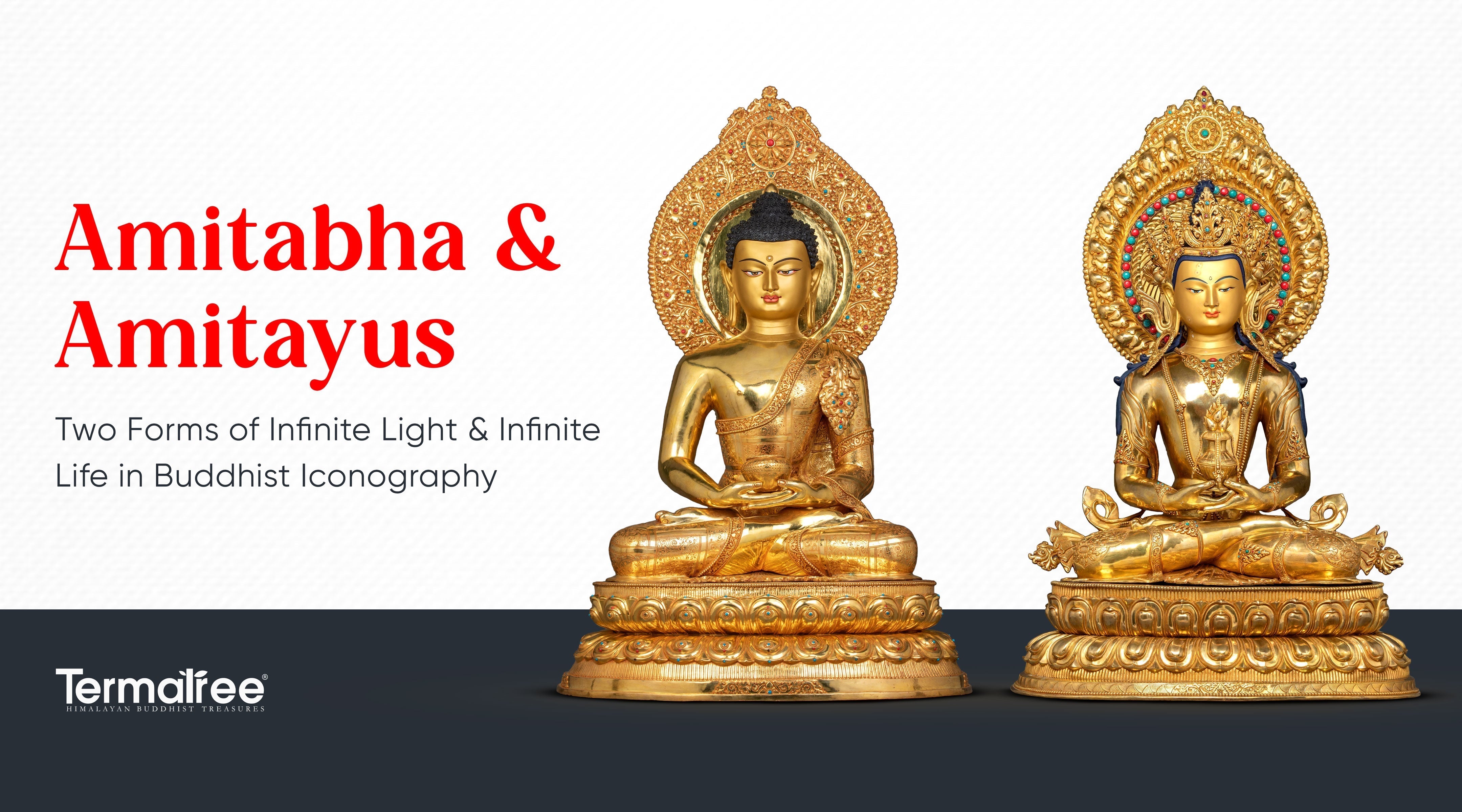
Amitabha and Amitayus are understood to be the same person, the first representing the form body and the second the apparitional body, and this single distinction accounts for nearly every visual difference between them.
-
Amitabha: Nirmanakaya, the Form Body. Amitabha is depicted as the supreme nirmanakaya Buddha, in the form of a renunciant like Shakyamuni Buddha. Accessible, monastic, and human in appearance is the Buddha as he would manifest directly in the world.
-
Amitayus: Sambhogakaya, the Enjoyment Body. Amitayus is depicted in the form of sambhogakaya, with iconography that includes the thirteen ornaments of that celestial body, princely, crowned, and radiant. The same being is manifest for the benefit of advanced practitioners in meditative vision.
The Iconography: How to Tell Them Apart
|
Feature |
Amitabha |
Amitayus |
|
Overall appearance |
Buddha appearance: the unadorned form of an enlightened renunciant |
Bodhisattva appearance: ornamented and regal |
|
Robes |
Traditional monk's robes |
Clothing and jeweled ornaments of a peaceful heavenly deity |
|
Crown & jewels |
Bare head; no crown or jeweled ornamentation |
Crowned and adorned with the full set of sambhogakaya ornaments |
|
Hand implement |
Alms bowl held in the lap with both hands |
Long-life vase held in the lap, filled with the nectar of immortality |
|
Color |
Red, associated with the setting sun and the western direction |
Body red in color, one face, two hands, eyes gazing with compassion |
|
Primary association |
Infinite Light; founder of Sukhāvatī, the Pure Land |
Infinite Life; longevity, vitality, and healing practices |
Amitabha: The Buddha of Infinite Light

Amitabha, meaning "Limitless Light" in Sanskrit, embodies infinite light that radiates throughout the cosmos, symbolizing wisdom. His light is said to eliminate the defilements of any conscious being it touches, establishing him as one of the most compassionate figures in Mahayana Buddhism. He is central to two key Mahayana texts: the Sutra of Measureless Life and the Amitābha Sutra.
According to the text, Amitabha established Sukhāvatī, a pure land of peace where faithful beings can be reborn and attain enlightenment, stemming from his forty-eight vows as the bodhisattva Dharmakaya. Sukhāvatī, associated with the West and symbolizing life’s end, is linked to Amitabha’s color, red. Shakyamuni Buddha taught that focusing on Amitabha, especially by chanting his name at death, aids in rebirth in this Paradise, fostering a significant devotional movement in Buddhism. The recitation of Amitabha's name, known as "nianfo" in Chinese and "nembutsu" in Japanese, is central to Pure Land Buddhism, emphasizing simplicity and continuous remembrance.
Amitayus: The Buddha of Infinite Life

Where Amitabha governs the path toward death and rebirth in the Pure Land, Amitayus governs the conditions of life itself. He is referred to in Mahayana sutra literature, is a popular meditational deity in Vajrayana Buddhism in his own right, distinct in practice even while doctrinally identical in essence to Amitabha.
Amitayus is regarded as the sambhogakaya, or enjoyment body, form of Amitabha, the compassionate manifestation of his infinite light transformed into life energy. One Tibetan teacher's explanation, recorded in contemporary Buddhist discussion, offers a striking interpretive key: one of the sambhogakaya carries among its defining certainties is the certainty of time, meaning it persists without manifesting birth and death, embodying limitless life. Only when a practitioner has fully come to terms with death, comfortable in its presence, can life in its fullest sense be approached. His connection to death and his connection to life are not opposites in this reading but two stages of the same realization.
The Long-Life Trinity

Amitayus is most often invoked alongside White Tara and Ushnishavijaya, forming a triad of deities dedicated to longevity and spiritual vitality. Tantric practitioners across the Himalayan world, including Rechungpa, the celebrated student of the great yogi Milarepa, received specialized transmission lineages devoted to the practice of Amitayus, a tradition that continues through unbroken lineages to the present day.
Amitayus practice centers on his mantra, "Om Amarani Jiwantiye Soha," recited to extend life, increase vitality, and purify accumulated negative karma. The long-life vase he is holding, overflowing with the nectar of immortality, is not only a decorative item but also is the main emblem of the practice itself and a pictorial assurance that the conditions for a continued spiritual cultivation and sustained life can be summoned by devotion to this form.
The Lotus Family: Where Both Forms Belong

Amitabha, as the "Buddha of Infinite Light," is the head of the Lotus Family (Padma Kula), one of the five Buddha families in Mahayana and Vajrayana Buddhism. He embodies qualities of love, compassion, and devotion; his radiance is believed to cut through the darkness of ignorance across all realms. As head of this family, he is closely linked to some of the most beloved figures in the Buddhist pantheon.
Amitabha is understood to have manifested himself both as the historical Buddha Shakyamuni and as the bodhisattva Avalokiteshvara, the embodiment of compassion, known across Asia as Guanyin, Chenrezig, and Kannon. He is frequently depicted with two principal attendants: Avalokiteshvara Bodhisattva to his left and Mahasthamaprapta Bodhisattva to his right, forming the central triad of Sukhāvatī iconography found throughout East Asian and Himalayan Pure Land art.
A brief reference table for the family as a whole:
-
Family (Padma): One of the Five Buddhas Families of the mandala, associated with the western direction and the qualities of discernment and compassionate attraction
-
West Direction: The direction of the setting sun, traditionally associated with the passage from life into death and rebirth
-
Red Color: Representing magnetizing power and the warmth of compassion
-
Pure Land (Sukhāvatī): In Tibetan established through forty-eight vows fulfilled over countless lifetimes
-
Spiritual Son: Avalokiteshvara, bodhisattva of compassion, frequently shown bearing a small image of Amitabha in his crown
A Duality Beyond Buddhism

The text states that Amitabha created Sukhāvatī, a pure land of peace where the faithful can be reborn and attain nirvana from his forty-eight vows as bodhisattva Dharmakara. Sukhāvatī is associated with the west and means the end of life and is related to the color red of Amitabha Buddha. Shakyamuni Buddha taught that contemplation of Amitabha (particularly chanting his name at the time of death) helps in rebirth in this Paradise, leading to a great devotion movement in Buddhism. Central to Pure Land Buddhism is the recitation of his name, which in Chinese is referred to as "nianfo" and in Japanese "nembutsu": it is simple and is about constant remembrance.
How contemplative traditions address the limitations of a single image to represent an enlightened mind. It reminds us that there are many elements that one shape cannot contain, for example, compassion and majesty. Rather than a single icon, Himalayan art uses many representations, relying upon the assumption that those various expressions refer to the same thing, such as how both an alms bowl and a jeweled vase are forms of the same object.
Why Two Forms Were Necessary
The existence of Amitabha and Amitayus as distinct iconographic forms is not an accident of artistic variation; it reflects a precise theological purpose. The nirmanakaya form of Amitabha communicates accessibility: this is a being any devotee, regardless of their level of practice, can call upon through simple recitation at any moment, especially the moment of death. The sambhogakaya form of Amitayus communicates a different register entirely, a celestial visualization reserved for tantric practice, invoked specifically when the goal is the extension and protection of life, rather than the navigation of its end.
Together, the two forms span the entire arc of human concern: how to live well and how to die well. A practitioner who fears illness or seeks longevity turns to Amitayus and the long-life vase. A practitioner contemplating mortality, or accompanying someone through their final hours, turns to Amitabha and the promise of Sukhāvatī. Neither form is complete without implying the other, which is precisely the point. Infinite light and infinite life are not two different blessings. They are one blessing, named twice, so that it might be approached from wherever a person currently stands.