Understand as Sacred Supports for Mindfulness, Devotion, Meditation, Wisdom, and the Path Toward Awakening
Buddhism is not a religion built on belief in a creator god. It is a tradition built on practice and the disciplined training of attention, ethics, and understanding, directed toward the liberation of the mind from suffering. The Buddha was not a divine being who demands veneration; he was a human being who achieved awakening and spent the reminder of his life teaching others how to do the same. This foundational point matters enormously when trying to understand what a Buddhist statue actually is, what role it plays in practice, and why calling it an "idol" misses the point almost entirely.
Buddhist Statues Are Symbols of Enlightened Qualities

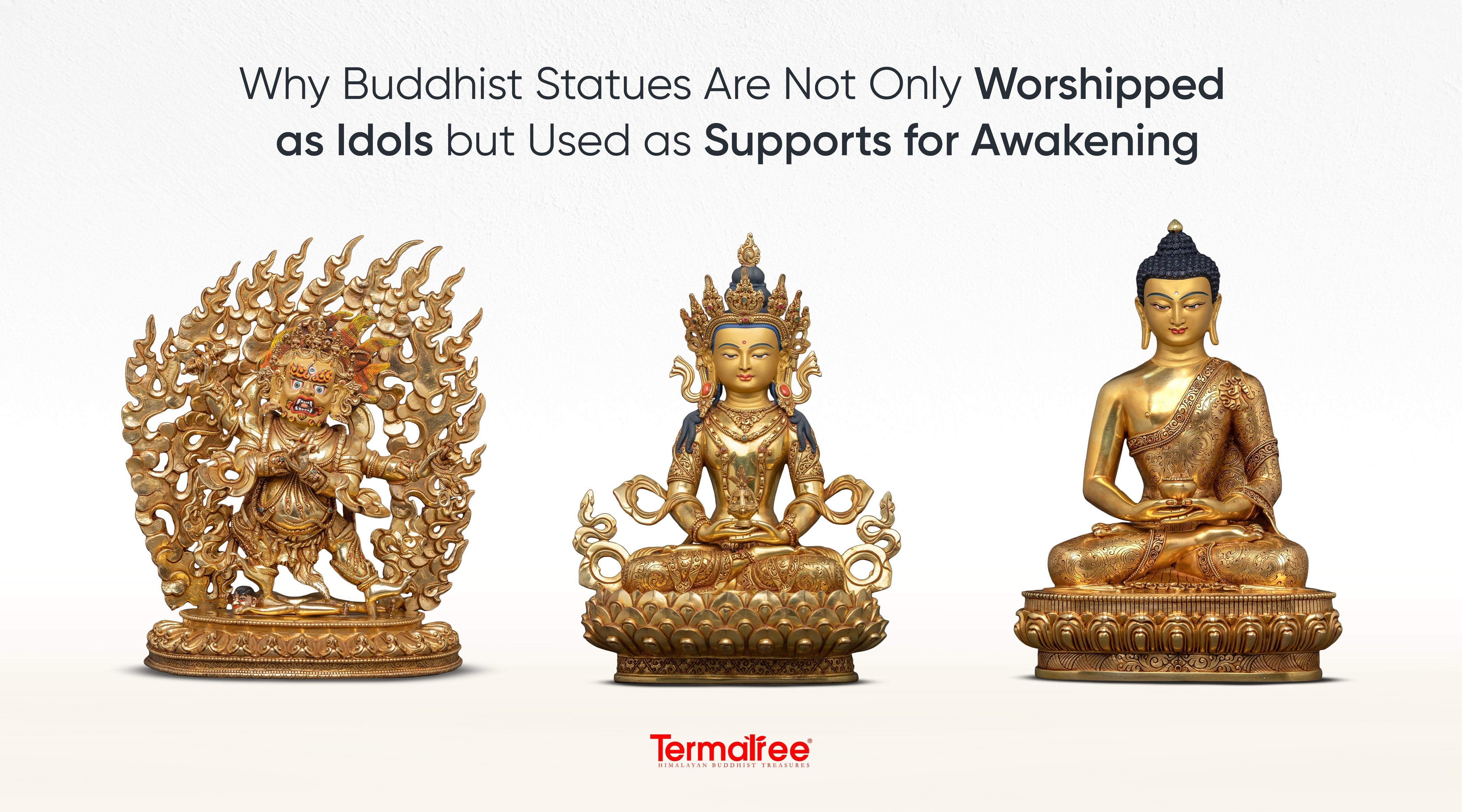
A Buddhist statue derives its significance not from its material composition in copper, bronze, clay, stone, wood, silver, or gold, but from the symbolism it embodies. Each aspect, including facial expression, hand position, body posture, ornaments, lotus base, and held objects, conveys spiritual messages. The Shakyamuni Buddha statue is an example of a statue that represents the Buddha in meditation, holding the earth-touching mudra, which signifies his enlightenment under the Bodhi tree, symbolizing determination and awakening. Similarly, other statues such as Medicine Buddha emphasize healing of physical and mental difficulties; Amitayus stands for long life and wisdom, Green Tara for compassion, and Manjushri for wisdom that dispels ignorance. These statues, in their sculptural forms, give silent lessons and teach profound Dharma without words.
Not Idol Worship, but Mind Training
Within the Buddhist tradition, confusion sometimes occurs about the nature of the statues, which are not images that are to be worshipped, but rather supports for spiritual development. Bowing in front of a Buddha statue is a gesture of humility and is a way to reduce the sense of self and ego, as well as negative emotions, and to remember that enlightenment goes beyond one's attachments and negative emotions. In the same way, gifts given to statues, whether flowers, candles, lamps, incense, or water, have great significance: flowers remind us of impermanence, candles are for wisdom, which dispels ignorance; incense is for discipline and purity, and water offerings are for generosity and clarity. These external practices are meant to lead to an internal change, cultivating virtues like generosity, mindful presence, devotion, and wisdom in the practitioner.
The Statue as a Mirror of the Mind
 The Buddhist statue displays a balanced, peaceful, and calm expression not just through artistry but through awakened thought. Half-closed eyes represent meditation and awareness, the balance between quietness and compassionate awareness. By placing practitioners in front of it, the statue becomes a mirror, a way to reflect on oneself and reveal the inner peace that is lost in stress, anger, fear, or confusion.
The mind is often scattered; in everyday life, it may wander in the past and worry about the future. Buddhist statues create a sacred focus point to encourage people to pause, breathe, and reawaken their awareness. They occupy a key role in meditation rooms, shrines, monasteries, and houses and create the atmosphere that is conducive to calming the mind. A statue may not wake a person on its own, but it can facilitate the conditions so that the person can be awakened on their own.
Sacred Iconography: Every Detail Has Meaning
The statues of Buddha are made in accordance with the iconographic tradition. The body proportions, facial expression, hand gestures, ornaments, posture, and symbolic objects are not arbitrary. Involved in sacred art traditions that have been passed down from generation to generation. One of the most frequent symbols in Buddhist art is the lotus base. A lotus is born in muddy water, but it does not get dirt on it. This is the spiritual way. Enlightenment rises above the mud without being stained by the mud, just as the flower of the lotus grows above the mud.
The hand gestures (mudras) are also richly symbolic. The mudra in meditation symbolizes focus and calmness. Teaching is known as the Dharmachakra mudra (the gesture of turning of the wheel of Dharma). “The fearlessness mudra is an offering of protection and courage.” The boon-giving mudra is a symbol of compassion and generosity. Every gesture conveys a different element of the awakened path. The statues of wrathful deities can be ferocious, but they are not evil. Their flames and weapons represent how they are able to destroy ignorance, ego, and obstacles with great force, as do their skull ornaments and their powerful expressions. Their wrath is not like any other anger. It is keen compassion, the power that penetrates the fog and saves the Dharma. Buddhist statues can be seen as iconographic texts. They share their teachings via shape, hue, movement, and being.
Devotion and Wisdom Work Together

Buddhism sees devotion as an aid to wisdom and not the replacement. This reverence for images of enlightened beings, like Buddha or Bodhisattva statues, can inspire and melt away pride and help to motivate. But devotion is not enough; it is necessary to go hand-in-hand with understanding, meditation, ethical living, and insight. Buddhist statues are there to remind us, not to solve our problems, and we get the liberation we seek through our own practice and effort, not through belief. For example, sitting in front of a Chenrezig statue during meditation helps to develop the path of compassion, and sitting in front of Manjushri helps to develop the path of wisdom. Likewise, invoking the name of Green Tara brings forth courage, and the Medicine Buddha's image means a pledge to heal and to reduce suffering. Finally, there is a mind-level shift that takes place within the practitioner, and this is what constitutes true transformation, and the statues help to lead the practitioner on the path.
Supports for Meditation and Visualization
-
In Vajrayana Buddhism, statues are used as tools for visualization, with the aim of meditating on the Goddess as an expression of an enlightened mind.
-
Focused visualization is achieved with these deities symbolizing wisdom, compassion, protection, or healing.
-
Practitioners are taught to see that the divine attributes are not of a divine person but are their own.
-
The statue is a means to help make these qualities visible and accessible.
-
For instance:
- Meditating on Medicine Buddha involves visualizing blue healing light to
remove suffering and ignorance.
- Focusing on Vajrasattva emphasizes purification and cleansing of
negative karma.
- Meditating on Tara connects practitioners with fearless compassion and
swift responses to suffering.
-
Statues are mediators between the outside and the inside.
The Role of Consecration and Sacred Presence

In various Buddhist cultures, statues are consecrated before their use in practicing or mounting them on an altar. Consecration is a ritual process in which prayers, mantras, and blessings are invoked to make the statue a sacred support. In Tibetan Buddhism, statues may also be filled with mantras, relics, herbs, precious substances, or sacred texts before consecration. This does not mean the material object becomes a creator god. Rather, the statue becomes a properly prepared vessel for spiritual practice. It is treated with respect since it symbolizes the enlightened body, speech, and mind of Buddha or a deity.
That is why Buddhist people treat statues with care, set them out with care, and do not place them directly on the ground. The reverence towards the statue is also the practice of training the mind to treat the Dharma, the teacher, and the path to awakening with reverence.
Buddhist Statues in the Home and Shrine
Buddhist statues are often placed on home altars, meditation rooms, or quiet corners, creating a sacred space for meditation and prayer. These statues are not only practical for use in a spiritual context, but they also add a sense of calm and beauty to any space, even for those who are not religious. It is important, though, to place statues with the necessary respect and tradition on a clean raised surface, not on the ground, not in toilets, and not in a hastily prepared setting for decoration. Maybe an organized altar with a statue or offering bowls, flowers, lamps, or incense is a good focus for contemplation. It is not intended for people to see the statue as a display of their spiritual identity but to help them remember who they are on the inside: patient, compassionate, mindful, and peaceful.
Art, Craftsmanship, and Spiritual Intention

Buddhist statues, particularly those created in traditional Himalayan and Tibetan styles, are not just beautiful works of art but also embody a certain spiritual purpose. Sometimes, highly trained artisans practice traditional metalwork techniques, sculpting, gilding, engraving, and painting. Statue making is a revered art that is handed down from generation to generation in some areas such as the Kathmandu Valley and Patan in Nepal. The crafting of a Buddhist statue involves more than just technique. It's also a devotional practice. Artists should familiarize themselves with iconography, proportions of the figure and symbol, and the spiritual meaning of the deity. The face should be calm and relaxed. The posture should display balance. The ornaments have to have symbolic value. The finished statue should be inspiring.
Hence, the reason why handmade Buddhist statues are not only valued as art pieces but also as spiritual supports. They are the bearers of the devotion of the maker and the meaning of the tradition.
Why the Word “Idol” Does Not Fully Explain Buddhist Practice
The term "idol" generally means the worship of material things, which is not what is meant in Buddhism. Buddhism can be summarized as a philosophy of statues that lead its practitioners, not a representation of the ultimate truth. They are like maps or photographs, and they evoke memories and associations rather than being a destination or a person. The potential risk lies not in having sacred images but in overlooking their significance. When treated merely as decorations or magical artifacts, their deeper purpose is obscured. But when understood as a tool to help awaken, they are valuable reminders of the Dharma.
Conclusion: The Statue Is a Reminder of the Path
Buddhist statues are a sacred support for awakening, representing the message of the Buddha, which stands out as the highest spiritual teaching, and the possibility of attaining enlightenment. The calmness in their faces brings about a peaceful atmosphere; the mudras are to invoke wisdom and compassion, and the lotus seats represent purity. These statues are located in different spiritual places and serve as a reminder for practitioners to consider the foundations of spiritual practice and live mindfully. Bowing to a statue is bowing to a property, not the material, but the qualities of awakening; it reminds a person that peace comes from within. The statue is symbolic of the path of spiritual growth and development and is a call to return to the practice of mindfulness, compassion, and wisdom.