The Wrathful Power That Transforms Obstacles into Wisdom
In the world of Vajrayana Buddhism, wrathful deities have a special place and are highly symbolic. The ferocity is not anger or violence, but rather a manifestation of enlightened compassion, shining with unyielding light, dispelling obstacles, and safeguarding sentient beings. There are many strong and enlightened protectors among these; Bhutadamara Vajrapani is one of the most formidable and spiritually meaningful of the protectors.
Bhutadamara Vajrapani is the wrathful aspect of Vajrapani, the Bodhisattva and protector of the enlightened power of all the Buddhas. He is believed to be sacred to the tantric Buddhist practices of the religious tradition and is said to be particularly effective in combating the harmful spirits, negating internal and external obstacles, and transforming negative energies into wisdom. His presence is fearless compassion and a winning power of the awakened mind.
Who is Bhutadamara Vajrapani?

The name “Bhutadamara” can be understood as “Subduer of Spirits” or “Tamer of Harmful Forces.” The word "bhuta" refers to spirits, invisible beings, or obstructive forces, while "damara" means to tame, control, or subdue. He is not considered a separate deity from Vajrapani but a wrathful tantric manifestation that expresses Vajrapani’s enlightened activity in its most active and forceful form. Vajrapani himself is one of the most important bodhisattvas in Mahayana and Vajrayana Buddhism and is traditionally known as the protector and holder of Buddha’s teachings. Alongside Avalokiteshvara, who represents compassion, and Manjushri, who represents wisdom, Vajrapani represents enlightened power.
Origin of Bhutadamara Vajrapani
The origins of Bhutadamara Vajrapani are rooted in the esoteric traditions of Vajrayana Buddhism, particularly within the tantric systems associated with Vajrapani and higher yoga practices. Vajrapani himself appears throughout Buddhist literature as the embodiment of the enlightened power of all Buddhas and serves as one of the earliest and most important protector figures in Buddhist tradition. The figure of Vajrapani was depicted as a protector of Buddha and keeper of sacred knowledge in early Buddhist stories and later evolved into many peaceful and wrathful forms in the Mahayana and Vajrayana traditions.
One of these Avidharma-Tantrikas, who inhibits obstructions, spirits, and evil influences, is him. The name itself is a combination of "bhuta," spirits, unseen entities, and "damara," meaning tame, conquer, or overcome. He is not a war of destruction, as is often interpreted; it is a process of transformation, making the chaotic and harmful forces into those that facilitate awakening.
In Vajrayana practice, Bhutadamara is related to enlightened activities and protective rituals that clear visible and invisible obstacles. These barriers are believed to be external disturbances as well as internal factors like ignorance, attachment, fear, anger, and confusion. Through this symbolism, he became an important deity representing courage, purification, and the active force necessary to progress on the spiritual path.
Iconography of Bhutadamara Vajrapani
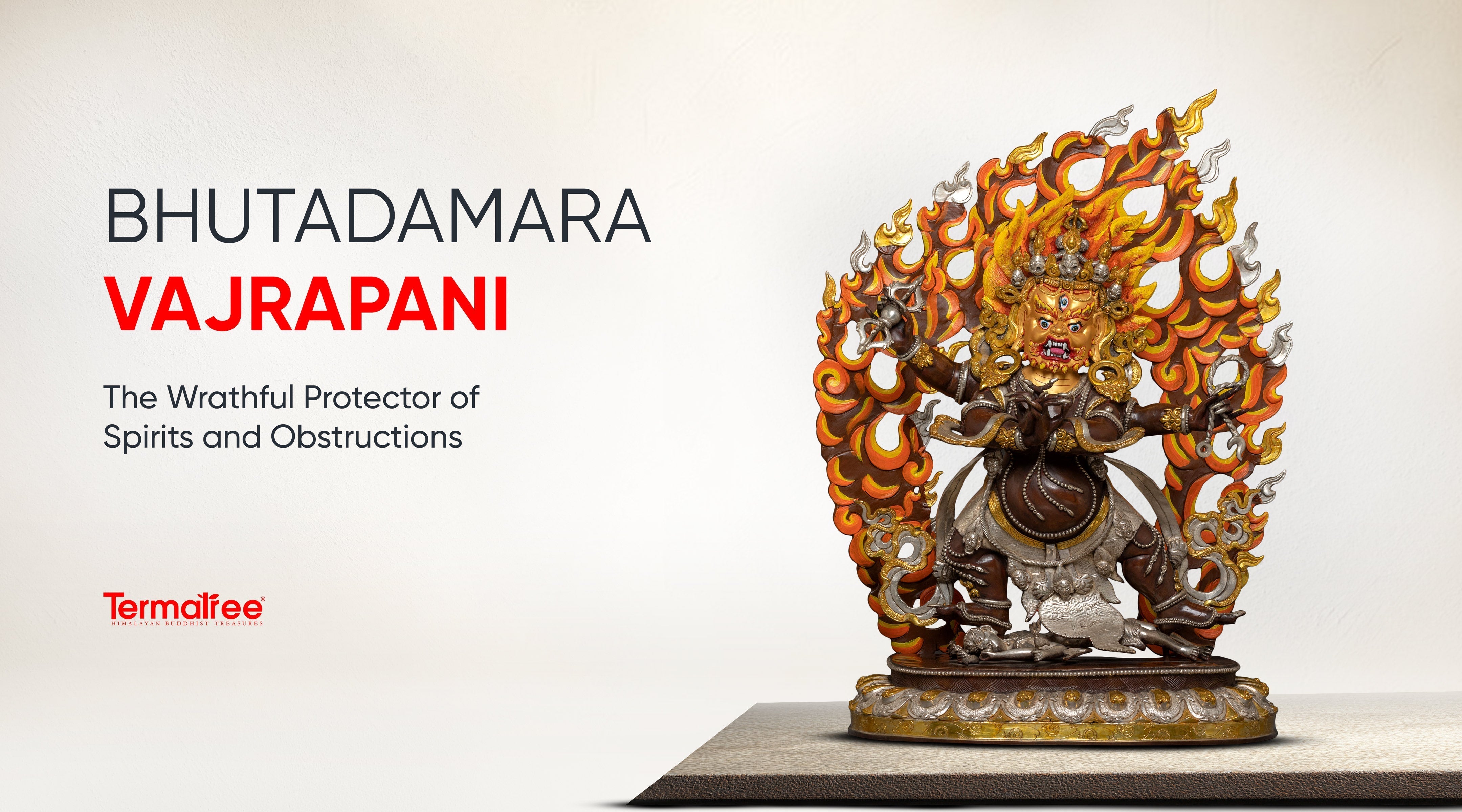
His iconography is powerful, dynamic, and filled with symbolic meaning. Every element of his appearance communicates enlightened qualities and serves as a visual teaching rather than a representation of ordinary wrath.
Wrathful Expression and Gaze

Represented with a fierce expression on their faces, huge eyes, and an intense gaze. His face represents enlightened compassion in a strong, powerful form to eradicate ignorance and safeguard practitioners. This wrath is not anger but activated energy that strives with the decision to overcome suffering and confusion.
Four Arms
Generally depicted with four arms, representing the capacity of enlightened power to operate in several dimensions simultaneously. Each arm and gesture carries ritual and symbolic significance.
His attributes include:

-
Upper Right Hand: Holds an open blue vajra, which represents indestructible wisdom and enlightened force.

-
Upper Left Hand: Carries a vajra lasso that contains energies that bind and subdue obstructive and harmful energies.

-
Two Main Hands: Make the mudra to subdue the demons, near the heart, which represents mastery over obstacles in the inner and outer worlds.
Alidasana or Dancing Posture
Bhutadamara is usually depicted in a dynamic posture or standing with a strong, dancing stance. This dynamic attitude embodies the constant activity of enlightened action and the immediate response of meeting suffering beings with compassion. Unlike peaceful deities seated in meditation, his movement reflects active transformation and fearless engagement.
Crown of Five Skulls
Many wrathful forms wear a crown composed of five skulls. These symbolize the transformation of the five mental poisons.
- Ignorance → Dharmadhatu Wisdom
- Anger → Mirror-like Wisdom
- Pride → Wisdom of Equality
- Attachment → Discriminating Wisdom
- Jealousy → All-Accomplishing Wisdom
into the five transcendental wisdoms. Rather than eliminating human emotions, the symbolism teaches their transformation into enlightened qualities.
Flaming Aureole

Often surrounded by blazing flames that represent wisdom fire. These flames will eat up ignorance, burn away obstacles, and cleanse negative conditions. The fire does not destroy beings but transforms obscurations into spiritual clarity.
Ornaments and Sacred Adornments
Embellished with bone decorations, a serpent, and symbolic decorations. But wisdom is the key to victory, the sublimation of negativity, and the answer to adversity with wisdom. His symbolism survives, inspiring practitioners and fans alike, a perennial reminder that growth often begins where comfort ends.
Trampling Bhuta Aparajita

One of his most distinctive iconographic features is standing upon Bhuta Aparajita, a subdued spirit figure shown beneath his feet.
The Role of Bhutadamara Vajrapani in Vajrayana Buddhism
In Vajrayana practice, wrathful deities like Bhutadamara Vajrapani are seen not as external punishers but as symbols of awakened qualities that help cut through confusion and negativity. He is crucial in overcoming the external and internal obstacles that hinder spiritual development and reminds us that enlightenment is a matter of courage. He appears to have subdued the evil spirits, and these are also a representation of the negative qualities within him, such as anger and greed. The practice related to him promotes transformation rather than destruction and challenges; it encourages confronting challenges. It is believed that he safeguards those who practice advanced spiritual techniques and is a symbol of discipline, protection, and dedication to awakening.
Spiritual Meaning of Bhutadamara Vajrapani

The essence of Bhutadamara Vajrapani is in the transformation and the courageous journey of spiritual growth. Part of human life is fear and uncertainty, emotional problems, distraction, and resistance. From a Buddhist perspective, these happenings are the “spirits” or hindrances that block the clarity and obstruct progress towards awakening.
Bhutadamara states that these obstacles must not be avoided, ignored, suppressed, or evaded. Rather, they need to be acknowledged and changed by consciousness and commitment. The fury of his appearance represents the power of wisdom to confront ignorance directly. His portrait serves as a reminder to practitioners that sometimes spiritual growth is rough, sometimes it's frightening, and sometimes it's unpleasant. His symbolism teaches practitioners to develop their inner strength, confidence, courage, stability, and compassion/wisdom. Fierce looks are a reminder that difficulty can be an opportunity for transformation.
Bhutadamara Vajrapani in Sacred Art and Practice
Bhutadamara Vajrapani statues and paintings are masterpieces in terms of iconographic accuracy and religious symbolism in the art of the Himalayas. Each gesture, decoration, posture, and facial expression is conventional and has been passed down through the ages in the course of art and spirituality. These sacred icons are typically installed in meditation rooms, home shrines, spaces for prayer and religious communities, and within monasteries, as well as in religious collections. They are meant to arouse determination, concentration, and recollection of good qualities.
In the practitioner's experience, sacred images serve as visual aids in the process of contemplation and devotion. They are not just decorative items; they are a visualization of awakened qualities in which practitioners aspire to develop themselves. He is also popular with collectors and admirers of Himalayan sacred art, both for its dramatic quality of energy and its detailed craftsmanship and rich symbolic meanings. His images are not only artfully mastered; they also contain deep spiritual teachings.
Why Bhutadamara Vajrapani Remains Relevant Today

Bhutadamara comes from ancient Buddhist traditions, his symbolism is pertinent for modern life. Today's challenges are not necessarily forms of spiritual or unseen forces but are still manifested as stress, anxiety, exhaustion, distractions, uncertainties, or inner conflict. He is a symbol of steadfastness and bravery amidst such challenges. His wisdom teaches us how to be resilient, yet compassionate and clear.
Today's spiritual seekers find Bhutadamara to be a remarkable example of the fact that there is no such thing as strength through aggression and protection through domination. Rather, wisdom is the key to victory, the sublimation of negativity, and the answer to adversity with wisdom. His symbolism survives, inspiring practitioners and fans alike, a perennial reminder that growth often begins where comfort ends.
Conclusion
Bhutadamara Vajrapani is still one of the most powerful wrathful aspects of the Vajrayana tradition and an extraordinary form of enlightened activity. His role is to tame spirits and dispel obstacles, representing his fearlessness, steadfast spiritual power, and the power of wisdom to change lives. His fearsome appearance is a message that is ever relevant: obstacles can be opportunities, fear can be courage, even the most challenging of experiences can be a path to awakening.
From the light of Buddhist philosophy to sacred art and meditation practice, or the spiritual symbolism, he remains a source of inspiration, protection, clarity, transformation, and empowerment for anyone willing to experience it.