The Wrathful Protector with Infinite Compassion and Power
In Vajrayana Buddhism there are many protector deities. Some are not only known for their incredible power and strength but also for their limitless compassion and benevolence. Of all of these, the 1000-armed Dukar is one of the most powerful and fearsome figures. This god is the synthesis of limitless skillful ways and unflagging commitment to the protection and welfare of sentient beings.
1000-Armed Dukar, is the protector of wrathfulness and compassion, who subjugates negative forces, protects the spiritual path, and empowers practitioners to overcome obstacles with courage and wisdom. In Vajrayana, she embodies the miraculous union of power and compassion in enlightened protection not just defense but also guidance and transformation.
Who is 1000-Armed Dukar?

Dukar means ‘protector’ or ‘guardian’, with ‘1000-armed’ underscores the deity’s infinite ability to act in countless ways for the wellbeing of all beings. Both arms represent the limitless methods used to safeguard practitioners, to demolish obstacles, and to help sentient beings attain spiritual liberation.
Wrathful manifestation 1000-Armed Dukar is a wrathful manifestation which, unlike ordinary wraths, is a powerful expression of enlightened compassion. Each position, weapon and quality is holds with symbolic meaning, deity’s commitment to dispelling negative mental states and serving as a spiritual guide for the practitioner.
Origin and Spiritual Lineage of 1000-Armed Dukar
1000-Armed Dukar is rooted in esoteric Vajrayana Buddhist traditions, especially tantric practices involving protector deities. Classical Vajrayana texts describe Dukar as embodying the union of enlightened energy and compassionate intention to confront and surpass obstacles to enlightenment.
Historically, practices of 1000-Armed Dukar have been associated with monastic communities, advanced tantric practitioners, and ceremonies that seek protective blessings. She is also associated with the transmission of spiritual lineages, which helps to safeguard the teachings and ensure that the practitioners are safety. His wrathful image has come to dominate Himalayan Buddhist art and culture, and she has also become a power to be believed with for his boundless ability to act for the benefit of living beings. In her worship, she highlights the virtues of courage, perseverance and steadfastness in the spiritual journey.
Iconography of 1000-Armed Dukar

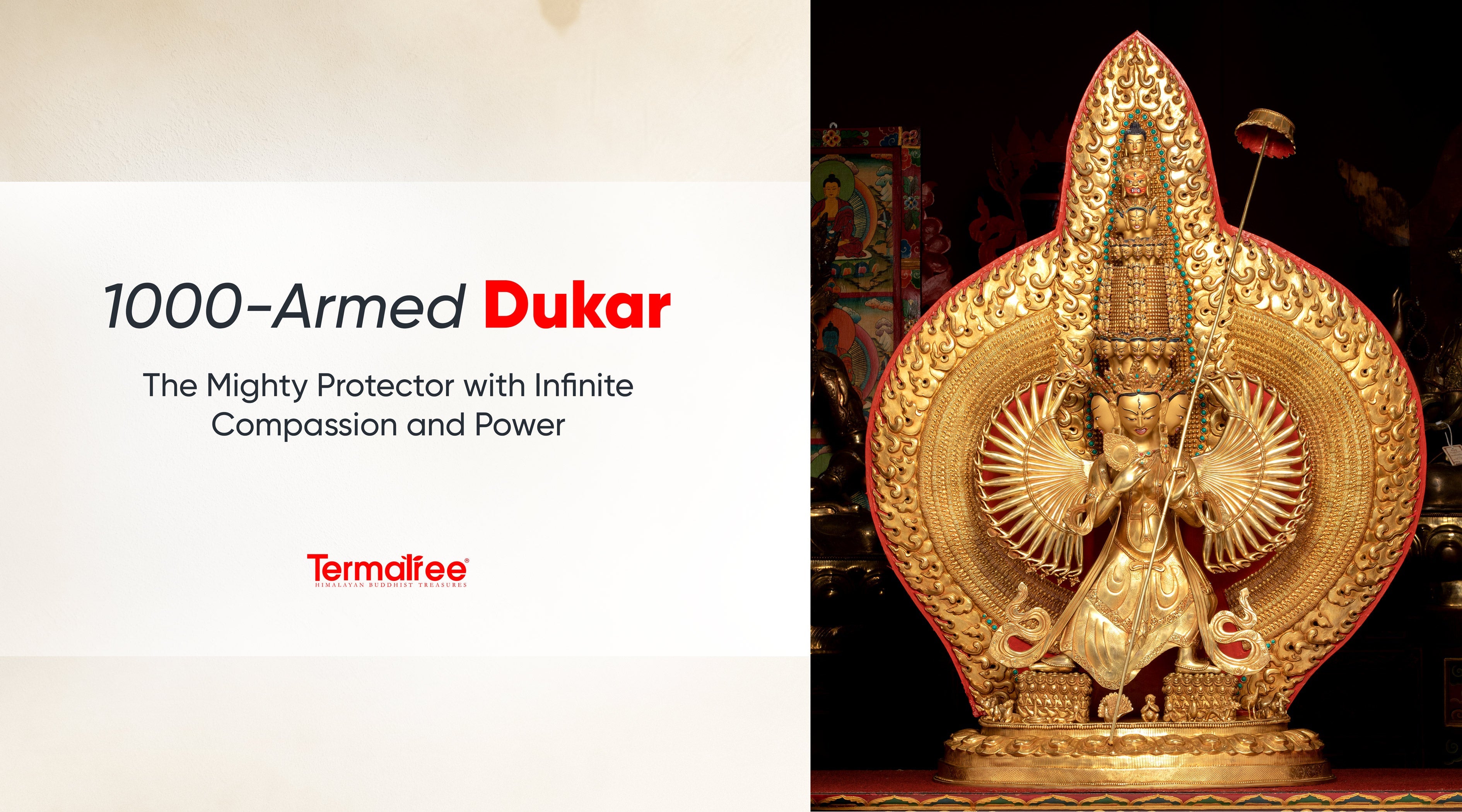
The representation of 1000-Armed Dukar has symbolism and is intended to depict his countless abilities. The iconography conveys his protective, transformative, and compassionate nature:
One Wrathful Face:
The 1000-armed Dukar has an intense, focused, and greater compassion on a single face. The wide, staring eyes shows his predicament of all living things of the past, present and future. Her bare fangs show his determination to challenge ignorance and negative influences. The general attitude of the expression indicates that challenges are to be faced head-on and that spiritual support is sometimes a matter of being decisive and courageous. The statue is a reminder that wrathful energy can be manifested as enlightened compassion in action.
1000 Arms:

The thousand arms have symbolic significance, representing the infinite number of skillful means that protect, guide and help sentient beings. Some of the arms hold weapons, which are metaphors for cutting through negative emotions, attachments, and ignorance. The other arms are open in the mudras of blessing, teaching, or protection, which means the capacity to heal, empower, and give guidance at the same time. Collectively, the arms reflect the boundless capacity of enlightened activity; Dukar can act in infinite ways to help beings wherever they are.
Weapons and Ritual Implements:

Common implements include the white parasol and mirror. The white parasol symbolizes the ultimate refuge, and a protection from harm for practitioners. The mirror symbolizes clarity, self-reflection, recognition and transformation of inner obstacles. These tools connects,1000-Armed his defense is wisdom, insight, and compassionate guidance.
Crown of Skulls:
The five skulls symbolize the removal of the five mental poisons and their transmutation into the five transcendental wisdoms and are often placed on the head of Dukar. The crown invites us to identify these feelings as potentials to be cultivated and developed into spiritual virtues. It reminds the practitioners of the power, even for the worst of emotions, to become an instrument of wisdom when viewed with enlightened awareness.
Flaming Aureole:

This fire destroys the ignorance and negativity that cause the obstacles to spiritual development. The flames are also a symbol of the intensity and clarity of enlightened awareness, and help practitioners to remember that spiritual energy is not passive; it actively lights up and transforms conditions. The fiery aura expresses both protection and purification at the same time.
Trampling of Negative Forces:

Dukar is portrayed standing on the obstructing spirits or negative energies which symbolizes, the overcoming of external and internal obstacles. The conquered figures represent ignorance, fear and negative patterns being transformed, but made the conditions for spiritual development, while obstacles can be overcome and spiritual growth is possible. It tells that strength is not by brute force but by mastery and transformation.
The Three Heads

The three heads with 1000 arms symbolize his total knowledge and safeguarding energy. The top head is tranquil and calm, representing an enlightened compassion and compassionate guidance and blessing for all. The middle head is wrathful, it symbolizes the power to face and change obstacles, negative energies and ignorance, and it protects the Dharma. The four lower faces face in various directions, representing omniscience, vigilance and the ability to see and act on suffering in the worlds, the all-pervasive activity and skillful means of the deity.
Dynamic Posture:
The energetic posture of the figure, whether dancing, shows an interaction with the spiritual and worldly trials of sentient beings. Peaceful deities in contemplative poses differ from those that interact with the world, such as the god of the earth. Her movement illustrates how enlightened compassion is an active force how it is determined and takes effort to protect and transform. The dynamic posture is a lesson for practitioners to take an active stance to obstacles, rather than avoiding them.
Every aspect of Dukar's form is thoughtfully designed to convey a teaching: true protection comes from compassionate action, wisdom, and the use of skillful means.
1000-Armed Dukar is a Form of Sitatapatra:

In Tibetan Buddhism, 1000‐armed Dukar is a wrathful form and very protective of Sitātapatrā, the White Parasol goddess, whose Sanskrit name translates as white parasol or white umbrella protector. Sitātapatrā is a bodhisattva and guardian deity that rose from the crown of the Buddha to guard the Dharma and practitioners from harmful influences, supernatural dangers and deep-rooted obstacles. In all her fullness, she appears with a thousand faces, ten thousand arms and ten thousand feet, representing the all-knowing awareness, and the limitless capacity to attend to the needs of all. The white parasol she carries is a symbol of ultimate refuge and Divine protection, and the many arms she carries indicate many forms of activity through which she can conquer negative influences and protect her spiritual progress. In this complex form the unity of wisdom and protection in Vajrayana practice is emphasized, as well as her status as a fierce yet compassionate guardian, who transforms obstacles into conditions for awakening.
Read More: Two Major Forms of Dukkar: Sitatapatra
Spiritual Significance of 1000-Armed Dukar
The spiritual essence of 1000-Armed Dukar, draw out difficulties from life as opportunities to grow spiritually. According to Vajrayana symbolism, every obstacle in human life, fear, ignorance, attachment, anger, and suffering, is depicted as an obstruction or a negative energy. These forces are not enemies to be destroyed but conditions to be transformed skillfully by awareness and disciplined practice. She shows that the power to overcome challenges is rooted in courage, compassion, and wisdom.
Meditating on 1000-Armed Dukar, practitioners develop the courage to deal with their fears, patience to conquer their internal and external obstacles, compassion for themselves and others, discipline, and focus in spiritual practice. The thousand arms represent infinite skillful means, and it means that compassionate action can take infinite forms to reduce suffering and bring about beneficial results. Every challenge faced is then a chance for awakening when approached with determination and conscious awareness.
1000-Armed Dukar in Sacred Art and Practice

In the traditions of the Himalayan Buddhist religion, artists portray the 1000-armed Dukar in a thangka painting with great care. His fierce face, crown, flames of wisdom, and the arrangement of his thousand arms with their symbolic objects or protective mudras are carefully depicted by artists. These thangkas are not just decorative; they can also be used as visual aids for meditation and contemplation. They are housed in monasteries, private shrines or spiritual collections where they serve as reminders of courage, compassion and the power of enlightenment to protect. Thangka visualizations are frequently employed during meditation to concentrate on the energy of the deity to develop resilience, clarity and compassionate action. In meditation practice thangkas are frequently used to concentrate on the energy of the deity, helping to create resilience, clarity and compassionate action.
The statues of 1000-Armed Dukar are three dimensional and the devotees can interact with him physically and ritually. Sculptors note the gestures of arms, ornaments and facial features and the dynamic posture to represent caring activity, strength, and protection. They are usually set on a pedestal or in a shrine in a prayer space or meditation room, and are employed in rituals like offerings, chanting mantra and using a vajra or other sacred objects. By meditating on the statue, one can train the mind, embody the attributes of the deity, and internalize the spiritual messages that the statue symbolizes: the wrathful yet compassionate nature of Dukar.
Why 1000-Armed Dukar Remains Relevant Today
Today, there are many different kinds of challenges, tensions, emotional difficulties, unknowns, and diversions that come our way. The “spirits” subdued by the symbolic “Dukar” are not necessarily literal in modern experience, but his teachings are quite relevant. She encourages practitioners to face difficulties bravely and change them with mindfulness and wisdom.
In 1000-Armed Dukar, participants learn to develop resilience, compassionate engagement, and clarity in decision-making. The images she conveys are not images of strength and aggression but images of action, ethical awareness, and a serious commitment to the good of oneself and others. Contemporary use of invoking Dukar includes ritual practice or meditation, which helps people to deal with their personal problems and to develop inner courage and transformative insight.
Conclusion
The 1000-Armed Dukar is an amazing manifestation of limitless compassion and limitless power. She is a fearless warrior, a master of spiritual power, and a guide that dispels negativity and removes obstacles; a symbol of courage, strength, and wisdom. Her angry and kind expression speaks a timeless message: the crossroads of life may be opportunities to grow, fear can be a source of courage, and obstacles can be the very conditions that lead to awakening. From meditation, to sacred art, to devotional practices, she continues to inspire those who seek spiritual protection, clarity and the strength to go beyond limitations.