How One Goddess of Learning Came to Be Revered Across Hinduism and Buddhism
Saraswati is one of the deities who is respected with quiet reverence in the tradition of South Asia. Before wealth, power, and fame, she represents the knowledge that many people consider the foundation of a meaningful life. Saraswati is worshipped by both the Hindus and the Buddhists, with her image and meanings different in each of the two faiths, since she is the goddess of learning, speech, music, and creative expression. In Nepal and across the Himalayan world, especially, her worship reflects a rare instance of shared devotion: a single goddess bridging two of the region's major religious traditions, invoked by students before exams, musicians before performances, and scholars before doing something new.
Who is Goddess Saraswati?

Sanskrit words in the name "Saraswati" are related to "saras" (flow), “sva” (essence), which represents knowledge and speech. The origin connects her directly to the Saraswati River, which was an ancient river and, according to some accounts, has now stopped to exist and is referred to in early Vedic literature as a source of purity, fertility, and inspiration. Throughout the very earliest Vedic context, Saraswati was also known as a river goddess, a goddess of pure, life-giving water.
Throughout the centuries, it expanded as a river carries and connects, Saraswati came to be considered the one who carries the flow of consciousness, inspiration, and eloquent speech. By the later Puranic and classical periods, she had fully transformed from a river deity into the embodiment of wisdom, learning, and the arts, a goddess invoked wherever knowledge was created, refined, or passed on. She has held ever since among scholars, artists, musicians, and spiritual practitioners.
Saraswati in Buddhism: The goddess of wisdom, learning, and Dharma
Saraswati was adopted into Buddhist tradition, where she is associated with wisdom, eloquence, memory, learning, and the protection of the Buddhist teachings themselves. She is generally understood within Buddhism as a wisdom figure who supports practitioners on the path to understanding a natural extension of themes already central to Buddhist philosophy, where the cultivation of prajna (wisdom) is considered essential alongside compassion for reaching enlightenment. Her incorporation into Buddhist practice reflects a broader historical pattern in which Buddhism, as it spread across South and Central Asia, absorbed regional deities associated with qualities the tradition already valued, reframing them within its own doctrinal context rather than discarding them.
Saraswati in Vajrayana Buddhism
In Vajrayana Buddhism, Saraswati is regarded as a wisdom deity who helps practitioners develop clarity, memory, and eloquence. Qualities are considered not only for personal realization but also for transmission of the Dharma to others. She is invoked by scholars, translators, and artists engaged in preserving or transmitting Buddhist teachings, particularly during the memorization of texts. The training of memory required in traditional monastic education. In Tibetan Buddhist tradition, she holds a particular reputation as a protector of learning and spiritual understanding, sometimes invoked before study, formal philosophical debate, as she is invoked by Hindu students before an exam a striking point of continuity between the two traditions, despite their differing doctrinal frameworks.
Saraswati in Hinduism: Goddess of knowledge, speech, and creativity
In Hindu tradition, Saraswati is revered as the goddess of knowledge (jnana), speech (vak), music, and the arts, playing a crucial role in learning and creativity. She is believed to remove ignorance (avidya) and illuminate the mind, symbolized by her dispelling darkness. Saraswati is traditionally invoked at the beginning of significant intellectual, such as the new school year, the first music lesson, or the initiation of a manuscript, emphasizing the necessity of acknowledging the source of clarity and insight. Beyond formal rituals, Saraswati's influenced daily life; many families maintain a depiction of her near study areas for children. In regions of India and Nepal, it is customary to show respect for books, considering them extensions of Saraswati, representing a cultural belief that speech, learning, and the arts possess sacred power and should be treated with divine expression.
Saraswati and Brahma: The Union of Creation and Knowledge

Saraswati is closely associated with Brahma, the creator deity in the Hindu trinity, and in various Puranic accounts is described as either his daughter, his consort, or an aspect of his creative power given independent form. Symbolically, Brahma represents the act of creation itself, the raw impulse to create something new, while Saraswati represents the knowledge and wisdom without which that creation would have no direction, structure, or meaning. Their pairing expresses a broader philosophical idea running throughout Hindu thought: that creativity and intelligence are inseparable, and that genuine creation, whether of a universe, an artwork, an invention, or an idea, requires wisdom to give it form and purpose. Without Saraswati, Brahma's creative energy would remain formless potential; with her, it becomes meaningful reality.
Saraswati and Lakshmi: Knowledge and Prosperity

Saraswati is placed alongside Lakshmi, the goddess of wealth and prosperity, as the two are often considered complementary aspects of the feminine divine, sometimes described in folk tradition as sisters who rarely dwell comfortably in the same house at once. Saraswati represents wisdom, learning, and spiritual richness, while Lakshmi represents material abundance and worldly prosperity. Their relationship carries an enduring teaching in Hindu prospective : that true and lasting prosperity depends on balancing material wealth with knowledge and wisdom, since wealth acquired without wisdom is considered unstable or even destructive, while wisdom without any material support struggles to sustain itself or benefit others. Many households and businesses in South Asia deliberately honor both goddesses together, particularly around festival seasons, precisely to avoid favoring one form of richness over the other.
Iconography of Saraswati
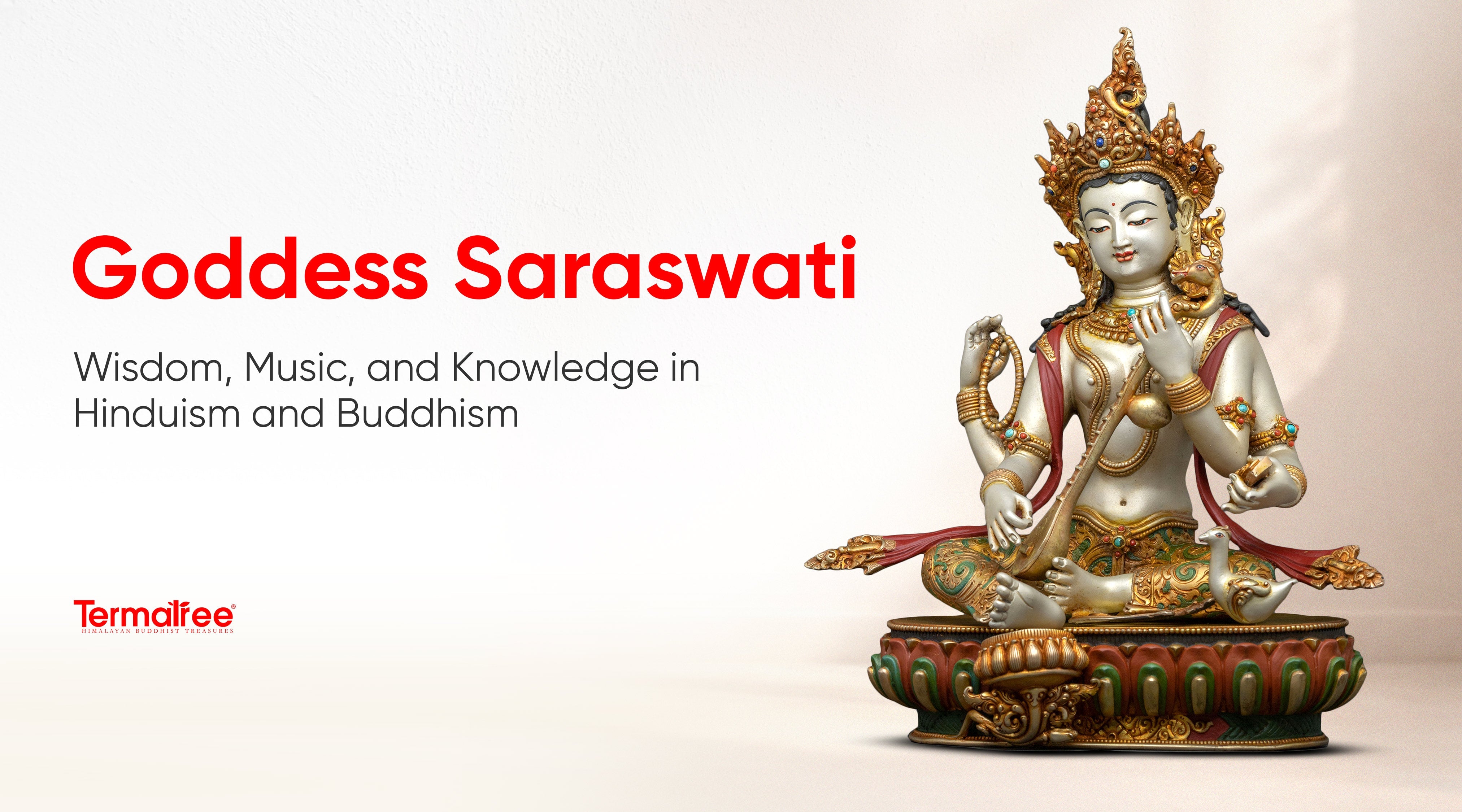
Hindu depictions of Saraswati commonly share several recognizable features, each carrying its own layer of symbolic meaning:

-
White clothing, symbolizing purity and wisdom, and often contrasted deliberately with the more colorful attire of other goddesses to emphasize her association with clarity rather than worldly abundance.
-
Four arms, representing the different aspects and dimensions of knowledge commonly interpreted as the four aspects of the human personality involved in learning: mind, intellect, alertness, and ego, or as mastery over the four Vedas.

-
A veena, representing music, harmony, and creative expression.
-
A book, representing sacred knowledge and the Vedas, often shown resting on a lotus rather than held directly, symbolizing wisdom that supports rather than burdens.
-
A prayer bead (mala) symbolizing meditation and disciplined spiritual practice.

-
A swan (hamsa), symbolizing the discernment between truth and illusion, based on a folk belief that a swan can separate milk from water when the two are mixed, a metaphor for wisdom's capacity to separate the essential from the superficial.
-
A lotus, representing purity and spiritual awakening, is often shown as her seat, indicating that her wisdom rises above worldly attachment while remaining rooted in the world.
Buddhist Saraswati Iconography
Buddhist depictions of Saraswati vary more by lineage and regional tradition, but share some recurring elements:

-
Often shown as a youthful wisdom deity, associated with artistic mastery, generally depicted with a more serene, understated presence compared to some of her more elaborately ornamented Hindu forms.
-
Holds a veena, symbolizing the harmonious expression of the Dharma, alongside a book representing Buddhist teachings, or other implements associated with learning, such as a sword symbolizing the cutting through of ignorance in some tantric depictions.
-
In Vajrayana art, she may appear as a peaceful deity connected specifically with enlightened wisdom activity, rather than purely with worldly learning, and is sometimes shown in a more simplified two-armed form rather than the multi-armed compositions typical of Hindu iconography.
The Sacred Veena: Saraswati's Musical Instrument
The veena is Saraswati's most recognizable attribute and one of the oldest stringed instruments in South Asian musical tradition. It represents the harmony between body, mind, and spirit, the balance between knowledge and creativity, and the refinement of consciousness achieved through disciplined musical practice.
The connection of Saraswati with music also connects her to the Gandharvas, the celestial musicians of Indian mythology who are believed to reside in the higher realm and play music of extraordinary beauty. The relationship is part of a larger concept in South Asian philosophy: music is not just for entertainment, but a sacred that can help open up the dimensions of the human experience. In this perspective, sacred sound becomes an avenue of spiritual insight, rather than merely an art form.
 Different forms of Goddess Saraswati
Saraswati appears in several distinct forms across Hindu and Buddhist traditions, each emphasizing a different facet of her nature.
|
Form |
Tradition |
Association |
|
White Saraswati (Shweta Saraswati) |
Hindu |
The most common form; represents purity, wisdom, and peaceful knowledge |
|
Vajra Saraswati |
Vajrayana Buddhist |
Enlightened wisdom, eloquence, and spiritual understanding |
|
Maha Saraswati |
Hindu |
The expanded form of divine knowledge and creative power |
|
Neela Saraswati (Blue Saraswati) |
Tantric |
A more esoteric form associated with deeper, transformative wisdom |
|
Arya Saraswati |
Buddhist |
Connected with learning, memory, and the preservation of teachings |
Famous Saraswati temples in Nepal
Nepal holds a particularly rich tradition of Saraswati worship, especially among students, artists, musicians, and scholars, reflecting the country's long history of shared Hindu-Buddhist devotion.
Saraswati Temple, Swayambhunath, Kathmandu

(Photo from Wikimedia Commons)
Located just behind the hilltop of the famous Swayambhunath stupa complex, this small but significant shrine is an important pilgrimage stop for devotees seeking blessings for wisdom and learning. Nestled quietly on the western side of the hill, away from the main crowds circling the great stupa, the temple reflects Newari craftsmanship in its woodwork and stone idols, and is visited by both Hindu pilgrims and Buddhist devotees, who honor Saraswati alongside Manjushri, the bodhisattva of wisdom associated with the same site. This blending is one of the clearest examples anywhere in Kathmandu of how Hindu and Buddhist worship coexist within a single sacred space.
Nil Saraswati Temple, Kathmandu Valley

Located in the Lazimpat and Gairidhara area of Kathmandu, this temple is associated with tantric traditions of Saraswati worship and represents a more esoteric aspect of the goddess, tied to the Neela (Blue) Saraswati tradition. Licchavi-era king Gunakamadeva, with the current image believed to date from the late Malla period. The same image is worshipped under two different names depending on the tradition of the devotee: Hindus revere it as Neel Saraswati, while Buddhists revere it as a form of Manjushri, and in some tantric lineages the deity is further identified with Ugratara, one of the ten Mahavidya goddesses. "On Basanta Panchami," worship at this temple follows tantric ritual methods, and the site draws especially large crowds of students seeking blessings for their studies.
Saraswati Temple, Lele, Lalitpur

A popular sacred site dedicated to the goddess of knowledge, located in the scenic Lele Valley south of Kathmandu, and especially visited during Saraswati Puja celebrations, when students and families travel from across the valley to seek her blessing for the year ahead.
Saraswati Shrines Across the Kathmandu Valley
Beyond these well-known sites, many traditional Newar Hindu and Buddhist communities maintain their own smaller Saraswati shrines within courtyards, monastery complexes, and neighborhood temples throughout the valley. Collectively, these smaller shrines serve as a living, everyday demonstration of the shared cultural heritage between the two traditions in the Kathmandu Valley, proof that devotion to Saraswati is not confined to a handful of famous pilgrimage destinations, but woven into the ordinary religious life of the region.
Saraswati Puja: celebrating knowledge and learning
 (Photo from The Kathmandu Post)
Saraswati Puja, celebrated especially during Basanta Panchami, is one of the most widely observed celebrations dedicated to the goddess. Students traditionally come with their books before the images of Saraswati for her blessing to commence the school year, and artists and musicians come with their instruments and creative tools for inspiration and creative blessing. The celebration's core represents a view that has been passed down through the ages: knowledge is the key to individual and spiritual development, and creativity and learning should not always be utilized.
Conclusion: Saraswati as the eternal symbol of wisdom and creativity
Saraswati is one of the most worshipped female deities in South Asian culture because she is fully representative of the pursuit of scholarship, but not of any particular tradition. Her story begins as a river whose purity and flow become a metaphor for consciousness and speech, transforming her into the embodiment of wisdom and the arts. In Hindu tradition, she is paired with Brahma as the wisdom that gives creation its form, and with Lakshmi as the counterbalance to material wealth. In Buddhism, she was absorbed as a wisdom figure supporting practitioners toward prajna, especially within Vajrayana traditions where she protects learning and the transmission of the Dharma. Her many forms and shared temples in Nepal, like the one behind Swayambhunath and the tantric Nil Saraswati shrine, show this dual inheritance most clearly, often as the very same image worshipped by both traditions under different names.
Hindu tradition honors her as the goddess of wisdom, speech, and the arts; Buddhist tradition recognizes her as a figure of learning, eloquence, and the preservation of the Dharma. These are two interpretations of the same reverence for the mind's capacity to learn, create, and grow. Saraswati's veena, her scholarly teachings, and her scriptures remind people who venerate her that knowledge is the true wealth, and she continues to guide scholars, musicians, and spiritual seekers throughout Nepal, India, and the Himalayas and beyond.