
The Spiritual Meaning Behind a Standing Buddha Statue
The Standing Buddha statue is a powerful symbol of Buddhist philosophy. It symbolizes the presence of Buddha as a teacher, a guide, and a source of compassion. Seated Buddha images are often associated with meditation and the search for enlightenment, while standing Buddha images are associated with movement, readiness, and the expression of enlightened wisdom. They are the Buddha’s relentless effort to propagate the Dharma and liberate beings.
In Buddhist cultures, artists have created standing Buddha statues of precious metals, bronze, wood, clay, crystal, and natural stones. Materials have their own cultural significance, their own history of generations of craftsmanship. These sacred statues are still a source of inspiration, meditation, and spiritual reflection, from the ancient temple sculptures of Asia to the handcrafted statues created by artisans of the Himalayas today. Art is not the sole reason for the standing posture. The position of the hands, the facial expression, the flowing robes, and the position of the feet all symbolize the teachings of Buddha Shakyamuni: compassion, wisdom, and fearlessness.
Who is Buddha Shakyamuni?

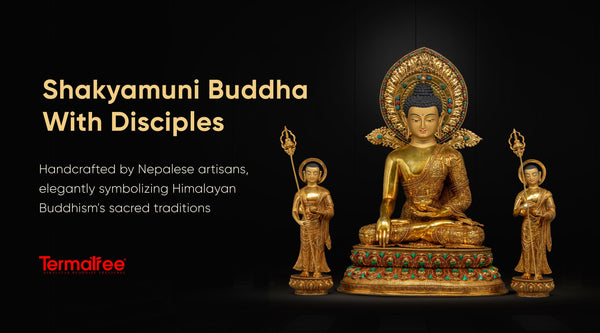
The historical Buddha, Siddhartha Gautama, was born as a prince in the Shakya clan during the 5th to 6th century BCE. Traditionally, after experiencing the four sights: old age, sickness, asceticism, and death, he renounced his royal existence and began a search for a solution to the problem of suffering. He practiced asceticism and meditated for years and then became enlightened under a Buddha tree in Bodh Gaya, India, and was "the Buddha," which means "the Awakened One." Unlike other Buddhas named in Buddhist cosmology, such as Amitabha and Maitreya, Shakyamuni is the Sage of the Shakya. His teachings are the basis of Buddhism. The Four Noble Truths and the Eightfold Path are the basis for all schools of Buddhism.
What is The Symbolism Behind His Standing Posture?

The standing Buddha, unlike the cross-legged meditative pose, is generally understood to represent the Buddha actively engaged with the world, teaching, blessing, or walking. Several symbolic threads run through this posture:
-
Active compassion: A standing Buddha represents that he is not content to stand still and contemplate, but is ready to move, to reach out, and to guide straight to those in need.
-
The moment of teaching or blessing: Many statues of the Buddha are standing with one or both hands raised in abhaya mudra or varada mudra, indicating protection and generosity toward all beings.
-
The Buddha in daily life: Some standing forms remind us of certain episodes of the narrative, such as the Buddha's descent from Tavatimsa heaven after imparting his teachings to his mother or when he walked in the villages on his alms round.
-
Steadfastness and presence: The upright, grounded stance is also read as a symbol of unwavering resolve, a Buddha who remains present and available in every realm and circumstance.
-
The "walking Buddha" variant: In Thai art especially, a distinct sub-style shows the Buddha mid-stride, one heel raised, which developed during the Sukhothai period (13th–14th century) and is considered a uniquely Thai innovation, emphasizing grace, fluidity, and the Buddha's physical presence moving through the human world.
Notable Standing Buddha Statues Around The World
Standing Buddha statues appear across Asia, ranging from ancient rock-cut carvings to modern engineering feats.
1. Laykyun Sekkya (Monywa, Myanmar)
Standing on a throne roughly 116 meters (380 feet) tall, this is one of the tallest standing Buddha statues in the world, completed in 2008 after more than a decade of construction. It stands beside a large reclining Buddha depicting the Buddha's final passing, and visitors can climb through the interior of both statues, which contain multiple viewing floors.
2. Spring Temple Buddha (Lushan County, Henan, China)

At 128 meters (420 feet) excluding its pedestal, and 208 meters (682 feet) including it, this bronze statue of Vairocana Buddha briefly held the title of the tallest statue in the world before being surpassed by India's Statue of Unity in 2018. Built from more than 1,100 individually cast bronze pieces, its hands alone measure over 19 meters long, and its construction used roughly 1,000 metric tons of copper alloy.
3. Ushiku Daibutsu (Ibaraki, Japan)
A 100-meter (330-foot) bronze statue of Amida Buddha, completed in 1993 and once the tallest Buddha statue in the world. Visitors can enter the statue itself, which houses an observation deck near the chest and a small museum.
4. Avukana Buddha (North Central Province, Sri Lanka)

Carved from a single granite rock face around the 5th century, this roughly 12-meter (40-foot) standing Buddha is among the finest surviving examples of ancient Sinhalese sculpture, shown in the asisa mudra, a variant blessing gesture. A thin gap was deliberately left between the statue and the rock face, an engineering technique that helped protect the carving from erosion over the centuries.
5. Wat Intharawihan (Bangkok, Thailand)
Known as Luang Pho To, this 32-meter (105-foot) standing statue of the future Buddha Maitreya took roughly 60 years to complete, from 1867 to 1927. Made of brick and stucco, it is now covered in gold leaf and glass mosaic, and its topknot is said to enshrine Buddha relics gifted by Sri Lanka.
6. Standing Buddha of Bongeunsa Temple (Seoul, South Korea)

A large modern granite standing Buddha in Bongeunsa Temple, Seoul, South Korea, with the iconic view of the city skyline.
7. The Buddhas of Bamiyan (Afghanistan)
The two standing Buddhas, 53 m and 35 m tall in the cliff face, were sculpted around the 6th century. Tragically destroyed by the Taliban in 2001, they remain historically significant as some of the earliest and largest standing Buddha monuments ever created.
Types of Standing Buddha Statues by Medium
 Standing Buddha statues have been created in nearly every material available to the cultures that revered them, each medium carrying its symbolism and craftsmanship tradition.
Gold statues
Gold standing Buddhas, whether solid or gilded, are associated with purity, transcendence, and the "golden body" (suvarna-varna) that Buddhist texts describe as one of the physical marks of a fully enlightened being. Gilded standing Buddhas are common as temple centerpieces across Thailand, Myanmar, and Sri Lanka, where devotees also apply gold leaf to statues as an act of devotion over time.
Copper and bronze statues
Bronze and copper alloys are the most common materials for large-scale standing Buddha statues, prized for their durability, weather resistance, and capacity to hold fine detail even at monumental scale. The Spring Temple Buddha, Ushiku Daibutsu, and Laykyun Sekkya are all bronze or copper-based, reflecting centuries of East and Southeast Asian metal-casting traditions dating back to the early spread of Buddhist art.
Wooden statues
Standing Buddhas are traditionally carved from camphor, sandalwood, and other durable woods by skilled craftsmen in Japan, China, and Southeast Asian Buddhist art, especially in these countries. Wood can be used for warmth and intimacy in smaller statues of the temples and household, but is susceptible to decay, fire, and insect damage compared to stone or metal.
Clay statues
Clay and terracotta standing Buddhas have a long history in South and Central Asia, including the once-standing colossal Buddhas of Bamiyan, whose niches were finished with clay and stucco detailing over a stone core. Clay remains popular for temporary or ceremonial statues in some traditions, valued for its affordability and ease of fine sculpting, though it is far less durable than stone or metal.
Crystal and stone statues
Stone-carved standing Buddhas, from sandstone and granite to marble, represent some of the oldest surviving examples of Buddhist art, including the Avukana Buddha and the original Bamiyan colossi. Crystal and semi-precious stone statues are typically smaller in scale, prized for their translucence and association with clarity of mind, and often used as personal or altar objects rather than monumental public works.
The Importance of Craftsmanship in Standing Buddha Statues
 The value of a sacred Buddha statue is not just in the beauty, but in the discipline of making the statue. Traditional Buddhist sculpture follows well-established iconometry in classical writings from several regional traditions. These systems determine exact proportions for various parts of the statue so that it conforms to the idealized Buddha and not to a particular artist's style. Any deviation from these proportions that affects the statue diminishes its spiritual authenticity.
In other parts of the world, such as Nepal and Tibet, artisans pass on their craft through apprenticeship, and every element of their art matters. The lotus base is a symbol of purity. The draping of the robes varies from style to style and is a symbol of simplicity and renunciation. The religious message led to the choice of certain hand gestures or mudras. Numerous statues are "consecrated" by the stuffing of sacred materials into them and the "opening of the eye" ceremony performed by a qualified teacher before the statue is considered fit for worship. These traditions transform the image of the statue into a key aid to meditation and devotions, and it becomes a living symbol of the Buddha's qualities.
Conclusion: The Timeless Presence of The Standing Buddha Statue
The Standing Buddha statue is an artistic creation and not a historical figure. It reflects the Buddha’s compassion, wisdom, and tireless quest to bring beings into His awareness, rather than hiding from them, and is in an attitude of movement, availability, and engagement with the world.
From the technical expertise of the artisans who create them, to the doctrinal and spiritual values they convey, each statue contains the technical dedication of its makers and the doctrinal and spiritual values of the tradition of which it is a part, from the rules of proportions that make it instantly recognizable across centuries and cultures, to the consecration rites that turn a sculpted object into an object of living devotion. Whether it's the rock-cut Buddhas of Asia or contemporary meditation rooms and private altar spaces around the globe, standing Buddhas remain symbols of peace, mindfulness, and the potential for enlightenment that is always within reach for those willing to follow the path. A standing Buddha does not simply mark a moment in history. It represents a continuing invitation: toward wisdom, toward compassion, and toward the kind of inner transformation the Buddha himself is said to have modeled nearly 2,500 years ago.