The Sacred Connection Between Guru Rinpoche and His Living Image
In the world of Buddhist arts of the Himalayas, certain statues go beyond representation to embody the presence and spiritual energy of enlightened masters; one such example is the “Looks Like Me” Guru Rinpoche Statue. It is believed to have been blessed by Padmasambhava (Guru Rinpoche), who brought Vajrayana Buddhism to Tibet, making it a unique statue with his own personal connection. The statue, called “Looks Like Me” (Nga Drö Zhig) in Tibetan, is believed to have been an expression of Guru Rinpoche's awareness of a striking resemblance to his own enlightened body, and also to represent the transmission of enlightened qualities and blessings. This statue is an effective reminder to devotees that sacred images are much more than objects of veneration; they are vehicles for encountering wisdom, compassion, and awakened awareness.
Who Was Guru Rinpoche?

Padmasambhava is a figure who sits somewhere between history and hagiography. He was a tantric master from the Swat Valley region of medieval India, and according to Tibetan sources, he traveled to Tibet in the eighth century at the invitation of King Trisong Detsen to help establish Buddhism there. Tibetan tradition reveres him as an emanation of Buddha Shakyamuni and refers to him as the "Second Buddha." Modern scholarship, following historians like Lewis Doney, has moved from treating him as purely legendary to "cautiously" accepting him as a genuine historical figure, even as layers of myth were added to his life story over the following centuries.
Whatever the precise historical facts, his role in Tibetan Buddhism is undisputed: he is honored as the founder of the Nyingma school, the oldest of the four major schools of Tibetan Buddhism, and countless Nyingma lineages trace their origin back to him and his circle of twenty-five principal disciples.
The Founding of Samye: Taming the Land Itself

To understand the statue, you first have to understand the monastery for which it was made. Samye Monastery, built in the 770s under King Trisong Detsen's patronage, was the first true Buddhist monastery in Tibet. Its construction had already been attempted once by the Indian scholar Shantarakshita, but, according to tradition, the half-built structure kept collapsing, and local workers came to believe that a demon or hostile spirit was responsible.
Trisong Detsen then invited Padmasambhava, Shantarakshita's contemporary, to intervene. Tibetan chronicles describe him performing the Vajrakilaya dance and a "thread-cross" ritual to subdue the region's local spirits, most famously binding the spirit Pehar Gyalpo by oath, an event later tied to the founding of the Nechung Oracle tradition that still advises the Dalai Lamas today. With the obstacles cleared, construction finally succeeded, and the monastery whose name is said to derive from the king's astonished exclamation upon seeing a vision of the finished building became the seedbed of Tibetan monasticism, the site where the first Tibetan monks were ordained and where Indian Buddhist texts were translated into Tibetan for the first time.
It was in this charged, foundational setting, a monastery literally built to anchor Buddhism onto Tibetan soil, that the Guru Ngadrama statue was made.
The Making of the Statue and the Moment It Got Its Name

According to tradition, the statue was sculpted from life in the eighth century while Padmasambhava himself was present in Tibet, making it the earliest and, in the eyes of many practitioners, most authentic likeness of him ever created. When Guru Rinpoche saw the finished image installed at Samye, he is said to have looked at it and remarked, simply, "It looks like me." He then blessed the statue, declaring, "Now it is the same as me!" transforming it from a mere sculpted likeness into something understood as inseparable from his own living presence.
That double moment of recognition followed by consecration is the entire meaning of the name Guru Ngadrama. In Tibetan Buddhist understanding, a blessed image is never just a representation; it becomes a support for the actual qualities and blessings of the being it depicts. Because this was the first image Padmasambhava personally approved and blessed, it set the template for how he would be depicted afterward. Later images of him that emerged through the terma tradition, the practice of "revealing" hidden spiritual treasures said to have been concealed by Padmasambhava and his students for future generations, were often described as bearing a close resemblance to this original Samye statue, reinforcing its status as the master copy, so to speak, of Guru Rinpoche's iconography.
Reading the Image

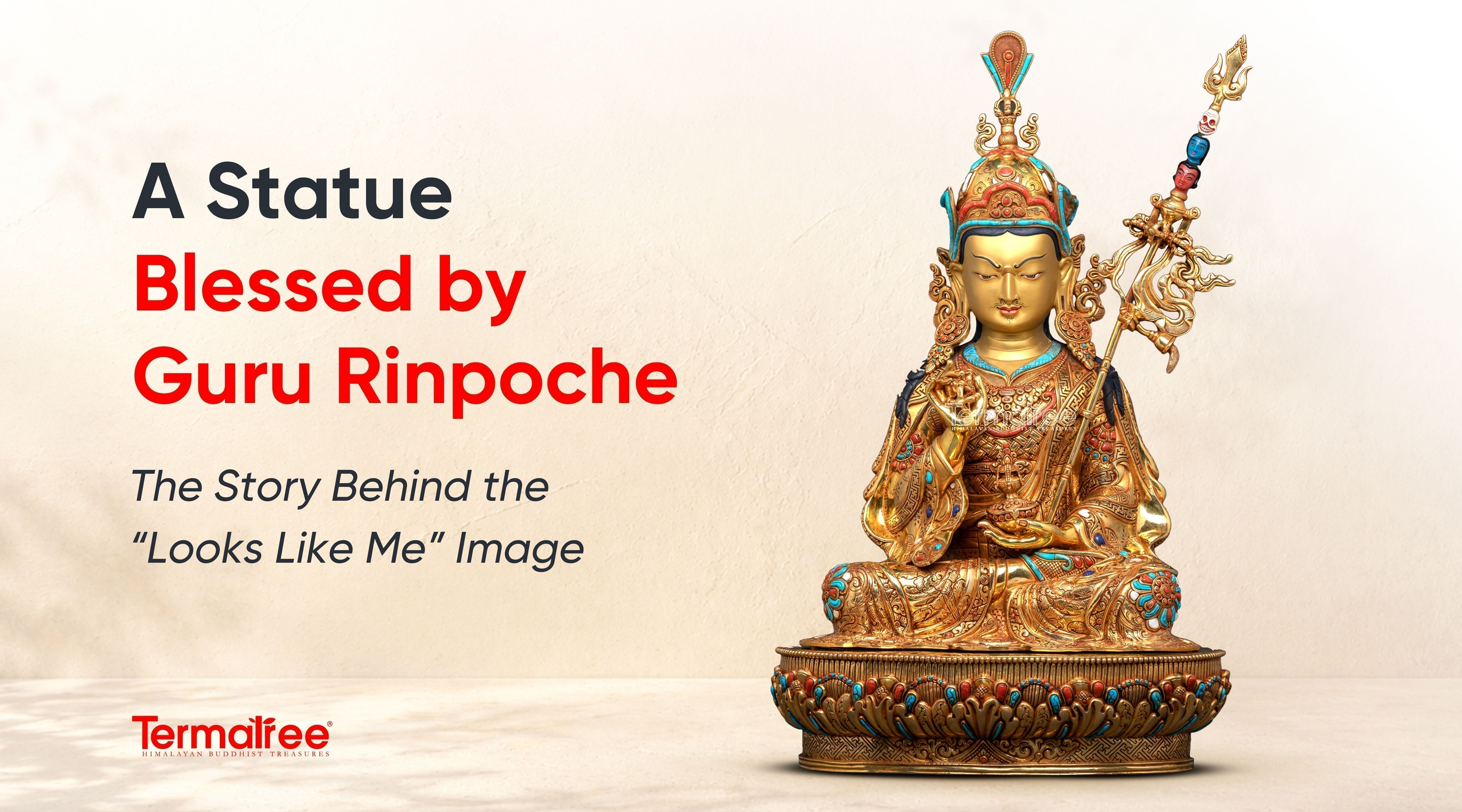
Part of why this particular form of Padmasambhava became so iconic is the way it condenses his entire spiritual identity into a single figure. Typical features associated with the Guru Ngadrama form include:
-
Royal robes and a lotus hat, reflecting his status as a tantric master invited by a king, rather than an ordinary monk
-
A vajra held at the heart, symbolizing indestructible skillful means
-
A skull-cup (kapala), representing the transformation of ordinary appearances and the wisdom that arises from transcending duality
-
A khatvanga (trident staff) cradled in the left arm, representing his consort in her secret, wisdom-body form.
-
A penetrating gaze, which visitors and pilgrims often describe as feeling almost uncannily alive, one of the reasons the statue has always been treated as more than an ordinary artwork
To Tibetan and Himalayan Buddhists, this composite image became the standard against which every subsequent depiction of Guru Rinpoche was measured.
Read More: Rooting the Dharma: The Sacred Convergence of Guru Rinpoche, Shantarakshita, and King Trisong Detsen
A Fragile Legacy: The Photograph That Survived

Here the story takes a poignant turn. The original statue at Samye did not survive intact into the modern era; it was destroyed during the Cultural Revolution (1966–1976), a period in which a huge number of Tibet's monasteries, statues, and manuscripts were damaged or destroyed. Samye itself was heavily affected, and much of what stands there today, including large portions rebuilt from the late twentieth century onward, is reconstruction rather than original eighth-century fabric.
What preserved the image for the rest of the world was a black-and-white photograph taken by the Queen Mother of Sikkim, Gyalyum Kunzang Dechen Tsomo Namgyal, before the destruction occurred. That photograph was later digitally enhanced, guided by the recollections of lamas who had seen the original statue in person, to produce the vivid color image now reproduced on thangkas, posters, altar cards, and prayer booklets around the world. In a real sense, the "Looks Like Me" image that most practitioners know today is a carefully reconstructed echo of a blessed object that no longer physically exists, which only adds to its poignancy as a living link to eighth-century Tibet.
Why the Statue Still Matters
The Guru Ngadrama image continues to occupy a special place in Tibetan Buddhist practice. Teachers within lineages such as Rigpa have described using the image as a focal point for devotional practice and mass offering ceremonies at Samye itself, treating a pilgrimage in front of the statue's site as a significant spiritual undertaking. On Guru Rinpoche Day, observed monthly according to the Tibetan lunar calendar, communities around the world still circulate this same image alongside prayers such as the Seven-Line Prayer to the Lotus-Born Guru, reaffirming a chain of devotion that stretches back, at least in legend, to the moment Padmasambhava looked at his own likeness and recognized himself in it.
It's a small story, a master glancing at a statue and offering an offhand remark, but it captures something central to Vajrayana Buddhism's relationship to sacred art: an image isn't valuable merely because it is skillfully made, but because of the blessing and lineage that animate it. "Looks Like Me" endures not simply as a portrait of Padmasambhava, but as a reminder that, in this tradition, the boundary between a sacred image and the being it depicts is understood to be far thinner than it first appears.
Conclusion: A Living Symbol of Guru Rinpoche’s Blessing
The “Looks Like Me” Guru Rinpoche statue stands as one of the most meaningful examples of sacred Himalayan Buddhist art. Its story connects history, devotion, craftsmanship, and spiritual practice into a single powerful symbol. It is believed that this image was blessed by Guru Rinpoche Himself and continues to symbolize the ongoing presence of the Precious Master and His timeless teachings. It has been a reminder to generations of practitioners that there is no separation between enlightenment and wisdom, that it can be acquired through devotion, meditation, and the transformation of the mind.
“Looks Like Me” is not a mere statue, but a living link to the past and to the present; a connection to the master and the disciple; an ordinary life, and a path to awakening.