How a Tibetan master united Vajrayana wisdom with architecture, blacksmithing, civil engineering, art, opera, and healing practice
Master Thangtong Gyalpo is remembered as one of the most extraordinary figures in Tibetan Buddhist history. He was not only a realized Vajrayana master or mahasiddha, but also a bridge builder, architect, blacksmith, civil engineer, artist, founder of Tibetan opera, and a spiritual healer associated with the dispelling of epidemics. His life shows how spiritual realization can take practical form not only through meditation and teachings, but also through bridges, temples, performances, prayers, and public service. The Khyentse Foundation describes him as both a legendary and historical figure whose influence in Tibetan and Bhutanese culture remains unparalleled.
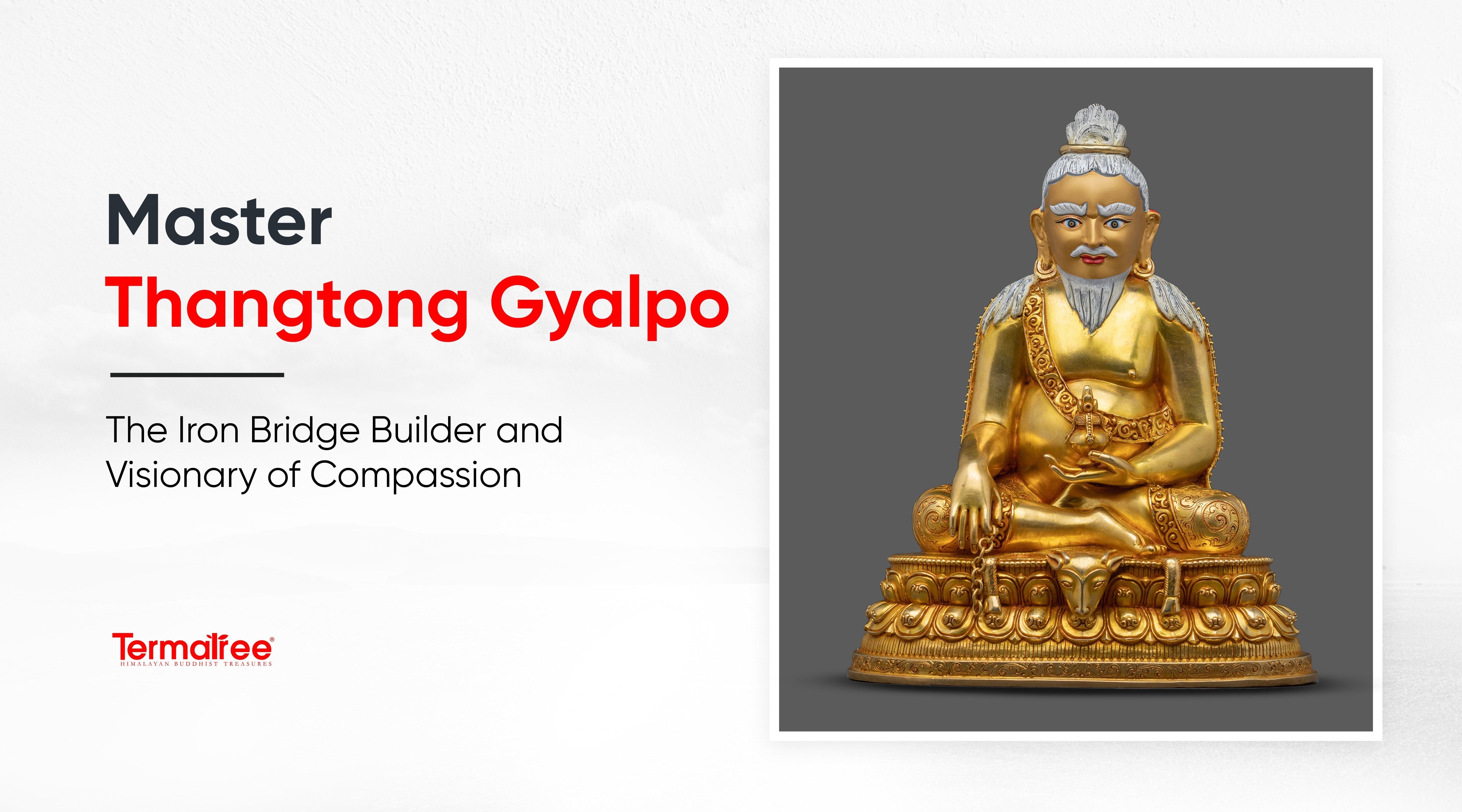
The dates of Thangtong Gyalpo’s life differ among traditional sources. Some accounts place his birth in 1385, while other records give a wider range around the 14th and 15th centuries. In Tibetan tradition, he is often portrayed as an elderly yogi with long white hair and a white beard, symbolizing wisdom, longevity, and spiritual strength. This visual form is not simply artistic decoration; it expresses his role as a master of long-life practice, fearless activity, and enlightened service.
A Mahasiddha Beyond Ordinary Categories

Thangtong Gyalpo was a mahasiddha, meaning a great accomplished master whose realization went beyond ordinary religious learning. He was associated with deep Vajrayana practice and with several Tibetan Buddhist traditions, including Shangpa Kagyu, Nyingma, Sakya, and Jonang connections.
Yet what makes him especially remarkable is that his realization did not remain hidden in caves or monasteries alone. His compassion became visible in the world. He built bridges so pilgrims, traders, monks, farmers, and ordinary travelers could cross dangerous rivers and Himalayan gorges. He created sacred structures to stabilize spiritual and social life. He used drama, music, and performance to spread Dharma teachings to people who might never enter a monastery. In this way, Thangtong Gyalpo became a rare example of a Buddhist master whose spiritual vision became public infrastructure.
Read More: Thangtong Gyalpo: His Life, Teachings, and Contributions to Tibetan Culture and Buddhism
The Architect of Sacred Landscapes

As an architect, Thangtong Gyalpo was not only concerned with physical beauty. His constructions were understood as sacred interventions in the landscape. The Khyentse Foundation notes that he designed and built many large and unusual stupas across Tibet and Bhutan, including the great Kumbum Chörten at Chung Riwoche, and also established Gongchen Monastery in Derge. Shangpa Foundation similarly records that he designed large stupas, founded Derge Gongchen Monastery, and contributed to sacred sites across the Himalayan region.
In Tibetan Buddhist culture, a stupa is not merely a monument. It symbolizes the enlightened mind of the Buddha and is a field of merit for those who circumambulate, pray, or offer something at it. Thangtong Gyalpo, who constructed stupas and temples, was forming spiritual geography. His architecture offered communities a center of devotion, protection, and continuity. As one of Tibet’s most prolific architect and states that his bridges, monasteries, and stupas enriched Tibetan culture for more than five hundred years.
The Blacksmith Who Turned Iron into Compassion

Thangtong Gyalpo’s title “Chakzampa” means “Iron Bridge Maker,” and this name reflects one of his greatest achievements. According to the Khyentse Foundation account, his vision for bridges began after a ferryman refused him passage. From this experience, he had envisioned the idea of iron-chain suspension bridges to be able to cross safely even as pilgrims and travelers. To make this vision possible, however, he needed to be able to comprehend the metallurgy, smelt iron, develop tough chain links, and plan for labor and resources that were necessary for construction.
His blacksmithing was therefore not a simple craft skill; it was a form of compassionate technology. In a very practical sense, the iron links he forged were tools of liberation. They facilitated people crossing the river safely, provided access to pilgrim trails, and linked remote communities. The Khyentse Foundation states that he developed a method of smelting iron to create large chain links and is traditionally credited with building 58 suspension bridges, many of which remained in use in Tibet and Bhutan. Other sources preserve different numbers, with the Shangpa Foundation mentioning accounts of 108 iron-chain bridges, 58 suspension bridges, and 118 ferry crossings, showing how vast his engineering legacy became in Tibetan memory.
A Civil Engineer of the Himalayas

As a civil engineer, Thangtong Gyalpo worked with some of the most difficult terrain in Asia. Tibet and Bhutan are lands of mountains, deep valleys, freezing rivers, and unpredictable weather. In such places, a bridge was not only a convenience; it could mean access to trade, medicine, pilgrimage, monastic education, and survival. His bridges created movement where nature had placed obstacles.
Mandala Publications records that he built his first iron suspension bridge over the Kyichu River near Lhasa in 1430 and later became famous throughout Tibet and the Himalayan regions as the “Iron-Bridge Man.” The same source states that by the end of his life, he had constructed 58 iron bridges, 60 wooden bridges, and 118 ferries. These numbers show the scale of his work. He was not only building isolated structures; he was creating networks of passage across sacred and social landscapes. His engineering was also deeply symbolic. Bridges were not just physical, but they were also a symbol of the Buddhist path. Dharma brings beings from the confusion side to the wisdom side; similarly, a bridge brings beings from one side to another. Cyrus Stearns shares its explanation that Thangtong Gyalpo knew that bridges were a way of moving from one place to the next, a way of using skillful means and wisdom to cross the “rivers” of suffering. This is why his iron bridges became more than engineering achievements. They became spiritual metaphors made visible in iron.
The Artist Who Made Dharma Visible
Thangtong Gyalpo was also an artist, not only in the narrow sense of painting or sculpture but also in the larger Buddhist sense of creating forms that awaken the mind. Himalayan Art describes his common iconographic features: an elderly figure with white hair and beard, simple garments, bare feet, sometimes holding a chain link, medicinal pill, skullcup, or long-life vase. Each of these attributes carries meaning. The chain recalls his bridges. The medicinal pill and long-life vase connect him with healing and longevity. The simple garments reflect the yogic life beyond ordinary status.
His artistic legacy is also connected with performance, ritual, and sacred storytelling. Thangtong Gyalpo understood that not everyone learns through philosophy. Some people are moved by song, image, gesture, humor, and drama. Through artistic expression, he brought Buddhist teachings into public spaces and everyday life. In this sense, he made Dharma visible, audible, and emotionally accessible.
Founder of Tibetan Opera
 Lhamo Tibetan Opera (Photo from Tibet)
One of Thangtong Gyalpo’s most enduring cultural contributions is his connection with Tibetan opera, known as Aché Lhamo or Lhamo. The Khyentse Foundation states that he used performing arts to raise funds for his projects and established Tibet’s first Dharma theater troupe, which performed operas, recited mantras, and told stories to teach and benefit beings. Shangpa Foundation also records that he established a song and dance troupe of seven sisters to raise money for bridge building and is considered the father of Tibetan opera.
This demonstrates his creativity as a spiritual master as well as a social organizer. Rather than removing the boundaries between art and religion, he merged them. Through opera, moral values were taught, Buddhist stories were shared, communities were brought together, and public works were supported. His concerts were no longer simply entertainment, but Dharma, moving. Through music, costume, dance, and story, he transformed Buddhist teaching into something ordinary people could see and feel. There is some scholarly caution around the exact historical relationship between Thangtong Gyalpo and Tibetan opera. Himalayan Art notes that he is credited with inventing Achi Lhamo, and that some believe he developed opera to fund bridge projects, while others question the connection. Still, within Tibetan cultural memory, his identity as the founder of Tibetan opera remains powerful and widely honored.
Dispeller of Epidemics and Healer of Suffering
Thangtong Gyalpo is also remembered as a dispeller of epidemics and a master connected with healing practices. The Khyentse Foundation explains that his prayers are considered effective against difficult circumstances and mentions the Thangtong Gyalpo Refuge Prayer as especially powerful in times of adversity. Himalayan Art also notes that he is famous for creating medicinal formulas for healing and longevity, many of which are still known in Tibetan tradition.
His healing activity should be understood within the world of Vajrayana Buddhism, where disease may be approached through medicine, ritual, mantra, prayer, karmic purification, and compassionate action. For Thangtong Gyalpo, healing was not only about the body. It also involved taking away fear, reconnecting, establishing safe routes, and establishing sacred spaces where folks could come together in faith. His bridges connected people together. His bridges healed social isolation. His prayers addressed suffering. His sacred architecture offered protection. His art carried hope. Shangpa Foundation records traditional accounts of him constructing Dumtseg Lhakhang in Bhutan and declaring that harmful influences causing disease were suppressed, especially in relation to leprosy in the valley. Such stories show how his legacy combines history, devotion, medicine, ritual power, and sacred geography.
Compassion as Practical Action

The most important lesson from Thangtong Gyalpo’s life is that compassion must become action. He did not only preach about helping beings; he built the means for them to cross rivers. He did not only teach Dharma in monasteries; he used opera and public performance to reach wider audiences. He did not only pray for healing; he became associated with practices and formulas for longevity and protection. His work shows the union of wisdom and method, which is central to Mahayana and Vajrayana Buddhism. He was a yogi, but also an engineer. He was a blacksmith, but also a visionary. He was an artist, but also a social reformer. He was a writer of operas, but also a dispeller of epidemics. His life refuses narrow categories because his compassion was not narrow. It moved wherever beings needed help.
Legacy of the Iron Bridge Builder
Today, Master Thangtong Gyalpo remains a symbol of fearless creativity and enlightened service. In Tibetan and Bhutanese memory, he is remembered as the master who transformed iron into bridges, performance into Dharma, architecture into protection, and spiritual realization into public benefit. His life teaches that the sacred is not separate from the practical. A bridge can be a prayer. A song can be a teaching. A stupa can be a protection. A chain of iron can become a chain of compassion.
In the sum of all things, Thangtong Gyalpo's legacy lives on because it is a message for a universal truth: wisdom is full of the promotion of others. He demonstrated that enlightenment is not just in quietude, contemplation, or scripture, but also in the courage to build, heal, create, and connect. Hence, he is still regarded as one of the most inspiring masters in the history of Himalayan Buddhism, a master-person who forged the way to the present through his hands and his realization, and through his compassion.
Thangtong Gyalpo in the Sacred Himalayan Art

Stories, prayers, bridges, Tibetan opera, and sacred Himalayan art are all part of the legacy of Master Thangtong Gyalpo. In the traditional iconography, he is depicted as an old man, wearing long white hair, with a compassionate face, sometimes linked with iron chains, denoting his role as the great Iron Bridge Builder. His image connects with practitioners in ways that remind them that realization happens not just in meditation, but also in service, creativity, healing, and in a practical way of compassion.
For more information on his life, teachings and depiction, read Termatree's detailed article titled Thangtong Gyalpo: His Life, Teachings, and Contributions to Tibetan Culture and Buddhism. This accompanying resource provides more information about his spiritual impact, his role as a bridge builder, his contribution to Tibetan opera and his significance for Buddhist art.
Conclusion
Master Thangtong Gyalpo's life embodies the truth of the transformation of spiritual wisdom into compassionate action. He was a Mahasiddha, bridge builder, architect, blacksmith, artist, opera creator and healer whose abilities he applied to help others and alleviate their suffering. His iron-bridges linked communities, his sacred writings ensured the Dharma and his prayers filled his people with hope in ill times.
Today he is still a potent reminder of service, creativity and enlightened compassion. His wisdom is in a message for us that the Dharma is not just about sitting in meditation, it is also about what we do to preserve, heal, and unite all beings.