
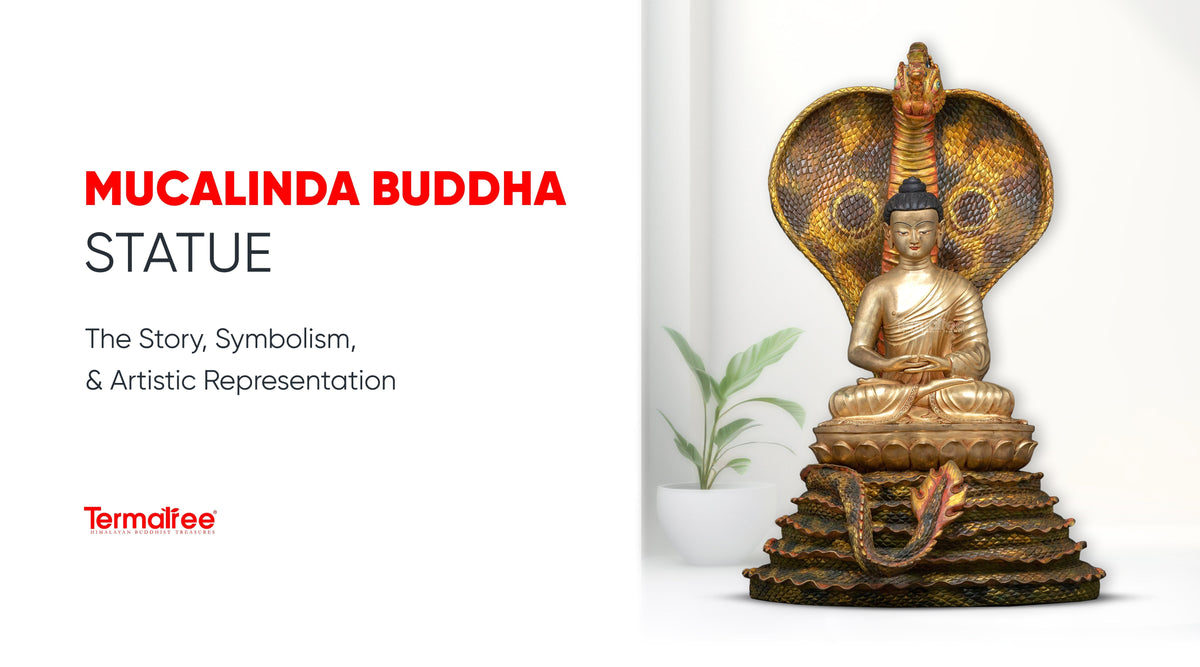
The Buddha Protected by the Naga King
The Mucalinda Buddha Statue is one of many types of Buddhist sculpture, and is especially significant as a symbol of a pivotal moment in the life of Shakyamuni Buddha following his enlightenment. Unlike the other images of Buddha concentrating, teaching or enlightening, this image has a narrative component of protection, serenity and the relationship between the awakened Buddha and the natural world.
In this depiction, the Mucalinda Naga King is shown protecting the seated Buddha from under his hood in meditation. The serpent deity extends his many heads above the Buddha, forming a protective canopy, and his coiled body holds up the Buddha's seat. This imagery became especially prominent in Southeast Asian Buddhist art, particularly in Cambodia, Thailand, Myanmar, and Laos.
The Story: A Storm in the Sixth Week

According to Buddhist tradition, the tale takes place shortly after Siddhartha Gautama attained enlightenment beneath the Bodhi tree in Bodhgaya. Rather than moving on immediately, he is said to have spent several weeks in the surrounding area in different states of meditation, absorbing the full weight of his realization. During the sixth of these weeks, while the Buddha sat in deep meditation near a nearby lake, the sky darkened, and a powerful storm broke out; heavy rain and rising floodwater threatened to disturb him for seven days and nights.
From beneath the earth, or from the depths of the lake, depending on the version of the story, rose Mucalinda, the king of the nagas, serpent beings of enormous size and spiritual significance in Indian and Southeast Asian traditions. To protect the meditating Buddha, he coiled beneath him, lifting him clear of the rising water, and spread his multi-headed hood above the Buddha's head like a canopy, shielding him from the wind and rain until the storm finally passed.
As the clouds dissipated, he is claimed to have relaxed himself around Buddha, transformed into a young man and bowed before him in reverence. The Buddha replied with a blessing and extolled the peace of solitude, non-affliction, and the absence of craving and ego, as set down in Buddhist scripture as the Mucalinda Sutta.
Who Is Mucalinda?
Mucalinda is referred to as a Naga King, one of the type of serpentine creatures that exist in Indian and Himalayan mythology. Nagas are often associated with water, fertility, hidden treasures, and guardianship. According to the Buddhism belief, nagas are not ordinary snakes. They are supernatural creatures who have great powers and are frequently depicted as guardians of sacred sites, teachings and enlightened beings. His role as a protector of Buddha demonstrates the Buddhist idea that wisdom and compassion create harmony among all forms of existence.
Origins and the Oldest Known Depictions
The Mucalinda story is far from a modern invention. Some of the very oldest surviving Buddhist artwork depicts this exact scene: a 2nd-century BCE stupa at Pauni, in the Indian state of Maharashtra, shows a five-headed naga guarding the Buddha's empty seat created during the "aniconic" period of Buddhist art, when the Buddha himself was represented only through symbols like an empty throne or footprints rather than a human figure. Around the same era, the remarkable stupa complex at Sanchi depicts Mucalinda in a part-human, part-serpent form, attended by a retinue of nagini (female naga spirits).

This story tells us something important: the sheltering-serpent motif isn't a later embellishment added by any single regional tradition but one of the earliest and most consistently retold episodes from the Buddha's life, carried forward and reinterpreted by nearly every major Buddhist culture that followed.
The Iconography of the Mucalinda Buddha Statue
The Mucalinda Buddha Statue combines the peaceful image of the Buddha with the protective presence of the Naga King. Every part of the sculpture has a symbolic value, symbolizing stability, protection and harmony.
Buddha in Meditation
 Buddha often sits in meditation (Dhyana Mudra) hands. It is the posture for deep concentration, inner peace and awakened mind. His calm expression is the unshakable nature of enlightenment even in the midst of disturbances outside of him.
The Naga Hood

Mucalinda rests upon Buddha with its multi-headed hood as a protective umbrella. The naga is a symbol of guardianship, reverence, and protection, and is often depicted with five or seven heads. It is its expanded form of protecting and supporting the Awakened Body of the Buddha.
The Coiled Serpent Body
 The body of Mucalinda is coiled, symbolizing stability, support and harmony between nature and enlightenment, behind the Buddha's back. The naga is not a Buddha killer, but rather a humble protector, demonstrating respect toward the Buddha's awakened wisdom.
What the Image Symbolizes?
The Mucalinda scene was not only narrative in value, it also had a number of layers of symbolic meaning still found in it which made it survive over so many centuries and cultures.
-
Protection and refuge
It is common for the spread of the naga's hood to be interpreted as the Buddha's protection of the Dharma, which is itself a metaphoric shield to protect all beings who take refuge in it from the metaphoric storm of life itself. -
Unshaken inner peace
The Buddha's face and attitude are unaffected by the chaos of wind, rain and rising water around him. The image is used to mean that true enlightenment is not a matter of circumstances, but of the mind's inner state; that the awakened mind remains undisturbed and unmoving, regardless of the turmoil caused by external events. -
Harmony between humanity and nature
His protective role is sometimes interpreted as an expression of reverence for and a deep bond between Buddhist practice and nature, given his threefold nature as earth, water and half-divine. Instead of threatening, nature comes to the aid of and celebrates the Buddha in this story. -
Humility and devotion
He bows before the Buddha once the storm passes, taking human form to do so, reinforcing the idea that even powerful, semi-divine beings recognize and pay homage to the Buddha's realization.
Artistic Representation Across Buddhist Cultures
While the underlying story stays consistent, artists have rendered it differently by region, period, and material tradition.
1. Cambodia and the Khmer Tradition

Some of the most celebrated Mucalinda images come from the Khmer world. A well-known 12th–13th-century Cambodian sandstone statue, now held in the Metropolitan Museum of Art, depicts the Buddha seated calmly atop his coils beneath a fully fanned seven-headed hood, a style closely associated with the Bayon period of Angkorian art, when naga imagery took on particular political and cosmological importance tied to Khmer kingship. Cambodian bronze workshops continue this tradition today, often rendering his seven heads with individually detailed, crowned faces and bared fangs, framing the Buddha's serene expression in dramatic contrast.
2. Thailand

(Photo from Metropolitan Musuem of Art)
In Thailand, the Mucalinda scene occupies a very specific place in popular religious life. Thai tradition assigns a distinct Buddha posture to each day of the week, based on events believed to have occurred on that day during the Buddha's life, and the Naga-sheltered Buddha, known as Pang Nak Prok ("Protected by the Naga King"), is the posture associated with people born on a Saturday. Thais born on that day are traditionally said to be calm, logical, and drawn to detailed or technical work, and many keep a small Phra Nak Prok amulet or make merit at temples on Saturdays by offering flowers or gold leaf to Naga-protected Buddha images. Well-known examples can be found at temples such as Wat Pho and Wat Benchamabophit in Bangkok, among many others across the country.
3. Myanmar, Laos, and Continued Theravada Tradition

The Mucalinda image remains a familiar and consistently reproduced motif across Myanmar (Burma) and Laos as well, where it appears in temple courtyards, meditation halls, and smaller devotional statues alike, a reflection of how deeply the story is embedded across Theravada Buddhist cultures more broadly, not confined to any single national tradition.
4. India: The Original Setting

(Photo from Wikimedia Commons)
The story itself is rooted in a specific place: Bodhgaya, in the Indian state of Bihar, where the Buddha attained enlightenment beneath the Bodhi tree. Devotional literature traditionally identifies the site of the storm and his protection as the Muchalinda Lake also known as the Lotus Pond located near the Mahabodhi Temple complex. Today, the lake remains a recognized part of the Bodhgaya pilgrimage circuit, with a modern statue of the Buddha sheltered by the naga's hood placed at its edge, allowing visitors to stand at the very spot the tradition associates with the original event.
5. Nepal and the Himalayan Lost-Wax Tradition

(Photo from Nepal Heritage Recovery Campaign)
Nepal's Kathmandu Valley, particularly the city of Patan, maintains its own strong tradition of Mucalinda statues, produced through the region's long-established lost-wax bronze casting method. These statues are made in Nepal rather than India, but devotional literature still frequently links the imagery back to Bodhgaya's Muchalinda Lake as the story's original setting. Newar artisans typically combine fine surface detailing on the naga's hood and crown with gilding, giving these statues a luminous, richly ornamented appearance distinct from the sandstone or painted bronze traditions of Southeast Asia.
A Note on the Number of Heads
Visitors often assume the naga's hood always has seven heads, and this representation is indeed the most common convention in later Buddhist art, likely influenced by naga iconography more broadly, where seven-headed serpents carry strong symbolic associations with protection and completeness. But this wasn't fixed from the start: the earliest known depiction at Pauni shows a five-headed naga, and other regional and period variations exist as well. When examining or commissioning a Mucalinda statue, the exact head count is worth treating as a stylistic and regional choice rather than a strict doctrinal requirement.
Why the Image Still Resonates?

Centuries after its earliest depictions, the Mucalinda Buddha remains one of the most commissioned and collected images in Buddhist art, found everywhere from major temple complexes to home meditation altars. Part of its staying power lies in how directly it visualizes an experience nearly everyone can relate to: sitting through a storm, literal or otherwise, and choosing to remain steady rather than be swept away by it. Whether encountered in a centuries-old Khmer sandstone carving, a gilded Nepalese bronze, or a modern devotional statue on a home altar, the image continues to carry the same essential message it always has: that genuine peace of mind isn't the absence of storms, but the capacity to remain undisturbed within them.
Conclusion
The Mucalinda Buddha Statue is more than a depiction of Buddha beneath a serpent canopy. It is a visual representation of protection, harmony and stability of enlightenment. The iconography continues to influence generations of artists and practitioners from the ancient Indian traditions to the magnificent Khmer sculptures of Cambodia to the bronze images of Southeast Asia. The contemplation of Shakyamuni Buddha under the umbrella of Mucalinda is a reminder that the awakening is untouched, peaceful and stable even in the midst of storms.


