The Divine Guardians of Tibetan Medicine: Exploring Protection, Healing, and Enlightened Wisdom
Tibetan medicine, or Sowa Rigpa, has never been a purely clinical system. Alongside pulse diagnosis, herbal formulas, and the famous Four Medical Tantras, it carries a rich layer of tantric ritual and protector deities who guards the lineage itself, its texts, its practitioners, and the spiritual power that keeps the healing tradition alive. At the head of that guardianship stands a fierce, jewel-holding figure named Shanglon Dorje Dudul, accompanied by four directional guardians. Together they form one of the more specialized, and least written-about, corners of Himalayan protector iconography.
Who Is Shanglon Dorje Dudul?

Shanglon Dorje Dudul is regarded as the special protector of the Tibetan medical tradition, its lineage, its texts, and the physicians who carry it forward. His name "Shanglon" translates roughly as "minister" or "royal minister," casting him not as a supreme ruler but as a devoted attendant and defender standing beside a greater figure of authority. The Medicine Buddha himself, whom Shanglon is described as serving as a brave minister, protecting a king, clearing obstacles to health and prosperity, safeguarding the natural environment, and removing hindrances to spiritual practice.
One of the most detailed catalogues of Tibetan Buddhist iconography, Shanglon appears in two main iconographic families:
-
The Outer–Inner–Secret trio: a seated wrathful figure that manifests in three distinct forms, each representing a different level of spiritual accomplishment (outer, inner, and secret).
-
The Yuthok Nyingthig form: a wrathful, Mahakala-like deity who rides on horseback, accompanied by a retinue of eight attendant deities. This form is specifically tied to the Yuthok Nyingthig, the tantric practice cycle at the heart of the Yuthok medical lineage.
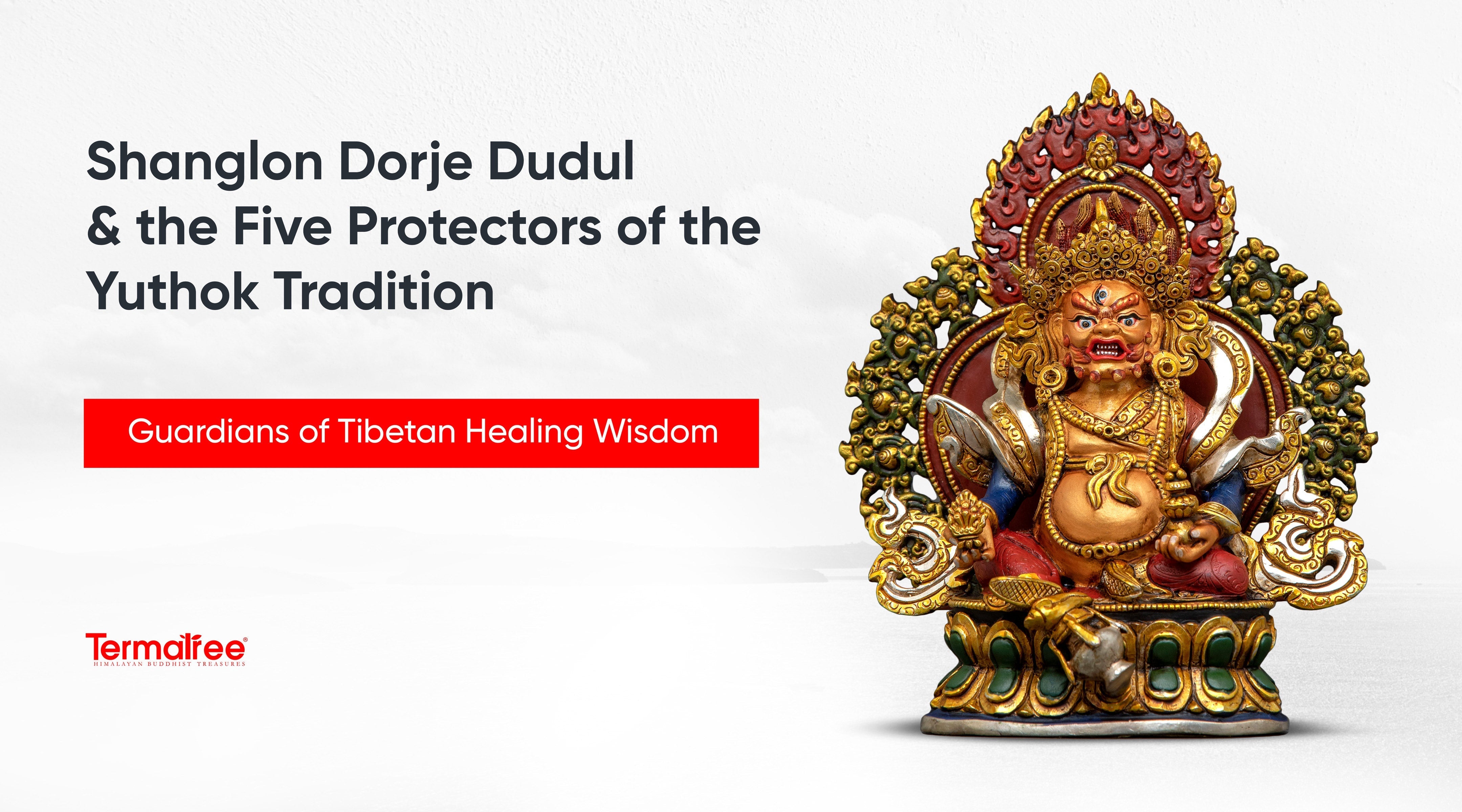
In the Outer Accomplishment form, Shanglon is described as a black, three-eyed, fanged figure with upward-flowing hair, dressed in dark silks, felt boots, a jeweled crown, and a necklace of human heads, holding a wish-fulfilling jewel in his right hand and a golden treasure vase in his left. It's a classically wrathful protector image, but one whose attributes point toward abundance and healing rather than destruction alone. Because Shanglon is closely associated with the Mahakala class of protectors, some cataloguers place him within that broader family, even while treating him as a distinct deity in his own right, specifically tied to medicine rather than to a monastery or school.
Read More: Shanglon Dorje Dudul: A Sacred Guardian of Tibetan Medical Wisdom
The Five Protectors: Shanglon's Retinue

The "Five Protectors" of the title come within the Outer Accomplishment mandala; Shanglon is accompanied by five retinue figures, each holding a specific directional and symbolic role:
|
Figure |
Direction |
Identity |
|
Dorje Dundrubma |
Consort (Left side) |
His female counterpart |
|
Norlha Karpo |
East |
A white form of Jambhala, god of wealth |
|
Gonpo Nagpo |
South |
A blue form of Mahakala |
|
Trogne Marpo |
West |
A red Yaksha Pancha ("wrathful-faced") figure |
|
Namse Jangku |
North |
A green form of Vaishravana, guardian king of the north and lord of wealth |
Arranged around Shanglon at the center, these five figures form a protective mandala that mirrors a common pattern in Tibetan Buddhist iconography: a central wrathful deity surrounded by four directional guardians, each drawn from the wider pantheon of wealth and protector deities (Jambhala, Mahakala, and Vaishravana) but repurposed here specifically to defend the medical lineage and its practitioners. In the more elaborate Yuthok Nyingtig form, this retinue expands further still, to eight attendant deities surrounding the horse-riding Shanglon Mahakala.
The Yuthok Lineage This Protector Guards

Tibetan medical history centers on two revered physicians, referred to as father and son, both bearing the name Yuthok Yonten Gonpo. The more historically grounded of the two, Yuthok Yonten Gonpo the Younger (1126–1202), is regarded as the principal architect of Tibetan medicine, credited with compiling the Four Medical Tantras (Gyu Zhi), the foundational treatise still studied by Tibetan doctors today.
Born into a hereditary line of physicians, he reportedly began medical study at age eight, traveled to India multiple times to study the Eight Branches of Healing, and eventually distilled his learning into two legacies: the medical tantras themselves and a separate tantric practice cycle called the Yuthok Nyingthig ("Heart Essence of Yuthok"). Unlike the medical tantras, which train physicians in diagnosis and treatment, the Yuthok Nyingthig is a complete Vajrayana path including preliminary practices, guru yoga, generation- and completion-stage meditation, and advanced practices connected to Mahamudra and Dzogchen designed specifically for healers who want their medical work and their spiritual realization to develop together.
The scholars of Himalayan art have flagged: some researchers, drawing on the work of the 17th-century regent Desi Sangye Gyatso, suspect that the tradition of two Yuthok physicians (an elder and a younger) may be partly a later literary construction, with only the more recent figure resting on solid historical ground. Shanglon himself follows a similar pattern of textual layering: art historians note that his imagery is rarely found in art before the 17th century, suggesting his popularity as a distinct iconographic subject grew significantly under Sangye Gyatso's influence, even though the underlying practice traditions are traced back further, to the 11th-century terma revelations of Drapa Ngonshe, the treasure revealer credited with rediscovering the Four Medical Tantras themselves.
Read More: Yuthok Yonten Gonpo Statues: Sacred Symbols of Tibetan Healing and Wisdom
Why a Medicine Lineage Needs a Wrathful Protector

 A tradition devoted to healing would need a fierce, skull-adorned guardian at all. But this is entirely consistent with the logic of Tibetan Vajrayana Buddhism, where wrathful deities are not forces of harm but concentrated expressions of protective energy, compassion wearing an intimidating face to be effective against genuine obstacles. For physicians trained in the Yuthok Nyingthig, Shanglon's role covers several overlapping concerns:
- Protecting the purity of the lineage and its texts, ensuring the transmission from Yuthok Yonten Gonpo down through successive teachers remains unbroken and uncorrupted.
-
Removing obstacles to a practitioner's health and material stability, echoed in his attributes of the wish-fulfilling jewel and treasure vase.
-
Guarding the natural environment, an unusually explicit ecological dimension for a protector deity, fitting for a medical system that draws heavily on plants, minerals, and the land itself.
-
Clearing hindrances to spiritual accomplishment, so that the practitioner's inner development keeps pace with their outer medical skill.
The Yuthok Nyingthig marks the last day of each Tibetan lunar month, traditionally the day associated with dharma protectors, with dedicated Shanglon practice, often involving a sang (juniper smoke) offering and recitation of prayers to both his peaceful and wrathful forms. Groups such as Pure Land Farms, home to the Yuthok Ling temple in the West, have even commissioned limited-edition statues of Shanglon specifically to support practitioners maintaining this protector relationship.
The Connection Between Tibetan Medicine and Spiritual Practice
One of the unique characteristics of Tibetan medicine is its integration with Buddhist philosophy. In the traditional Tibetan medicine system, disease is viewed as a three-dimensional phenomenon:
Physical Causes: These are related to the imbalance of the bodily energies, environmental factors, diet, and lifestyle.
Mental Causes: In Tibetan Buddhism, emotional disturbances like attachment, anger, and ignorance are considered significant causes of suffering.
Spiritual Causes: Some diseases can be seen as a karmic issue or an energetic imbalance that may require spiritual work in addition to medical treatments.
Therefore, Tibetan healing often includes the following: Herbal medicine, dietary guidance, lifestyle recommendations, meditation, mantra recitation, ritual practices, and compassion practices. The presence of protector deities such as Shanglon Dorje Dudul reflects this holistic understanding of healing.
A Living Tradition

Shanglon Dorje Dudul and the five protectors are worth knowing about not just for their unusual iconography. The jeweled minister on horseback, the directional ring of wealth and wrath deities, but also what they represent about the Tibetan medical worldview as a whole. The healing was never conceived as a purely technical craft. It was understood as a discipline requiring its own spiritual infrastructure: a founding master regarded as an emanation of the Medicine Buddha, a tantric practice cycle for bridging clinical skill with inner realization, and a dedicated protector charged with keeping the whole system safe from corruption, obstacles, and decline. Shanglon and his five attendant guardians are the quiet architecture standing behind every pulse reading and herbal prescription passed down through the Yuthok lineage.
Conclusion: Preserving the Wisdom of Tibetan Healing
One of the deepest links between Tibetan Buddhism and traditional medicine is between Shanglon Dorje Dudul and the Five Protectors of the Yuthok Tradition. They are a representation of wisdom, compassion, protection, and understanding of the interrelatedness of life, which are all necessary for true healing to occur beyond physical healing. These holy individuals are custodians of Tibetan medicine, a reminder to practitioners that healing is a form of compassion. A physician, a medicine, a patient, and a path of spirit all share a common aim to alleviate suffering.
The blessings and teachings of Shanglon Dorje Dudul continue to be shared and inspire generations of healers and practitioners, and preserve the timeless wisdom of Tibetan healing traditions for generations to come.