The Flaying Knives
Significant attributes of wrathful deities

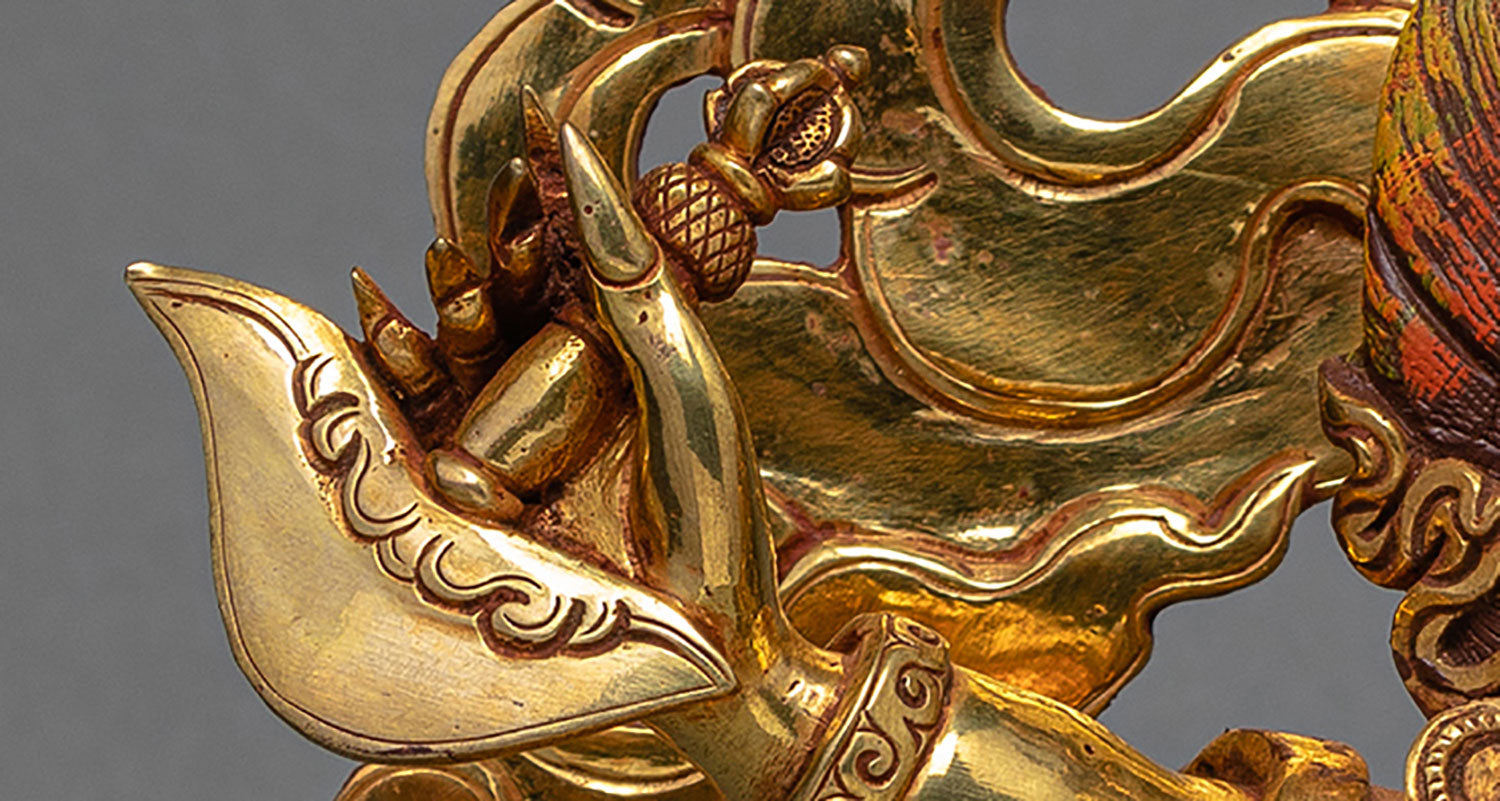
As one of the quintessential attributes of the wrathful Tantric deities, the kartrika, or flaying knife, symbolizes the power to sever the obstacles of delusions and karmic negativity of the practitioners. The ritual knife is invariably paired with the skullcup (kapala) as a metaphor of the Tantric methodology-the inseparable union of skillful means and wisdom.

When Vajravarahi wields it in her right hand, the knife represents the severing power of the female's wisdom that destroys all phenomenal conceptualization of the mind. When paired with the knife, the skullcup symbolizes the compassion of a Buddha and the cultivation of great bliss.

When a male figure or protective deity like Mahakala grasps the kartrika in his right hand, the attribute shifts meaning to represent the compassion and skillful means of the deity, whereas the skullcup becomes the symbolic site of the realized wisdom.
The flaying knives in the exhibition are two of the finest examples of the ritual implements, superbly crafted in the aesthetics of the Chinese Qing school. Made of iron with gold and silver inlay, the kartrika's characteristic form of the curved blade and hook is derived from the Indian butcher's knife.
The surface details, however, suggest the Sino-Tibetan origin, as the knives are crowned by finely crafted vajra hilts, supported by makara heads, which in turn give rise to the gracefully curved blades. The gold and silver inlays on the blades are further richly embellished with twisting motifs of dragons and lotuses anmidst foliate patterns. The distinctive stylistic elements in the decorations, such as in the makara motifs, suggest different hands, although the blades are so close as to have even been made at the same time.
For example, the bolder articulation and careful craftsmanship of the vishva vajra handle suggests a more experienced and skilled master, while the single vajra-handled kartrika is tentative and less refined in its treatment. This blending of both Chinese and Tibeto-Newar style embodied in the two kartrikas encapsulates the on-going influence of Tibetan Buddhism in the Chinese courts of the Qing dynasty. The ritual symbolism and use of such implements are indeed mandatory for the meditational practices of Tantríc Buddhism. Metaphorically, the kartrika represents the severing of the two Buddhist obscurations of defilements (klesha avararia) and knowledge (jneya avarana) that obstruct the path of enlightenment.
Source: The Circle of Bliss