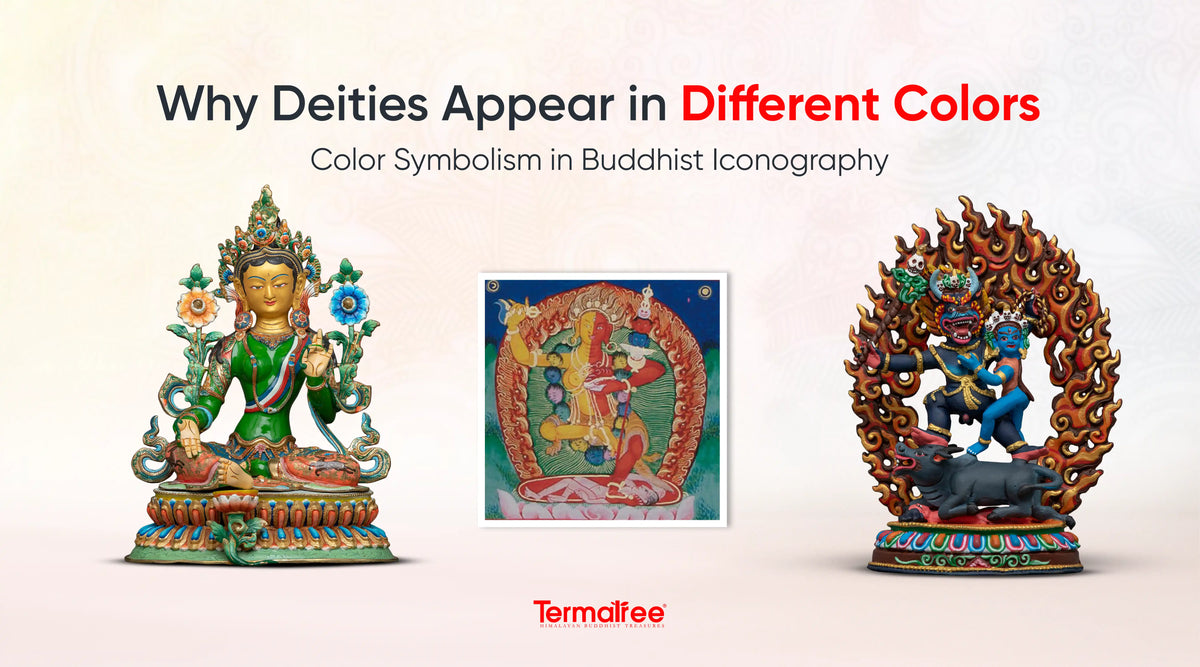

Why so many sacred Himalayan bronzes are empty inside and what that emptiness is actually for
Most people who view a beautifully designed Buddhist sculpture are interested in what they can see: The calm demeanor, the elaborate ornaments, the elaborate robes, and the refined gestures. Many of the traditional statues of the Himalayan Buddhist deity, however, have a hidden element that is not so common: a hollow.
On first inspection a hollow body can appear to be an incomplete crafting or a cost-saving idea. In practice, in the case of a traditional metal sculpture from the Himalayas, the hollow is sometimes more of an intentional and well-executed aspect of the casting process. It is connected to the ancient lost-wax casting technique, a method perfected by Newar artisans of the Kathmandu Valley and widely used for Buddhist and Hindu religious sculptures. The space inside a statue is therefore not a flaw. It is the result of a sophisticated artistic method that allows artisans to create detailed, balanced, and spiritually significant images.
The Technical Reason: How the Statues Are Made

Most Buddhist metal statues bronze, brass, or copper alloy figures from Tibet, Nepal, China, Japan, and Southeast Asia are produced using the lost-wax casting method. In Nepal, particularly within the Kathmandu Valley, Newar metalworkers developed especially refined versions of this hollow lost-wax technique, and their work became renowned across the wider Himalayan region and beyond. Understanding the process explains why hollowness shows up in the first place.
The basic idea works like this: a sculptor shapes a clay core, covers it in a layer of wax carved with all the fine detail of robes, hair, and facial features, then coats that in more clay to form a mold. The whole thing is heated so the wax melts and drains away, leaving a thin cavity in its exact shape. Molten bronze is poured into that cavity, and once it cools, the mold is broken away, and the surface is filed, polished, and finished. Because the bronze only fills the thin space where the wax used to be, the finished statue is essentially a metal shell wrapped around space. The original clay core is usually left inside rather than dug out, but the figure remains substantially hollow.
Why Hollow Casting Was the Practical Choice
This isn't a shortcut or an accident. Hollow casting exists because of real, practical constraints:
-
Material cost: Solid bronze statues of any real size would require enormous amounts of metal, historically one of the most expensive materials available to artisans.
-
Weight: A fully solid figure becomes extremely heavy rapidly as it gets larger, a real problem for anyone who has to carry it to a monastery, lift it onto an altar, or transport it across trade routes. Hollowing the interior let artisans work at an ambitious scale without sacrificing that portability.
-
Casting reliability: Different sections of a mold cool at different rates, and thick, solid masses of metal are especially prone to cracking, warping, or trapping internal stress as they contract. A consistent, relatively thin wall thickness cools more evenly, which protects the fine detail sculpted into the wax and reduces the risk of the casting failing later on.
-
Precision of detail: Because the fine sculptural detail lives in that thin wax layer, hollow casting is actually what allows for crisp, intricate ornamentation, mudras, jewelry, and drapery that would be far harder to achieve if sculptors were carving directly into solid metal.
Hollowness is a deliberate and sensible traditional choice. Seams, sprue marks, and slightly uneven interior walls that show up inside these statues are marks of a handmade process, not defects of modern machine-cast reproductions; by contrast, they tend to have unnaturally smooth, uniform interiors.
Is a Hollow Statue "Lesser" Than a Solid One?

It's a common assumption that a solid statue must be more valuable simply because it contains more metal. In traditional Himalayan and Buddhist sculpture, though, that's not really how value works. Collectors, scholars, and practitioners generally weigh a much broader set of factors, including:
-
The quality and skill of the craftsmanship
-
Accuracy of iconography, correct proportions, mudras, and attributes for the figure depicted
-
The fineness of carved and engraved detail
-
The materials used and how they were finished (gilding, inlay, patina)
-
Historical age and provenance
-
The statue's ritual or devotional purpose and consecration history
A hollow statue produced through skilled lost-wax casting can represent an extremely high level of artistry, and in fact, many of the most historically significant Himalayan Buddhist bronzes in museum and monastic collections were made this way. Hollowness is simply how the tradition has typically produced its finest work.
The Religious Reason: A Vessel Waiting to Be Filled

In many Buddhist traditions, especially Vajrayana (Tibetan) Buddhism, but also in Chinese, Japanese, and Korean practice a statue is not considered a fully sacred object simply because it has been sculpted. It becomes sacred through a ritual process that transforms it from a piece of craftsmanship into what practitioners describe as a living support for devotion and meditation. A central part of that process is filling the hollow interior with consecrated materials before the base is sealed.
What goes inside varies by region and tradition, but commonly includes:
-
Mantra and dharani scrolls: prayers and sacred formulas written or printed on paper or cloth, tightly rolled and placed inside as an enduring devotional presence rather than a decorative afterthought.
-
Sutra excerpts: hand-copied or printed scripture passages, which may be prepared in particular to be done as a merit-making act.
-
Relics or relic substitutes: small relics or relic substitutes, like mini stupas, representing the Buddha's presence, even if one does not have a physical relic.
-
Central wooden dowel: A sacred wooden pillar usually used as the main vertical axis of the statue, symbolizing the axis of spiritual energy through the sacred figure.
-
Others: Medicinal herbs, incense, grains, semi-precious stone materials related to purification, healing and prosperity.
These materials are normally arranged in a purposeful order which fits into the greater cosmological structure accepted by the tradition . Filling is normally supervised by a qualified lama or monk who chants prayers and mantras over each element before it being sealed within . Once the cavity is packed and the base is closed, often with a metal plate that may be soldered, crimped, or otherwise sealed in place, a final consecration ceremony invokes the presence of the deity the statue depicts.
Why the Contents Usually Stay a Mystery

One of the more striking things about consecrated statues is how rarely anyone actually knows what's inside them. Opening a sealed statue is generally considered inappropriate, even sacrilegious, in Buddhist practice, since it disturbs a completed ritual object. As a result, most of what we know about statue contents comes from a fairly narrow set of sources: statues that were damaged or opened for museum conservation, X-ray and imaging studies conducted with religious communities' cooperation, and the documented ritual instructions used by lamas performing the filling ceremony.
Conservators examining sealed statues generally rely on indirect evidence: weight, sound when tapped, and the condition and craftsmanship of the sealing plate, rather than opening them out of curiosity. For collectors and museums, an intact, undisturbed seal is often considered more valuable and significant than satisfying the urge to know exactly what's inside.
Hollow vs. Solid Buddhist Statues
|
Hollow Statue |
Solid Statue |
|
Created through hollow lost-wax casting |
Made with metal filling the entire interior |
|
Lighter compared to size |
Much heavier |
|
Common in traditional Himalayan casting |
Less common for large religious sculptures |
|
Allows consecration materials inside |
Limited interior space |
|
Requires advanced mold-making skills |
Requires significantly more metal |
Both methods can produce beautiful sacred images, but hollow casting remains one of the most important traditional approaches in Himalayan Buddhist sculpture.
Craft Mistake or Intentional Design?

Putting the two threads together, the honest answer is that hollowness operates on two levels simultaneously, and neither one is a mistake:
-
As a casting outcome, the hollow body is the direct, deliberate result of the lost-wax method, a technique chosen precisely because it saves material, reduces weight, casts reliably, and allows for fine detail.
-
As a religious feature, that same hollow cavity is what makes consecration possible. Without an empty interior, there would be nowhere to place the mantras, relics, and sacred substances that many traditions consider essential to making a statue a genuine object of worship rather than merely a sculpture.
In other words, the "flaw" a modern viewer might assume they're looking at is actually doing two jobs at once: it's a sound engineering solution and, in the same breath, sacred architecture. Not every hollow statue was filled some genuinely are just empty castings, and some pieces were hollowed later for purely structural reasons, but the underlying construction method was never a mistake to begin with. It was, quite literally, built to hold something more than metal.
Conclusion: A Hidden Feature with Deep Meaning
The hollow body of a Buddhist statue is not a craft mistake. Himalayan artisans have been employing the traditional lost wax casting technique which is a conscious attempt to make this hollow body for centuries. This hidden inside enables artists to produce sculptures with balance, detail, durability and retain the complexity of the Buddhist iconography. The hollow space is in many traditions a sacred space, too, for the consecration of sacred materials, and the inside is not just a technical one.
As a result, a Buddhist statue has a meaningful presence, both within and without. The visible surface conveys the teaching, its meaning and its symbolism, and the visible interior the craftsmanship, history and sacred traditions from which the image has emerged.
Explore Our Collection of Statues from Termatree.