Dakinis, Emperors, and the Crown that Liberates on Sight
In Tibetan Buddhism, few images are as instantly recognizable as the Karmapa seated beneath a black crown. The Black Hat is more than ceremonial headwear. It is the emblem of the Karmapa lineage, the head of the Karma Kagyu school, and it carries a story of dakinis, emperors, and a line of reincarnate masters that reaches back to the twelfth century.
The Black Crown is not simply a hat identifying the head of a Buddhist school. Within the Karmapa tradition, it represents something much more profound: the awakened activity of the Karmapa and the realization that lies beyond ordinary appearance. Its history combines visionary accounts, tantric symbolism, physical crowns created at different periods, imperial patronage, and a ceremony traditionally understood as offering liberation through seeing. This guide explains who the Karmapas are, the origin of the Black Hat, what it is said to do, and why the lineage still matters today.
Who Is the Karmapa?

The title "Karmapa" is usually translated as "the one who carries out Buddha activity." The Karmapa is the spiritual head of the Karma Kagyu, one of the largest branches of the Kagyu school, which traces its roots to the Indian masters Tilopa and Naropa and the Tibetan translator Marpa. Tradition holds that each Karmapa is a manifestation of Avalokiteshvara (Chenrezig), the Buddha of compassion, which is why the lineage is so closely tied to the ideal of compassionate activity in the world.
The Karmapa line is also significant for a historical reason: it is generally regarded as the first reincarnate lineage (tulku) in Tibetan Buddhism. The practice of recognizing a master's rebirth, now familiar through the Dalai Lamas and many others, is traditionally traced to the Karmapas.
The First Karmapa: Dusum Khyenpa
The lineage begins with Dusum Khyenpa (1110-1193), a close student of Gampopa, the great systematizer of the Kagyu path. After years of intensive practice and retreat, Dusum Khyenpa is said to have attained such complete realization that he could perceive past, present, and future, which is the meaning of his name, "Knower of the Three Times." In 1189, he founded Tsurphu Monastery, which served as the Karmapas' seat for centuries. Before his death, he left instructions about his next rebirth, setting the pattern that later lineages would follow.

What Is the Black Crown Ceremony?
The Black Crown ceremony is known as a special ceremony in which the Karmapa wears the Black Crown. It is traditionally connected with the idea of thongdrol, often translated as "liberation through seeing."
The basic idea is that seeing the crown in the appropriate context can plant a powerful positive impression in the mind of the viewer. The ceremony is therefore not simply a formal display of a religious object. It is understood as an opportunity for beings to encounter a symbol of enlightened activity. The historical origin of the ceremony itself is less certain than the history of the crown. According to teachings presented by the 17th Karmapa, the earliest clear historical source for the Black Crown ceremony comes from the Eighth Karmapa, Mikyö Dorje, although the tradition may have developed earlier.
The Origin of the Black Hat
The Black Hat is explained on two levels: as a legend of spiritual origin and as a historical event at the Chinese imperial court.
The Dakini Crown
According to tradition, when the First Karmapa reached full realization, dakinis, the enlightened feminine beings who guard and empower the practice, honored him with a crown woven from their hair. This crown is described as an expression of his awakened state, not an ordinary object. Tradition says that ordinary beings cannot normally see it, but that it hovers above the Karmapa's head.
The Gift of The Ming Emperor
The historical chapter belongs to the Fifth Karmapa, Deshin Shekpa (1384-1415). In 1407, the Yongle Emperor of the Ming dynasty invited him to Nanjing. The accounts say the emperor saw the invisible crown above the Karmapa's head during a ceremony and, moved by the vision, commissioned a physical replica to be made so that others might see it too. It was crafted of black silk, ornamented with gold and jewels, and presented to the Karmapa.
The Black Hat worn today by the Karmapa is therefore understood as a representation, made visible for the benefit of beings, of the dakini crown that belongs to the lineage's nature. Traditions about the precise whereabouts and form of the original objects vary, so it is wise to treat details of provenance as part of lineage teaching and not as settled museum history.
What the Black Hat Means

The Karmapas became widely known as the "Black Hat Lamas" because of their association with the Black Crown. However, the actual color of the traditional crown is more accurately described within the lineage as a very dark blue or blue-black rather than simple black.
In a teaching on the history of the crown, the 17th Karmapa explained that the Tibetan term traditionally translated as "Black Crown" is zhwa nag po, while the actual color can be understood as deep blue-black. This crown has been connected with the Vajra family of Buddha Akshobhya, whose associated color is deep blue. The crown carries several layers of meaning at once.
-
Awakened activity: Black is not a color of gloom here. It stands for the all-encompassing, protective power of enlightened activity, the very meaning of the title Karmapa.
-
Liberation through seeing: The crown is traditionally said to bring liberation upon sight (thongdrol). Even a glimpse, with faith, is believed to plant a deep karmic seed toward awakening.
-
Authority of realization: The hat does not indicate political rank. It stands for the Karmapa's attainment, handed down through the dakinis.
-
A bridge between visible and invisible: It makes tangible an experience that, in the lineage's view, is otherwise beyond ordinary perception.
The Black Hat ceremony
The Karmapa wears the crown during the Black Hat ceremony, a ritual in which he performs the Karmapa Chenno meditation and the assembled students receive its blessing. The ceremony is among the most sought-after public occasions in the Kagyu world, and attending it is considered a powerful opportunity for merit. Historically, the Karmapa performed it on special occasions, and today he holds it when he teaches at major gatherings. The phrase "Black Hat Lama" became closely associated with the Karmapas because of the Black Crown tradition. It is not a separate religious title unrelated to the Karmapa. Rather, it is an iconic description that highlights one of the most distinctive symbols of the lineage.
The Karmapa in Sacred Art

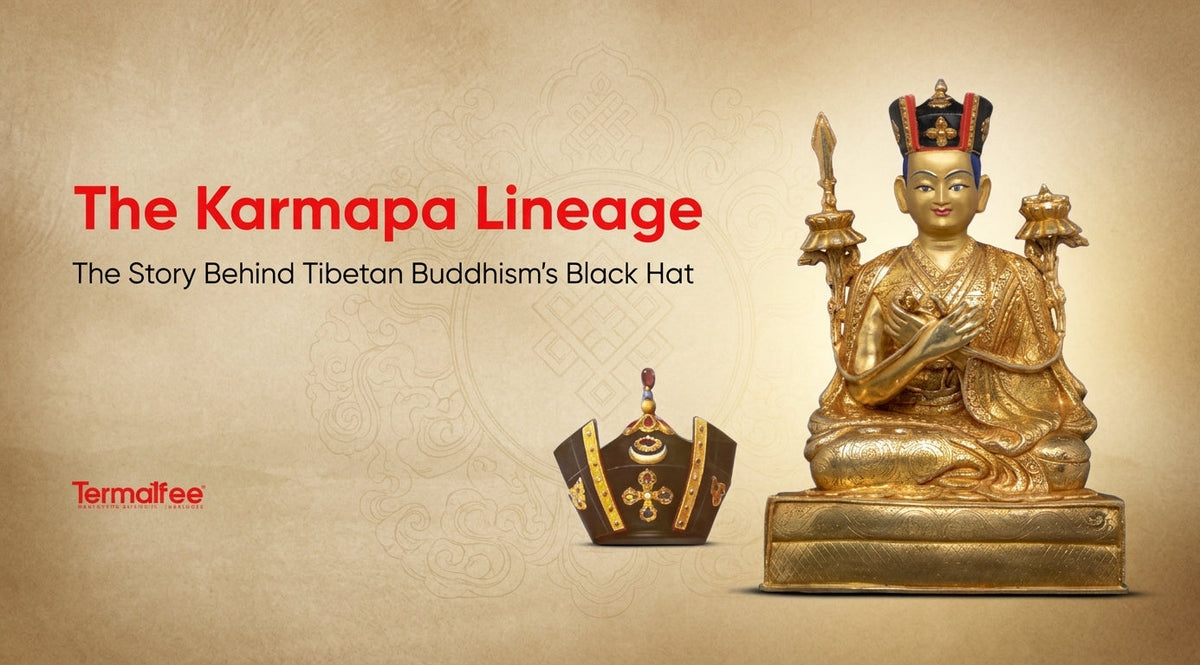
The Black Hat makes the Karmapa easy to identify in thangkas and statues. When you look at an image of a Karmapa, check for these features:
-
The black crown, often shown with gold ornaments and precise tailoring.
-
Seated posture in the meditation position, with hands in the teaching or contemplative gesture.
-
Monastic robes and the calm expression typical of Kagyu depictions of lineage holders.
In practice, such images serve as a focus for devotion and as a reminder of the unbroken transmission of the Kagyu teachings. Traditional artists follow strict iconographic rules, so a well-made image should show the crown clearly and carefully.
A Brief Tour of the Lineage
Seventeen Karmapas have been recognized so far, each leaving a distinct mark. A few stand out.
-
Dusum Khyenpa (1st, 1110-1193): founder of the lineage and of Tsurphu.
-
Karma Pakshi (2nd, 1204-1283): a powerful master who traveled to the Mongol court and was celebrated for his miraculous activity. He is also the first Karmapa explicitly identified as a reincarnation of his predecessor.
-
Rangjung Dorje (3rd, 1284-1339): a towering scholar-yogi who wrote key texts on Mahamudra and Dzogchen and integrated both into Kagyu practice.
-
Deshin Shekpa (5th, 1384-1415): the Karmapa of the Ming imperial court and the Black Hat gift.
-
Mikyo Dorje (8th, 1507-1554): an exceptional philosopher, poet, and artist, often called one of the finest scholars of his era. His artistic legacy also shaped the Karma Gadri school of Tibetan painting.
-
Rangjung Rigpe Dorje (16th, 1924-1981): led his community out of Tibet in 1959 and established Rumtek Monastery in Sikkim, India, as a new seat. He was a key figure in bringing Tibetan Buddhism to the West, giving Black Hat ceremonies to thousands during his world tours in the 1970s.
The Seventeenth Karmapa and a Contested Recognition
After the 16th Karmapa died in 1981, the search for his reincarnation became one of the most debated episodes in modern Tibetan Buddhism. Two candidates are recognized by different parts of the Karma Kagyu community:
-
Ogyen Trinley Dorje (born 1985) was identified through a prediction letter and recognized by Situ Rinpoche and Gyaltsab Rinpoche, and was also recognized by the Dalai Lama. He escaped from Tibet to India in 1999-2000 and is now widely regarded as the 17th Karmapa.
-
Trinley Thaye Dorje (born 1983) was recognized by Shamar Rinpoche, and he has a substantial following, especially in parts of Asia and Europe.
The disagreement has had real consequences for the lineage, including disputes over Rumtek Monastery. Many practitioners respect both teachers while following one. In presenting the lineage, it is fair to say simply that the community remains divided over this question, and that readers should consult their teachers and lineage institutions.
Why the Legacy Endures

The modern history of the Karmapa lineage is complex. The 20th century brought enormous disruption to Tibet and to Tibetan Buddhist institutions, particularly after the political upheavals of the 1950s. Its endurance rests on three things: the continuity of transmission from teacher to student, the practice of compassion embodied in the line of Chenrezig, and the Black Hat itself, a visible symbol that points beyond itself to the awakened mind. The Sixteenth Karmapa, Rangjung Rigpe Dorje, played an important role in preserving the Karma Kagyu tradition outside Tibet and established Rumtek Monastery in Sikkim as an important center of the lineage.
Today, the identity of the 17th Karmapa is a matter of competing recognition between two principal claimants, Ogyen Trinley Dorje and Thaye Dorje. Because this is a sensitive and institutionally contested subject, it is better to describe the competing claims rather than present one recognition as universally accepted. The broader Karma Kagyu tradition continues to exist internationally through monasteries, meditation centers, teachers, scholars, and practitioners.
Conclusion
The Karmapa lineage is one of the most distinctive traditions in Tibetan Buddhism, and the Black Crown is its most recognizable symbol. Beginning with Dusum Khyenpa, the First, the Karmapa lineage developed a unique tradition of successive incarnations in which each Karmapa was understood to continue the enlightened activity of the previous one.
The story of the Black Crown begins with visionary accounts of dakinis offering a crown to Dusum Khyenpa at the time of his realization. Later, physical crowns were created to represent this visionary crown, most famously through the patronage of the Yongle Emperor during the lifetime of the Fifth Karmapa, Deshin Shekpa. Over time, the Black Crown ceremony developed into an important expression of Karmapa activity and became associated with the idea of liberation through seeing. The crown's dark blue-black color, its connection with the Vajra family, its relationship with the Red Crown of the Shamarpa, and its place within Tibetan Buddhist art all reveal that it is much more than ceremonial headwear.