Meaning, Iconography, Mantra, and Practice of The Great Purifier of Vajrayana Buddhism
Almost every practitioner who enters Vajrayana Buddhism meets Vajrasattva early. He is the white, serene, jewel-adorned Buddha who appears in the preliminary practices, and he is often the first deity a practitioner learns to visualize. His name in Sanskrit is "vajra," which means "diamond," and "sattva," which means "being." Together, they form the name "Diamond Being." In Tibetan, he is Dorje Sempa, known as the great purifier. Tibetan masters teach that the practice of Vajrasattva is among the most powerful methods for cleansing negative karma, repairing broken vows, and clearing the obscurations that hide our Buddha nature. In many lineages, it is a required foundation before the higher tantric teachings are given.
This guide covers who Vajrasattva is, how he is depicted and what each symbol means, how the practice is done, what the famous 100,000-mantra retreat involves, and why statues and thangkas of him are made. It is written for curious readers, students, and collectors of Buddhist art.
Who Is Vajrasattva?

Vajrasattva is understood in light of the Buddhist teaching of non-self (anatman). Vajrasattva is known as Adi Buddha, Adi Guru, and Samaya Sattva, and he is practiced across the Nyingma, Kagyu, Sakya, and Gelug schools. He is not a creator god, a judge, or an external being who grants forgiveness. Neither a "who" nor a "what" is ultimately real. The tradition therefore describes him on several levels at once, and none of them cancels the others:
-
As a compassionate Buddha: a kind, understanding presence to whom one can openly confess one's faults.
-
As an emanation: he is described as emanating from the primordial Buddha Samantabhadra, from Vajradhara, or from Akshobhya, the Buddha of the vajra family.
-
As all Buddhas in one: he can be seen as identical in essence with every other Buddha.
-
As our own pure nature: considered a fully awakened being, Vajrasattva is none other than ourselves.
The tradition holds that no single description captures him, even though each is true in its own way. This is why the core statement of the practice is: "Vajrasattva is the practitioner, and the practitioner is Vajrasattva."
The Iconography of Vajrasattva
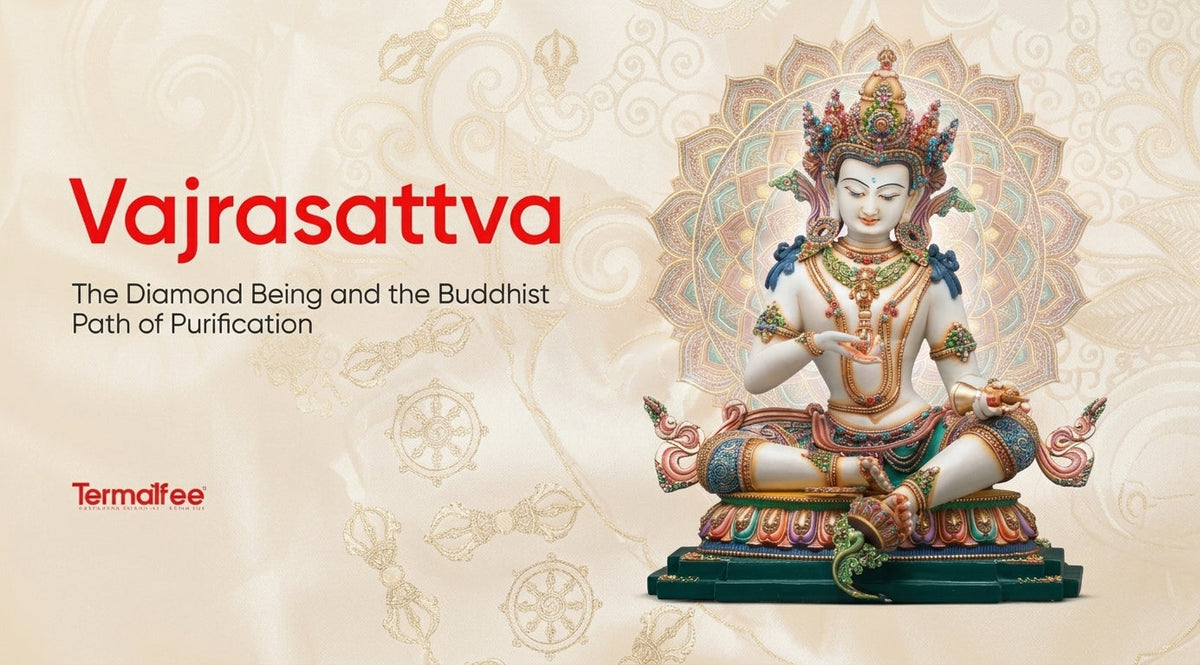
No detail in a Vajrasattva statue or painting is accidental. Each element teaches.
|
Feature |
Meaning |
|
White body |
Immaculate purity; the clear, stainless nature of mind |
|
Vajra held at the heart in the right hand |
Compassion and skillful means; indestructible truth |
|
Bell held at the hip in the left hand |
Wisdom: the understanding of emptiness |
|
Silks and jewels |
The "enjoyment body" (sambhogakaya); the royal attire of an Indian prince, signifying richness of enlightened qualities |
|
Youthful, serene face |
Freedom from aging, decay, and agitation |
|
Full vajra posture (lotus) |
Unshakeable stability, usual in most depictions |
The Vajra and The Bell Together
The pairing of vajra and bell is central to all of Vajrayana. The vajra stands for method, and the bell stands for wisdom. A path with only one of these is incomplete: wisdom without compassion is cold, and compassion without wisdom is blind. Holding both, Vajrasattva shows the union that is the heart of the path. These are the same attributes carried by Vajradhara, from whom Vajrasattva is considered an emanation.
Alone or With Consort

Depending on the tradition and the specific practice, Vajrasattva is visualized either alone or in union with his consort. The union symbolizes the inseparability of method and wisdom, and bliss and emptiness. It is an image of spiritual union, not a worldly one, and it is understood only within the context of tantric teaching.
The Practice: How Vajrasattva Purification Works
1. Purification
Buddhism teaches that our present circumstances arise from past actions of body, speech, and mind (karma). Negative actions leave imprints that cloud perception and produce suffering. As long as the body, speech, and mind remain stained, deeper transformation does not take hold. It is considered especially effective for repairing transgressions of tantric vows (samaya), including breaches in the student-teacher relationship.
Most presentations of Vajrasattva purification are built on a classic framework known as the four opponent powers. A genuine purification practice includes all four:
-
The power of reliance (support): taking refuge and generating bodhicitta, the aspiration to attain enlightenment for the benefit of all beings. Vajrasattva himself is the object of reliance.
-
The power of regret (remorse): honestly recognizing past negative actions and feeling genuine sorrow for them, without self-hatred.
-
The power of the remedy (antidote): the actual practice, which includes visualization, recitation of the mantra, and meditation.
-
The power of resolve (restraint): making a sincere promise to avoid repeating the harmful action, as far as one is able.
2. A typical visualization
Details vary by lineage and by the specific text, and the practice should be learned from a qualified teacher. In general outline:
-
Take refuge and generate bodhicitta.
-
Visualize Vajrasattva above the crown of your head, white and radiant, seated on a lotus and moon disc.
-
At his heart is a moon disc with the syllable HUNG.
-
While reciting the mantra, imagine white nectar flowing down from Vajrasattva, entering the body through the crown, and washing out all negativity, illness, and obscuration as dark fluid or smoke, which leaves through the lower body and is absorbed into the earth.
-
Vajrasattva speaks words of reassurance: your faults are purified.
-
Vajrasattva dissolves into light and merges with you. Rest in that stillness, then dedicate the merit to all beings.
The practice engages all three doors: the body (posture and gesture), speech (mantra), and mind (visualization). This is why it is described as combining meditation with speech, body, and mind. Visualizing the idealized form of an awakened being activates the mind's own capacity for purity.
The Mantras of Vajrasattva
Two mantras are especially important.
1. The six-syllable (short) mantra
"Om Vajrasattva Hum"
This short form is used for daily recitation and for practices on the go.
2. The hundred-syllable mantra
The long mantra is the heart of the preliminary practice. Wording and pronunciation differ somewhat between schools and between Sanskrit and Tibetan renderings. Practitioners receive the mantra through oral transmission from a teacher, and should follow the version used by their own lineage. The mantra asks Vajrasattva to protect the practitioner's commitments, to remain close, to grant spiritual accomplishments, to make the mind virtuous, and not to abandon the practitioner. It ends with a request to be made a vajra, to be oneself.
The 100,000-Mantra Retreat and Ngöndro

In Tibetan Buddhism, Vajrasattva practice is a core part of ngöndro, the "preliminary practices" that prepare the mind for the highest teachings. In most traditions, these include: Taking refuge and developing bodhicitta, Vajrasattva purification, Mandala offerings, and Guru yoga. In some lineages, practitioners are not given empowerment into the highest yoga tantra until they can complete an extended retreat.
Why such a demanding requirement?
The tradition gives a few reasons:
-
Depth of experience: Tibetan masters teach that a deep experience of these practices comes only through sustained, prolonged retreat, not casual sampling.
-
Filtering: The effort separates serious practitioners from those who approach tantra superficially. Hardship discourages the half-hearted. Those who persist show the perseverance and dedication that higher practices demand.
-
Foundation: Without a purified base, advanced practices do not take root, much as a stained cloth does not hold dye evenly.
What practitioners report
According to teachers, after genuine purification, one experiences a profound shift in how the world appears. The world itself has not changed, but the practitioner's view has. Beings and phenomena begin to appear pure, reflecting one's own healing. The pull that anchors us in mundane, ordinary perception loosens, and the "doors of perception" feel open. This gives strong encouragement for the higher path, and convinces the practitioner that enlightenment, though distant, is genuinely attainable. Some teachers say these practices alone can achieve enlightenment.
Vajrasattva in Art: The Purpose of Statues and Thangkas

Statues and thangka paintings go beyond elegance and beauty. Their purpose is to inspire and instruct. A Vajrasattva statue or painting serves practitioners in three ways:
-
As a visualization aid: The practitioner can look at the image to learn the details before reproducing them in the mind's eye. This sharpens and stabilizes meditation.
-
As a support for the mind: It embodies the concept of enlightened purity, so seeing it reminds the viewer of the goal.
-
As a field of merit: In devotional practice, the image is a focus for offerings, prayer, and respect.
As a result, traditional artists follow strict iconometric rules for proportions, postures, and symbolic attributes, often passed down in written manuals and workshops. If you are choosing a statue, look for correct attributes and for care in craftsmanship, such as hand-cast metal with gilding and cold-painted face details in the Nepalese and Tibetan tradition.
Frequently Asked Questions
Is Vajrasattva a god I pray to for forgiveness?
Not in the sense of an external judge. In Buddhism, there is no deity who forgives sins. Vajrasattva practice works through the four opponent powers, and the deity is understood as a manifestation of the purity of your mind.
Can I practice Vajrasattva without initiation?
This depends on the lineage. Some teachers give the practice openly as a purification method, while others require an empowerment or oral transmission. It is best to ask a qualified teacher, especially for the hundred-syllable mantra and the full visualization.
Why is Vajrasattva white?
White is the color of purity, and it reflects the immaculate, stainless nature of an enlightened mind.
What is the difference between Vajrasattva and Vajradhara?
Vajradhara is the primordial Buddha in the Sarma schools, depicted in blue and holding the vajra and bell crossed at his chest. Vajrasattva is considered his emanation, white in color, with the vajra at the heart and bell at the hip. In the Nyingma view, Samantabhadra is the primordial source.
Do I need to do 100,000 mantras?
The number is the traditional requirement for ngöndro, but any amount of sincere practice is considered beneficial. Teachers will advise on the right approach for your situation.