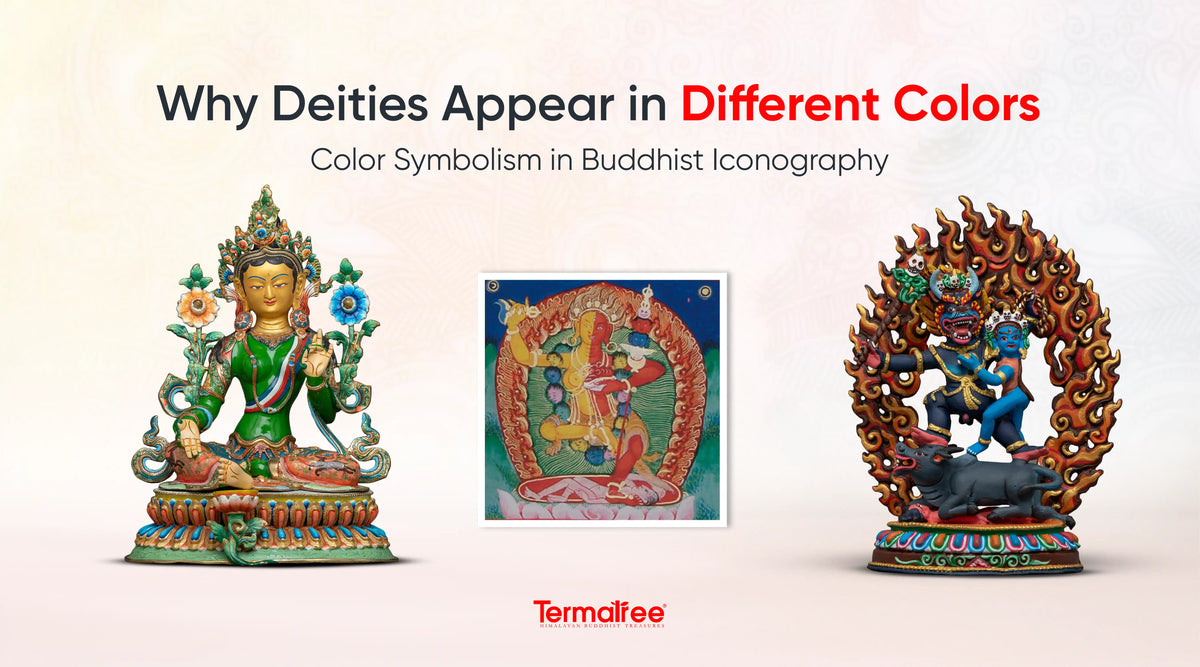

From Green Tara at the Center to the Gatekeepers at the Door
Tara is one of the most widely revered female figures in Vajrayana Buddhism, embodying enlightened compassion, protection, and swift compassionate activity. Known as the “Mother of All Buddhas,” Tara appears in many forms, each expressing a particular aspect of enlightened wisdom and activity. Among the most profound expressions of her sacred presence are Tara mandalas, where her form, surrounding deities, colors, directions, and symbolic arrangements create a complete visual representation of her enlightened realm.
A mandala is not simply an artistic composition; it is a symbolic map of an enlightened universe. In Vajrayana practice, the mandala represents the purified environment of a deity and serves as a support for meditation, visualization, and ritual practice. The Mandala of Tara presents the goddess at the center, surrounded by her retinue and sacred elements that express different aspects of compassion, protection, and liberation. Himalayan Art Resources preserves examples of Tara mandala traditions, including works illustrating the complex arrangement of Tara and her surrounding figures. Among the many Tara traditions, the 21 Taras associated with the Indian master Surya Gupta represent one of the important iconographic systems. This tradition presents Tara in multiple forms, each with distinct colors, gestures, attributes, and enlightened activities
Origins: The Suryagupta Lineage

This mandala comes from the tradition of Suryagupta, also called Ravigupta, a Kashmiri master traditionally placed around the 7th–8th century. According to Himalayan Art Resources, he became known for his visions of Tara, said to have followed a healing from leprosy at her hands. From these visions came several major Tara practice systems, including both the well-known Twenty-One Taras and the more elaborate Seventeen Deity Mandala shown in this painting. In Tibet, his approach became one of three major traditions for depicting Tara, alongside the Nagarjuna tradition and later "terma" (revealed treasure) traditions. The painting also carries a recorded lineage, tracing from Shakyamuni Buddha and Tara herself, through Suryagupta, down a chain of Indian and Tibetan masters, to the Sakya tradition in which this particular thangka was painted.
At the Center: Tara and Her Consort
In the center of the painting, Tara appears dark green, peaceful, with one face and two hands. Her right hand holds a lotus stem at her heart, the flower blooming at her shoulder and supporting a curved knife with a vajra handle. Her left hand holds a white skullcup to her heart. She wears an ornate tiara, large earrings, and red ribbons, her hair piled high with loose strands falling over her shoulders. She sits in union with her consort, Amoghasiddhi, shown light green, holding a multicolored double vajra in one hand and a gold bell in the other. The pair rest together on a moon disc and pink lotus, surrounded by a sphere of swirling red light, the innermost point of the whole mandala.
The Twenty-One Taras: One Compassion, Many Forms
Tara's best-known retinue system is the Twenty-One Taras; twenty-one distinct forms, each expressing a different aspect of her activity: protection from fear, removing obstacles, healing, long life, growing wisdom, overcoming harmful forces, and creating favorable conditions for practice. These aren't twenty-one separate goddesses; they're understood as one compassionate principle responding differently depending on what's needed. In the Suryagupta tradition, each of these twenty-one forms is given her own color, posture, ornaments, and hand implements, making the system unusually detailed compared to other lineages.
1. Color as a Guide to Her Forms
Color is one of the simplest ways to tell Tara's different forms apart:
-
-
Green Tara, the most familiar form, represents active compassion, quick to respond to suffering. Her posture, seated with one leg extended, suggests readiness to act.
-
White Tara represents healing, purification, and long life. She is often shown with seven eyes, symbolizing her ability to see suffering wherever it occurs.
-
Red Tara forms are linked to magnetizing activity; drawing in favorable conditions through transformed desire.
-
Dark or black Tara forms represent forceful protective activity, aimed at clearing away serious obstacles.
-
2. Reading Her Attributes
A few recurring details carry consistent meaning across Tara's forms:
-
-
The lotus she holds represents purity and awakened awareness, since it grows out of muddy water yet blooms untouched.
-
Her hand gestures communicate her activity, one common gesture signals generosity and blessing, while a hand held near the heart signals refuge and the union of wisdom and compassionate method.
-
Her ornaments like crown, earrings, jewelry represent qualities of enlightenment rather than worldly wealth. In some systems, five key ornaments correspond to the Five Wisdoms, symbolizing awakened perception.
-
The Surrounding Ring: The Five Buddha Families

Around the central pair, the mandala places the remaining four of the Five Buddha Families, each paired with a female consort, forming an eight-petaled lotus pattern:
-
Amitabha (red), above, paired with the white consort Pandara Vasini
-
Akshobhya (blue), at the right, paired with the blue consort Mamaki
-
Vairochana (white), below, holding a wheel, paired with the white consort Vajradhatvishvari
-
Ratnasambhava (yellow), at the left, holding a jewel, paired with the yellow consort Buddha-Locani
Each consort matches her Buddha's color and holds a similar curved knife and skullcup. In effect, this ring is the full Five Buddha Family system, doubled into male-female pairs, wrapped directly around Tara and Amoghasiddhi.
The Outer Retinue: Attendants and Gatekeepers
Just beyond the inner lotus ring, within the mandala's square enclosure, sit four female attendants: yellow Mukunda, red Muraja, green Vamsha, and white Vina, each seated with hands held to the heart. Guarding the four doors of the mandala's palace are four fierce gatekeepers, each with an animal face: yellow pig-faced Varamukha at the left, red dog-faced Shvanamukha above, white lion-faced Simhamukha at the right, and white horse-faced Hayamukha below. These animal-headed guardians are a standard feature, marking the boundary of the sacred space against obstruction.
The Palace Itself
The square enclosure represents the walls of a celestial palace. Its roof rises in tiers above each gatekeeper's door, topped with a Dharma wheel flanked by two reclining deer, the same emblem tied to the Buddha's first teaching. Banners and streamers decorate the roofline, and the whole palace rests on a four-colored double vajra, its points ringing the roof. Underneath sits a multicolored lotus, serving as the ground for the entire structure. Outside the palace walls, an outer ring holds various worldly deities, and beyond that, the whole composition is enclosed by five-colored flames, the traditional boundary marking the shift from ordinary space into the mandala's sacred architecture.
Figures Around the Border
Outside the mandala itself, the painting's border holds figures connecting it to a wider lineage and protective context: Shakyamuni Buddha and Tara at the top, followed by generations of teachers; the tantric deity Chakrasamvara; Amitayus, the Buddha of boundless life; the female tantric deity Vajravarahi; the wrathful deity Rakta Yamari; white Avalokiteshvara holding lotus blossoms; wrathful blue Vajrapani; the yellow wealth deity Jambhala; and the protectors black Mahakala and light-blue Shri Devi, riding a mule. A single monk in the lower corner is thought to be the patron who commissioned the painting.
A Different Mandala: The Twenty-One Taras Compared

It's worth being clear that the Seventeen Deity Mandala described above is only one of several mandalas tied to the Suryagupta tradition and structurally different from his better-known Twenty-One Tara system. In that separate cycle, Green Tara again sits at the center, but this time she's surrounded not by the Five Buddha Families, but by twenty further emanations of herself, each with a distinct posture, color, and set of implements, matching specific activities: pacifying, increasing, magnetizing, and wrathful. Unlike the Atisha tradition's version of the Twenty-One Taras, where the forms mainly differ by color alone, Suryagupta's version gives each Tara a genuinely different appearance, reportedly reflecting the full range, peaceful to wrathful, that Tara showed him directly.
Both mandalas share the same underlying idea: a central Tara, surrounded by figures who divide her qualities into distinct, nameable functions, whether that's the wisdoms of the Five Buddha Families, or the twenty-one activities of her own emanations. Either way, the mandala isn't decoration around Tara. It's a map of everything she's understood to encompass.
Conclusion: A Map of Compassion
The Suryagupta Mandala of Tara shows enlightened compassion as more than one quality, it's a complete path, laid out in visual form. Tara at the center represents compassion itself; the figures around her show the many ways that compassion responds to what different beings need. Across generations of Himalayan Buddhist art, these mandalas have carried a consistent message: enlightenment isn't distant from ordinary life. Like Tara herself, it stays present, ready to respond whenever it's called on.
In Vajrayana art, the figures surrounding a deity aren't just decoration each one stands for a specific quality, function, or aspect of that deity's enlightened activity. In a Tara mandala, the retinue is a way of showing the many forms her compassion takes: some figures represent other manifestations of Tara, some represent protection, some represent wisdom, and some support specific activities on the path.