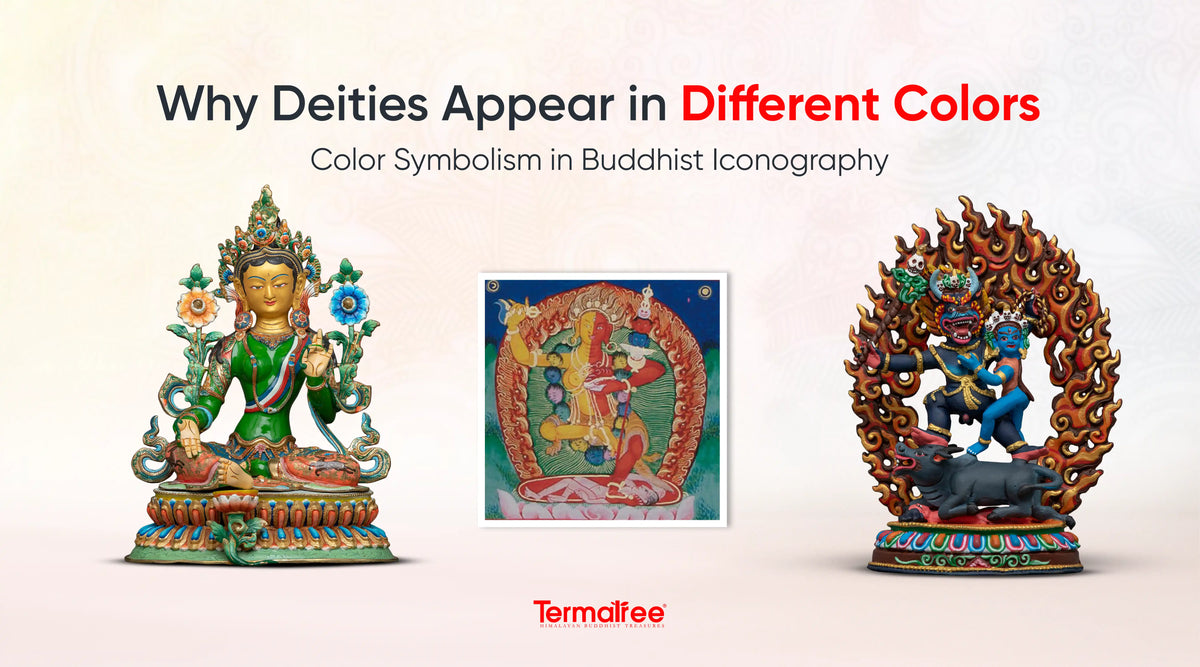

Fierce Compassion and the Transformative Power of Enlightened Wrath
In Vajrayana Buddhism, enlightened beings sometimes appear in fierce, wrathful forms. These super strong looks are not bouts of common anger or violence but symbolic illustrations of enlightenment and compassion that run with unwavering power to slice through ignorance, ego, and intense delusion. Wrathful deities represent the energy of wisdom or compassion, which is powerful, direct, and transformative. Vajrayana does not deny negative emotions, but instead, they can be changed into clearness and understanding once they have been perceived as they are.
The most significant of these wrathful beings are Vajrabhairava and Vajra Vetali, the main deities in the higher practice of tantric Buddhism, especially in the Gelug school of Tibetan Buddhism. He, the wrathful form of wisdom, is the symbol of triumph over death and annihilation of internal barriers, and she is the dynamic force of the awakened consciousness, inseparable from it. The combination of the two makes them a reflection of the marriage of wisdom and method as they prove that fear, mortality, and devastating feelings can be changed into the legitimate means of enlightenment.
Who Is Vajra Bhairava?

Vajrabhairava is also commonly referred to as "Yamantaka," or the "Vajra Terror or Diamond Wrathful One". He is a supposed furious incarnation of Manjushri, the bodhisattva of transcendental wisdom.
Manjushri is represented in this form as a frightening one, having the symbolic meaning of irresistible wisdom that wins over ignorance. Yamantaka is literally translated as "Destroyer of Yama," and Yama was the ruler of death in Buddhist cosmology. Therefore, he is the death-conqueror, not only in physical death but also in spiritual death (ignorance) and the cycles of existence (samsara).
The Iconography of Vajra Terror
Buffalo Head
 The dark buffalo head is looming in the battle with a primordial roar, and symbolizes the victory over Yama, the Lord of Death. According to Buddhism, the buffalo represents ignorance and the blind, tenacious power of samsara. Wearing this face, the deity demonstrates that the supreme knowledge has domesticated the same fear of death.
Multiple Faces
 His numerous faces represent omniscient knowledge. Though the majority of them are frightening, his masterpiece is still Manjushri. This shows that behind the terribly frightening indigo skin and fierce look, the essence of this energy is the wisdom that is pure and calm.
Multiple Arms
His thirty-two arms are a burst of boundless skill. Both hands hold symbolic instruments, the brightly colored ritual ornaments which are used as a form of spiritual surgery and slice through the dense layers of delusion that obscure the human mind.
Multiple Legs
 His sixteen legs are deeply rooted in different beings and worldly gods and symbolize maximum stability. Despite the upheaval of life, he still stands firm, and this represents the power to remain stable as one goes through the swirling winds of earthly life.
Ritual Weapons
 The vajra, skull cup, and curved knife, among others, are symbols of transformation and not violence. The vajra symbolizes wisdom that cannot be destroyed, and the other tools symbolize the slice of ego, attachment, and ignorance.
Flames of Wisdom
Surrounded by a roaring halo of wisdom-fire, his body is fired with a heat which burns the processions of ego-stuff which are the rubbish of the mind. It is no forest fire, it is a purifying fire which burns away the confusion, and leaves the diamond of lucidity beneath.
Consort in Union
 Vajrabhairava is portrayed in the highest yoga tantra images with his consort, as wisdom and compassion cannot be separated. This union is the symbol of nonduality, the total fusion of emptiness and enlightened action.
Who Is Vajra Vetali?

Vajra Vetali is the tantric consort of Vajrabhairava. In Vajrayana symbolism, union with a consort represents the inseparability of wisdom and method. She is not a separate “secondary” figure but an essential embodiment of enlightened energy. Her name also incorporates the word "Vajra," which means "indestructible reality," and "Vetali," which, in many cases, refers to "spirit" or "active force." A dynamic manifestation of wisdom, she is the active part of the same, which refocuses the energies of emotions into the mind of awakened consciousness.
Vajra Vetali frequently appears in iconography in deep embrace with Vajrabhairava, with deep symbolic meaning in the highest yoga tantra. This union of nonduality is the inseparability of complementary principles that mutually provide complete awakening.
1. Emptiness and Compassion
Sunyata confronts Compassion. The fact of togetherness is a testimony to the fact that only when we realize the fact of how interdependent we are, and how ego-less, can we really show kindness.
2. Wisdom and Skillful Means
Vajra Vetali is the Wisdom; Vajrabhairava is the Method. They are the two wings of a bird; without one, the other cannot fly towards liberation.
3. A Stillness and Dynamic Energy
This hug demonstrates that the end of things is at once silent and screaming. It consists of the collision of the mental state, the most quiet as a mountain, and the most lightning-bolt-like.
This symbolic union is the key to Highest Yoga Tantra practice, where awakening does not involve the rejection of opposites but the total unification of the opposites into one non-dual realization.
Tantric Context and Practice

Vajrabhairava practice belongs to Highest Yoga Tantra (Anuttarayoga Tantra), the most advanced class of tantric practice in Tibetan Buddhism. Je Tsongkhapa especially emphasizes it in the Gelug tradition. This path is traditionally undertaken only after strong foundations in ethics, renunciation, and the understanding of emptiness.
The practice generally includes the following stages:
1. Initiation (Empowerment)
The practitioner receives a formal transmission from a qualified lama, which authorizes them to engage in the deity practice. It establishes a sacred connection with the lineage and introduces the practitioner to the enlightened body, speech, and mind of Vajrabhairava.
2. Generation Stage (Kyerim)
Practitioners visualize themselves as Vajrabhairava, dissolving their ordinary identity and re-arising as the deity. This stage trains perception, weakening ego-clinging and cultivating divine pride, the recognition of one’s innate enlightened nature.
3. Completion Stage (Dzogrim)
Advanced meditations work with the subtle body’s channels, winds, and energies. These disciplines are geared to achieving the inseparable experience of bliss and emptiness by way of direct inner transformation.
4. Meditation on Emptiness
The very essence of the practice is deep meditation on emptiness, the ultimate character of any phenomenon. This philosophical understanding is the basis of visualization and subtle-body practices.
By these means, the practitioners are able to change fear, attachment, and, above all, fear of death to wisdom without fear. Nothing is intimidating in the fierce imagery of Vajrabhairava, but it symbolizes the intense destruction of ignorance and the realization of the indestructible clarity.
Symbolism of Wrathful Deities

Vajrayana Buddhism has wrathful deities, which are potent manifestations of enlightened compassion. Their shapes are vicious and even frightening, but their anger is not caused by dislike and violence. Rather, it is a caring intensity, the overpowering power of wisdom that is aimed at piercing through ignorance and setting creatures free from pain.
They have their imagery symbolically to express a few main principles:
- Destruction of Ignorance and Ego: The sharp facial expressions and weapons represent the cutting of self-clinginess and delusion. The wrathful form symbolizes the ruthless character of wisdom that destroys false identity and illusion.
- Protection from Obstacles: The vengeful gods are regarded as protectors of spiritual ways. Their frightening appearance represents the elimination of internal and external barriers to the practice and realization.
- Turning Anger into Wisdom: Emotions in Vedanta psychology are never rejected but transformed. When cleansed, anger becomes the wisdom of a mirror, clear, sharp, and reflective without distortion.
- Courage in Facing Impermanence: Their acute shapes motivate those who practice them to face fear head-on, particularly the fear of death and loss. Instead of shunning impermanence, the practitioner also learns to confront it with fearless awareness.
The fact that Vajrabhairava conquered Yama, the lord of death, is symbolic of a conquest over samsara itself. Through the direct experience of emptiness, the truth of emptiness is symbolically defeated by the practitioners, and they can understand that what the mind truly is is unborn, unceasing, and indestructible.
Knowledge of Non-Dual Philosophy
The concept of Vajrabhairava embodies the combination of absolute and relative truths in Mahayana Buddhism. Ultimate truth is emptiness, which brings to light the fact that everything that exists is devoid of independent existence, whereas relative truth lays stress on compassionate action in mitigating suffering. His appalling shape shows that knowledge and kindness are united elements of enlightenment. This image prompts the conversion of bad emotions, such as anger and fear, into triggers of spiritual development by the cognition of emptiness.
Vajra Vetali is a supplementary symbol of this symbolism, with all the activity and expressiveness of realization. She is wisdom, not fixed or withdrawn. force out of this world, but dynamic, alive, and changing. In combination, they show that real enlightenment is the living relationship of deep understanding and kind action, never-endingly laboring on behalf of all creatures.
Contemporary Relevance of Vajra Bhairava and Vajra Vetali

Although the symbolism of Vajrabhairava and Vajra Vetali was traditionally used by highly developed practitioners, the power of the symbolism is a psychological weapon of our age of burnout and existential anxiety. It is a practice where the modern self-help might say that we should think positively, but this practice has us literally looking right into the eyes of our demons, trauma, rage, grief, and see it in its pure form, as neutral energy. When we give up running, it is the same "scary" energy that will give us the fuel to wake up. This Vajra-Fearlessness is a reminder in a doom-scrolling world that the ego we are afraid of losing was not solid to start with; by understanding that emptiness (Sunyata), we become immovable. This is an active process and not a passive one; it is a dynamic, creative spark that interacts with a chaotic world. Finally, their union turns out to be a revolutionary fact: Wisdom and compassion are neither tender nor frail; they are the most blunt, powerful things in this world.
Conclusion
The Vajra Bhairava and Vajra Vetali are the most deeply rooted wrathful beings in Tibetan Buddhism. Instead of an expression of anger or violence, they are an expression of the ruthless compassion that annihilates ignorance and frees the mind of fear. Being expressions of the wisdom of Manjushri, they educate on the fact that enlightenment is not a passive phenomenon but an active, transformative, and fearless one. Practitioners get to learn through their symbolism and practice to approach death, the dissolving of ego, and the inexplicable, indestructible clarity of the awakened mentality.