
Sacred Gem Inlays in Buddhist Statues and Their Hidden Spiritual Meanings
The gem inlays found in Buddhist statues encode multiple layers of meaning drawn from canonical Buddhist scripture, indigenous Himalayan belief, cosmological symbolism, and over a millennium of closely guarded artistic tradition. Understanding why turquoise, coral, and other stones appear where they do and in which combinations is essential to understanding how Himalayan Buddhism conceives of the sacred and the broader relationship between material substance and spiritual realization.
The Foundational Principle: Matter as Spiritual Virtue

The use of precious materials in Buddhist sacred art rests on a philosophical premise quite distinct from simple notions of aesthetic value or the display of wealth. As stated in the early Buddhist scriptural traditions and developed in the Mahayana philosophical commentaries over later centuries, precious materials are thought to symbolize, not just represent, spiritual qualities. Luminosity, purity, durability, and rarity are not characteristics that gemstones happen to share with enlightened qualities; they are taken to be material expressions of those same qualities, manifested in the physical world.
This understanding is stated with unusual directness in certain Mahayana texts. Gold does not represent enlightenment so much as its incorruptibility and radiance are considered expressions of the same nature that characterizes the Buddha's mind at the level of material reality. Rock crystal, perfectly transparent and free of color, evokes the clarity of meditative awareness not by association but by structural analogy. The gemstone does not point toward a spiritual truth from a distance; it instantiates one.
The Scriptural Basis: The Seven Precious Jewels
The theology behind the use of gems in Buddhist religious art is based on the concept of the Seven Precious Jewels (saptaratna) found in many sutras, including the Lotus Sutra and the Amitābhavyūha Sūtra. In the Lotus Sutra, it vividly portrays the celestial worlds created of these materials, such as the lapis lazuli trees, golden flowers, and crystal rivers of the Pure Land. This is not just an image of material things from which riches are drawn, but rather the quality and brilliance of these gems: analogies of enlightenment in the material world, or a pure and uncorrupted mind.
|
Sanskrit name |
Material |
Spiritual Quality Represented |
|
Suvarṇa |
Gold |
Incorruptibility; the radiance of the enlightened mind |
|
Rūpya |
Silver |
Cleanliness; freedom from delusion in the mind; mental purity. |
|
Vaiḍūrya |
Lapis Lazuli |
Boundless compassion; the healing power of the Medicine Buddha |
|
Sphaṭika |
Rock Crystal |
Mindfulness and clarity; clear awareness. |
|
Musāragalva |
Red Coral |
Force of life and dharma protection |
|
Aśmagarbha |
Ruby or Emerald |
Spiritual achievement; the consuming fire of wisdom |
|
Rohitamukha |
Carnelian |
Vitality; auspicious energetic force |
Turquoise is one of the precious gems used in Tibetan Buddhist rituals and is not mentioned in the classical Sanskrit saptaratna list. It was adopted into the visual tradition of the Himalayas because of the pre-existing Tibetan myths and beliefs, which had great cultural and spiritual weight. This idea is reflected in the fact that the saptaratna was a dynamic concept that evolved to incorporate regional sacred materials as Buddhism spread across Asia.
The Three Defining Inlay Stones
Their individual identities and iconographic associations
Turquoise: Sky, Wisdom, and the Living Stone

Held in Tibetan culture as the National Gem of Tibet, turquoise symbolizes the elements of sky, water, and air simultaneously. It is considered a living stone that ages with its keeper. Strongly associated with Padmasambhava and with divine protection.
Red Coral: Life Force and Compassionate Energy

An organic material the skeletal remains of sea creatures coral carries vitality that mineral stones do not possess. In Buddhist symbolism it represents the life force, the blood of the Buddha, and the fierce commitment of protector deities to the dharma.
Lapis Lazuli: Boundless Compassion and the Medicine Buddha
 Mined primarily in Afghanistan, lapis lazuli is inseparable from the body of Sangye Menla (the Medicine Buddha), whose form the Bhaiṣajyaguru Sūtra explicitly describes as the color of lapis blazing with inner light. Inlaying lapis into such a statue is less decoration than scriptural literalism.
Rock Crystal: Clarity and the Opening of the Eyes

Rock crystal is frequently used for the eyes of consecrated statues. Its perfect transparency free of color, free of distortion represents unobstructed perception. In the Newar tradition, the "opening of the eyes" ritual is the pivotal moment of consecration, and crystal makes that presence visibly alive.
The Complementary Pairing of Turquoise and Coral

The association of turquoise with red coral is perhaps the most philosophically significant in the use of these stones in the art of the Himalayas. These two materials are understood in Tibetan Buddhist culture as complementary opposites, opposite ends of both the color spectrum and the energetic spectrum whose combination in a single object creates a symbolic wholeness that neither stone can achieve alone.
|
Turquoise |
Red Coral |
|
Sky · Wisdom · Cool |
Earth · Compassion · Warm |
|
The celestial element. The clarity of mind that perceives without distortion. Associated with infinite awareness and the dharma's expanse. Turquoise alone is worn during meditation. |
The vital element. The warmth of the heart that acts without hesitation. Associated with life force and bodhicitta. Coral is added when the practitioner seeks vitality or courage. |
The association of turquoise with red coral is perhaps the most philosophically significant in the use of these stones in the art of the Himalayas. These two materials are understood in Tibetan Buddhist culture as complementary opposites, opposite ends of both the color spectrum and the energetic spectrum whose combination in a single object creates a symbolic wholeness that neither stone can achieve alone.
Iconographic Placement: Which Stones Appear Where

The placement of gem inlays on a Buddhist statue is governed by iconographic convention. Different stones appear in different positions for distinct theological reasons, and a careful reader of these conventions can interpret a statue's material program with considerable precision.
1. Crown and Ushnisha
Typically inlaid with the full range of precious stones, turquoise, coral, lapis, and crystal, representing the Five Wisdom Buddhas and the fully awakened mind. Turquoise dominates, placing the quality of wisdom at the physical pinnacle of the deity's form.
2. Eyes
 Rock crystal, for its perfect transparency, is the canonical material for the eyes of consecrated images. The Newar ritual of netra pratishtha, the opening of the eyes, is the moment consecration is understood to be complete, and crystal eyes make that presence visibly luminous.
3. Chest and Necklace
Red coral beads and pendants appear frequently at the chest of bodhisattvas, particularly Avalokiteshvara (Chenrezig). The heart center in Tibetan Buddhism is the seat of bodhicitta, the awakening mind, and coral's association with vital warmth makes it the natural material for this position.
4. Robes and Lotus Base
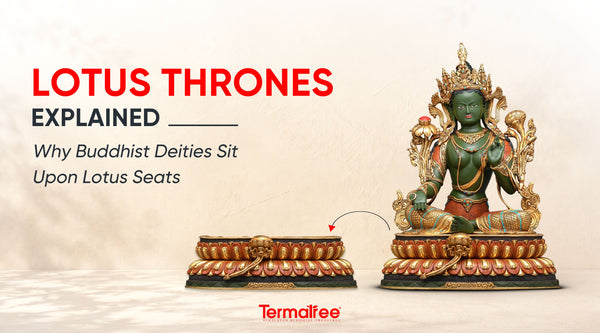
 Turquoise and lapis lazuli inlays along the motif borders of sculpted robes and lotus throne petals extend the symbolic field of wisdom and purity into the space the deity inhabits. In many Nepalese gilt-copper statues, the lotus base petals are outlined in alternating turquoise and coral, placing the union of wisdom and compassion at the deity's very foundation.
5. Ritual Objects
Vajras, bells, and other implements held in the deity's hands are themselves inlaid with turquoise, lapis, and coral. The bell, representing wisdom and emptiness, and the vajra, representing means and compassion, each bear stones that reinforce those identities at the level of material substance.
The Newar Craftsmen: Masters of the Inlay Tradition
The finest gem-inlaid Buddhist statues in the world are produced in the Kathmandu Valley by the Newar people, specifically by hereditary craft communities whose knowledge of sacred metalwork has been transmitted within family lineages for over a millennium. The Newar system of statue production is notable for its division of specialized labor: the Shakya community manages the lost-wax casting process; the Tamrakars are adept in metalworking with copper, bronze, and brass; the Manadharas specialize in the intricate detailing of features and ornaments; and the Vajracharyas, tantric priests, perform the ritual consecration without which no statue, however technically accomplished, can function as a sacred object.
Gem inlay is applied following casting and gilding, once the statue's surface has been prepared. Turquoise, coral, and lapis are cut and shaped to fit precisely into channels carved or cast into the metal, a process requiring lapidary skill and an intimate knowledge of the statue's iconographic program. The placement of each stone follows canonical guidelines transmitted through the craft lineage. What distinguishes Nepalese statues from Indian and Tibetan equivalents is precisely this combination of gilded gold surfaces against turquoise, coral, and lapis; the tension between warm metal and cool stone producing objects of extraordinary visual and devotional intensity.
Consecration: When the Stones Become Sacred

A finished statue, however perfectly executed and richly inlaid, is not yet a sacred object. In both Nepalese and Tibetan Buddhist traditions, a consecration ceremony called "rabne" in Tibetan and "pratishtha" in Sanskrit must be performed before the statue can function as a locus of the deity's active presence. The Tibetan rabne is an elaborate ritual requiring the collection of specific materials: mantras inscribed on incised plates, sacred texts, fragrant herbs, and a symbolic "life tree" (srog shing), a wooden dowel inscribed with mantras that serves as the deity's spine. These are placed within the hollow interior of the statue, which is then sealed at its base.
The gem inlays on the exterior are understood to participate in this consecration as part of a unified sacred program. From the craftsman's first cut of the stone, the gems are part of an iconographic whole that will be activated through ritual. Once consecrated, the turquoise in the crown, the coral at the chest, the lapis along the robe all of these are understood not merely to represent spiritual qualities but to embody and transmit them to the practitioner who meditates before the statue. The object becomes, in effect, a material argument for the reality of enlightenment: substantiated in gold, crystal, and stone.