Exploring Mahakala's Many Forms and The Wisdom Behind His Fierce Protection
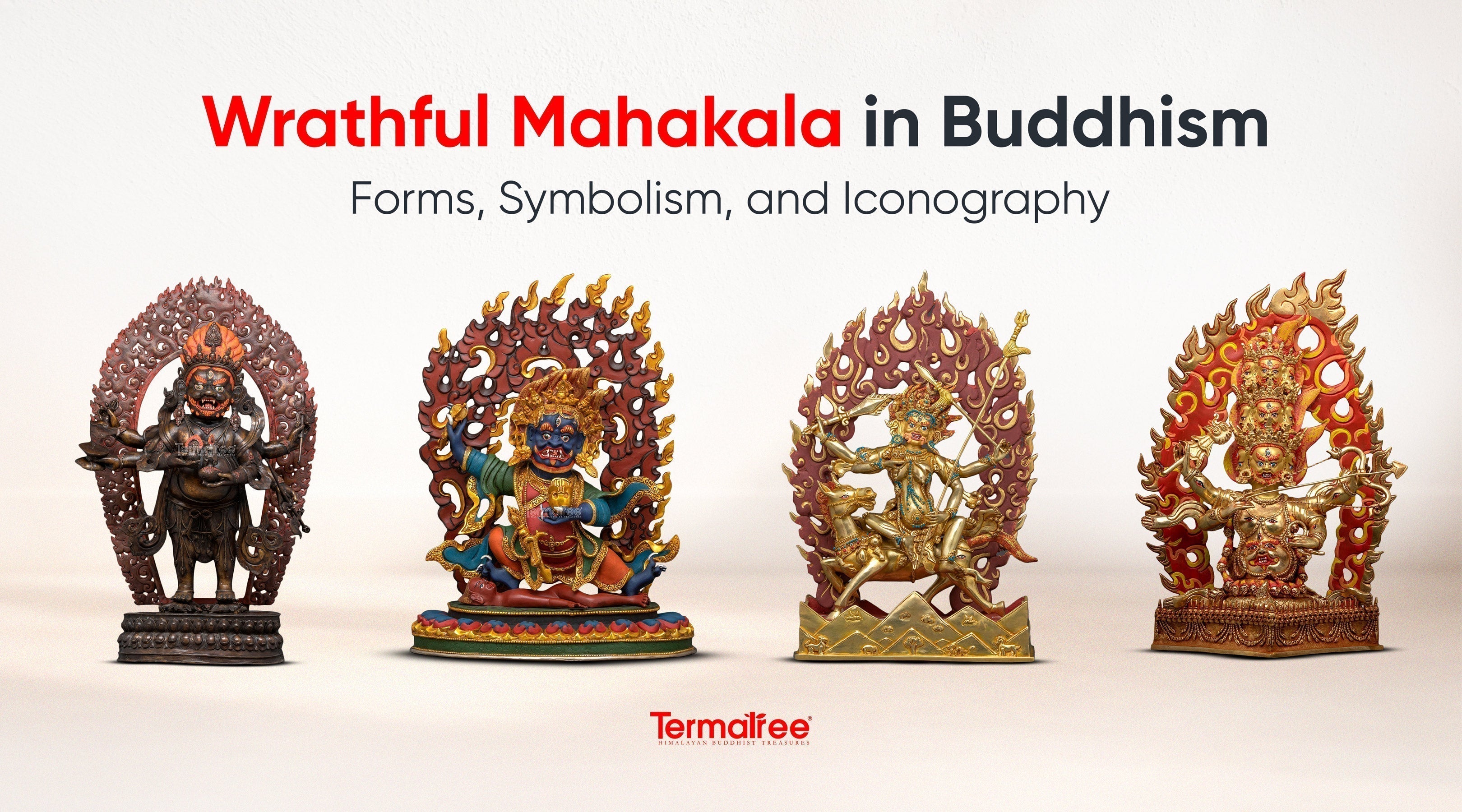
Among the many powerful figures of Vajrayana Buddhism, Mahakala holds a unique and respected position as one of the most important Dharma protectors (Dharmapala). With his dark body, fierce expression, flaming hair, skull ornaments, and powerful stance, Mahakala may appear intimidating at first glance. His wrathful appearance does not represent anger, violence, or destruction in the ordinary sense. Instead, it symbolizes the force of enlightened wisdom that removes ignorance, destroys obstacles, and protects the Buddhist teachings.
In the Vajrayana tradition, wrathful deities are the active and dynamic expression of compassion. Peaceful Buddhas guide beings with wisdom and compassion; wrathful protectors like Mahakala represent the power needed to overcome inner obstacles such as ego, attachment, hatred, and delusion. Mahakala appears in many different forms in the traditions of Tibetan Buddhism. Each incarnation has its own iconographic traits, colors, number of arms, ritual objects, and symbolic meanings. They all look different, but they all serve the same objective: to protect the Dharma and to help practitioners on the path to awakening.
Who Is Mahakala in Vajrayana Buddhism?

Mahakala, whose name means "Great Black One," is among the most important Dharmapalas in Vajrayana Buddhism. He is generally regarded as a wrathful emanation of Avalokiteshvara, the bodhisattva of compassion, and is relied upon across every major school of Tibetan Buddhism, appearing in distinct forms tied to specific lineages, practices, and functions.
It's important to clarify from the outset what that wrathful appearance actually means. Mahakala's fierce expression, blazing hair, and fearsome ornamentation are not expressions of anger in the ordinary sense; they represent enlightened activity aimed squarely at destroying the ignorance, ego, and negative forces that obstruct beings from reaching liberation. Tradition holds that Avalokiteshvara, recognizing that his peaceful forms alone would not be enough to subdue the difficulties of a degenerate age, took on this wrathful form specifically to protect practitioners and safeguard the Dharma itself, a compassionate strategy, not a loss of composure.
Different Forms of Wrathful Mahakala in Buddhism
1. Six-Armed Mahakala

The Six-Armed Mahakala, known in Sanskrit as Shadbhuja Mahakala, is one of the most widely depicted and practiced forms of Mahakala across Tibetan Buddhism, and serves as the principal protector of the Shangpa and Kagyu traditions in particular.
-
Black/dark blue color – represents the all-absorbing, wrathful power that consumes ignorance and negativity.
-
Three eyes – symbolize awareness across past, present, and future, so nothing escapes his protective vigilance
-
Crown of five skulls – shows that the five negative emotions (like anger and greed) have been transformed into five wisdoms rather than simply eliminated.
-
Figure underfoot – represents the ego or self-grasping being subdued, not killed, but mastered.
-
Six hands and Implements – each tool has a job: the curved knife cuts through ignorance, the skull cup holds transformed negativity, the drum calls beings to awaken, the skull rosary tracks the beings he's liberated, the trident pierces the three poisons (attachment, aversion, delusion), and the lasso binds and captures negative forces.
2. Four-Armed Mahakala

The Four-Armed Mahakala represents a related but distinct form, differing from the six-armed version in both emphasis and typical ritual context. Where the six arms are generally tied to the six realms or Six Perfections, four arms are more often read as symbolizing mastery over the four cardinal directions or the four types of enlightened activity: pacifying, enriching, magnetizing, and subjugating, giving this form a slightly more directly activity-based character.
-
Dark color and fierce look – same wrathful vocabulary as the six-armed form, signaling shared protective function
-
Crown of skulls – same meaning as above, transformed emotions
-
Four arms – tied to the four cardinal directions or four types of enlightened activity (pacifying, enriching, magnetizing, subjugating), giving this form a more action-oriented character than the six-armed version
-
Core four implements – a pared-down version of the six-armed set, suited to quicker, more direct ritual use
3. White Mahakala

White Mahakala represents a striking departure from Mahakala's more commonly seen black or dark blue forms. His white coloration doesn't diminish his wrathful nature so much as redirect its emphasis: rather than a purely destructive or subjugating force, White Mahakala is regarded primarily as a wealth deity and a benevolent protector, invoked for prosperity, generosity, and the removal of poverty and material obstacles, alongside his continued role in guarding the Dharma.
-
White color – unusual for Mahakala; signals a shift away from purely subjugating energy toward something more benevolent
-
Wealth bag or mongoose spouting jewels – classic wealth-deity symbols; the mongoose in particular is associated with the removal of poverty since it's said to spit out jewels instead of swallowing them
-
Overall shift in role – still wrathful in nature, but the "fierceness" here is aimed at obstacles to abundance and generosity, not at ego or hostile forces directly.
4. Mahakala Bernagchen

Mahakala Bernagchen, whose name translates to "Black-Cloaked Mahakala," holds a special place as the principal protector of the Karma Kagyu lineage, closely associated historically with the first Karmapa, Dusum Khyenpa. Distinct from the many-armed forms described above, Bernagchen is generally depicted as a two-armed form of Mahakala, a simplification that lends this form a particular emphasis on swiftness, directness, and focus rather than the elaborate multiplicity of implements seen in the six-armed form.
-
Two arms – a deliberate simplification meant to convey speed and single-minded focus rather than the elaborate, multi-tasking protection of the six-armed form.
-
Dark cloak – his defining visual feature, giving him a "black-cloaked" identity distinct from other Mahakalas; reinforces the sense of a swift, close-at-hand protector.
-
Attributes – fewer implements, again emphasizing directness over breadth of function.
5. Sakya Mahakala

Mahakala also holds a distinct, lineage-specific identity within the Sakya tradition, where his particular form and associated rituals carry unique ceremonial significance closely tied to Sakya doctrine and the history of its practices. As with Bernagchen's role in the Karma Kagyu lineage, Sakya Mahakala functions as a primary protector specific to the tradition's own ritual calendar, monastic ceremonies, and transmission lineage, distinguishing his practice and iconographic emphasis from the six-armed, four-armed, and Bernagchen forms described above, even while sharing Mahakala's broader wrathful, protective character.
-
Dark color and fierce look – same wrathful vocabulary as the six-armed form, signaling shared protective function
-
Crown of skulls – same meaning as above, transformed emotions
-
Four arms – tied to the four cardinal directions or four types of enlightened activity (pacifying, enriching, magnetizing, subjugating), giving this form a more action-oriented character than the six-armed version
-
Core four implements – a pared-down version of the six-armed set, suited to quicker, more direct ritual use
6. Palden Lhamo

Palden Lhamo (Sanskrit: Shridevi) stands apart from the Mahakala forms discussed above as the only female figure among the traditional group of Eight Great Dharmapalas, and is regarded as Mahakala's female counterpart and companion protector. She is uniquely positioned as the personal protector of the Dalai Lamas, a role that tradition traces back to a vow made to the first Dalai Lama, Gendun Drup, to safeguard his reincarnation lineage, a duty she is said to have kept across all fourteen Dalai Lamas since.
-
Riding sidesaddle over a sea of blood, on a mule – the blood represents the destructive, transformative energy of wrathful compassion; riding sidesaddle is a specific traditional detail tied to her mythic origin story.
-
Extra eye on the mule's haunch – extends her vigilance even to what's happening behind her; nothing is missed.
-
Three eyes – same meaning as other wrathful deities, watching past, present, future
-
Garland of severed heads – represents victory over ego and negative forces, a common motif among wrathful deities.
-
Seated on her son's flayed skin (in some depictions) – a dramatic symbol of destroying even the deepest, most personal attachment, showing that no obstacle, however intimate, is spared
7. Ekajati

Ekajati, whose name means "One Braid" or "Single Hair-Lock," is among the most instantly recognizable protector deities in the Nyingma tradition, distinguished by an iconography built almost entirely around the number one: a single central eye in the middle of her forehead, a single sharp tooth or fang, a single breast, and a single upward-flowing braid of hair, with some regional and lineage-specific forms depicting her with only one leg as well.
-
Single eye, tooth, breast, braid – the repeated "oneness" is intentional: it represents non-duality, a single undivided point of wrathful awareness, unlike the symmetrical, two-sided features of most deities.
-
Sometimes one leg – an extension of the same one-pointed symbolism
-
Role as protector of terma teachings – her fierce, asymmetrical form matches her job of fiercely guarding hidden treasure-teachings until the right moment for their revelation
Comparative Analysis of Wrathful Mahakala
Looking at these forms side by side reveals both a shared underlying logic and significant lineage-specific variation.
Masculine vs. feminine forms
Mahakala's forms represent the masculine side of wrathful protection, seen as emanations of Avalokiteshvara. Palden Lhamo and Ekajati represent the feminine side, each with her origin and role, not simply a female version of a male deity.
Arms, colors, and implements
Arm count usually maps to a specific meaning: six arms for the six realms or Six Perfections, four arms for the four directions or activities, and two arms for speed and focus. Black and dark blue stand for wrathful, all-absorbing power, while White Mahakala shifts that same energy toward generosity and prosperity.
Lineage-specific roles
Bernagchen belongs to Karma Kagyu; Sakya Mahakala to Sakya, and Ekajati mainly to Nyingma, each with its own rituals and history, even while sharing the same general wrathful look: skulls, flames, and a fierce stance.
Wrathful appearance as protection
Across all these forms, fierce imagery represents the strength needed to overcome deep internal obstacles such as ego, ignorance, and self-grasping, as well as outside threats. None of them are wrathful without reason; their intensity matches exactly what they are meant to overcome.
Why are Wrathful Deities Important in Vajrayana Buddhism?

Wrathful deities demonstrate one of Vajrayana Buddhism's deepest teachings: that compassion can appear in more than one form. The peaceful figure may inspire kindness and gentle devotion; the wrathful figure, courage, determination, and the will to face what a peaceful approach alone may not be able to overcome.
Mahakala specifically reminds practitioners that the biggest obstacles on the path are often internal, rather than external: ignorance, pride, attachment, fear, and negative emotions. His fierce look is not to scare for the sake of scaring. His fierce look inspires practitioners to confront these obstacles head-on, not avoid them, and to turn them into wisdom rather than repress them. Thus, wrathfulness in Vajrayana iconography is as much a teaching device as a protective one: it exemplifies the kind of unflinching honesty a practitioner needs to bring to their own inner obstacles, meeting them head-on rather than turning away.
Conclusion
Taken together, the wrathful forms of Mahakala, alongside protectors like Palden Lhamo and Ekajati, form less a single fixed iconography than a spectrum of enlightened activity, each figure calibrated to a specific lineage, ritual purpose, and symbolic emphasis while sharing the same underlying commitment to safeguarding the Dharma and its practitioners. Their number of arms, choice of color, specific implements, and lineage affiliations all carry deliberate meaning, turning what might look at first like simple ferocity into a precise visual language built up over centuries of practice and commentary.
For practitioners, these forms remain central to meditation, ritual, and iconographic tradition specifically because their fierce appearance was never meant to frighten for its own sake. Read correctly, Mahakala, Palden Lhamo, and Ekajati are best understood not as figures of anger but as compassionate protectors whose intensity matches the seriousness of what they guard against, proof that in Vajrayana Buddhism, even the most unsettling imagery can be, at its core, an expression of care.