How a Tantric Practice and A Historical Master Reveal the Same Enlightened Wisdom
In Tibetan Buddhism, some figures are historical people who lived, taught, and left a legacy behind Yumkha Dechen Gyalmo and Yeshe Tsogyal. Others are meditation deities, visualized forms used in practice to awaken specific qualities within the practitioner. What makes both Dakini's such a fascinating pair to explore together is that they are not really two separate, competing figures at all. They are deeply connected, almost two faces of the same jewel, and they understand how Vajrayana Buddhism thinks about enlightenment, feminine wisdom, and the dakini principle.
Who Is Yumkha Dechen Gyalmo?

Yumkha Dechen Gyalmo, known as "Queen of Great Bliss," is a meditation practice and visualized deity belonging to the Longchen Nyingtik cycle of teachings. This cycle is a terma, or revealed treasure teaching, brought forth by the great Nyingma master Jigme Lingpa. She is specifically a sadhana practice centered on Yeshe Tsogyal, the consort of Guru Rinpoche, approached here as a wisdom dakini. She holds a central place within the Longchen Nyingtik as one of its three root practices, alongside Lama Rigdzin Düpa and Yidam Palchen Düpa, representing the guru, the meditation deity, and the dakini respectively. In other words, she is the dakini root of this entire cycle of teachings.
Origin of Yumkha Dechen Gyalmo
The tradition holds that in 1773, Jigme Lingpa visited Tsogyal Lake and, amid wondrous signs, beheld the face of the Wisdom Dakini himself, receiving symbolic scripts that he later deciphered to produce the practice text used today.
According to the sources, Yumkha Dechen Gyalmo is the embodiment of the unity of wisdom that realizes emptiness and great bliss, with her practice designed to reveal awareness, or rigpa, which lies beyond dualistic concepts. Descriptions of her iconography vary across sources and lineage traditions; some depict her in a semi-wrathful form with a hand drum and a curved knife, while others portray her as a more peaceful, serene figure. This kind of variation is fairly common across Vajrayana deities, where the same figure may be visualized slightly differently depending on the specific lineage or empowerment being followed. Her ultimate nature is understood through the three bodies (kayas) of a Buddha: as Samantabhadri in the dimension of dharmakaya, as Vajravarahi in the sambhogakaya, and as Yeshe Tsogyal herself in the nirmanakaya, or physically manifested form.
The Iconography of Yumkha Dechen Gyalmo
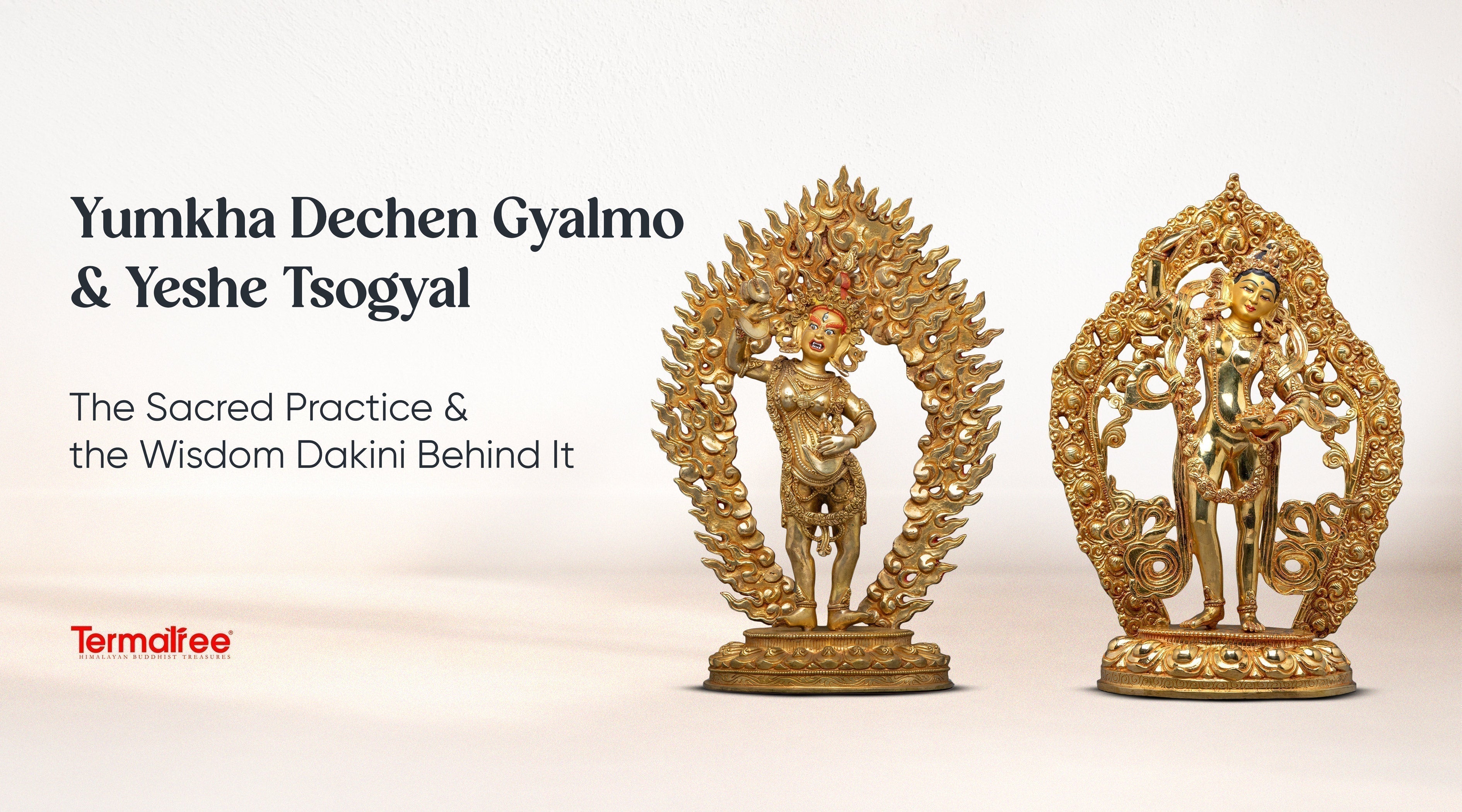
Her visual form carries specific symbolic weight, though it varies somewhat by lineage.
Semi-wrathful form:
-
Red color: reflects deep, focused energy rather than anger.
-
Damaru in right hand: used to call beings toward awakening.

-
Semi-wrathful expression: conveys intensity aimed at transformation, not aggression.
-
Garland of flowers with bone ornaments: reflects both her wrathful, protective quality and her connection to natural, life-giving energy.

-
Standing pose with right foot raised: symbolizes her readiness to act for the benefit of beings at any moment
-
Curved knife in left hand: represents cutting away ego and dualistic thinking.

Peaceful form:
-
Blue color instead of red
-
Serene, peaceful expression rather than wrathful
-
Attributes like the lotus and vajra, rather than the drum and knife
Who Is Yeshe Tsogyal?

While Yumkha Dechen Gyalmo is a visualized practice, Yeshe Tsogyal is remembered first as a real historical woman, an 8th-century Tibetan figure regarded as one of the most important founders of Buddhism in Tibet. She is best known as one of the principal consorts and closest disciples of Guru Padmasambhava (Guru Rinpoche), the Indian tantric master who established Vajrayana Buddhism in Tibet. Alongside him, she is remembered as instrumental in translating, practicing, and concealing many of the Terma teachings, hidden treasure texts meant to be revealed by future generations of masters, much like the very cycle that produced Yumkha Dechen Gyalmo centuries later.
Within the tradition, Yeshe Tsogyal is regarded as the founding mother of Tibetan Buddhism, with all female buddhas understood as manifestations of her as the Wisdom Dakini. She is not remembered as a supporting figure alongside Padmasambhava, but as a fully realized master and enlightened being in her own right.
The Iconography of Yeshe Tsogyal
- White or soft coloring: reflecting purity, wisdom, and her role as a realized teacher.
-
Peaceful, serene expression: rather than wrathful or fierce.

-
Curved Knife: a common dakini attribute representing skillful means and her connection to Guru Padmasambhava.
-
Skull cup held in hand: symbolizing transformed negativity turned into wisdom.

-
Seated posture: generally shown in a calm, dignified pose.
-
Standing pose with right foot raised: symbolizes her readiness to act for the benefit of beings at any moment.
-
Overall appearance: emphasizes her identity as a wise teacher and consort, rather than a purely wrathful protector figure
How the Two Are Connected Between Yumkha Dechen Gyalmo and Yeshe Tsogyal
Yumkha Dechen Gyalmo is not a rival deity to Yeshe Tsogyal, nor an earlier or separate figure. She is, in a very real sense, Yeshe Tsogyal seen through the lens of tantric visualization practice, a doorway to recognizing Yeshe Tsogyal's own enlightened nature. In the Yumkha practice, practitioners meditate specifically on the wisdom dakini Yeshe Tsogyal, understanding her as the embodiment of the three kayas all at once. They represent two different ways of approaching the same underlying wisdom:
|
Yumkha Dechen Gyalmo |
Yeshe Tsogyal |
|
|
Nature |
A visualized meditation deity and sadhana practice |
A historical 8th-century Tibetan master |
|
Origin |
Revealed as a terma by Jigme Lingpa in the Longchen Nyingtik cycle |
Lived and practiced alongside Guru Padmasambhava |
|
Role |
The "dakini root" of a specific tantric cycle, used for meditation and empowerment |
Regarded as the founding mother of Tibetan Buddhism and a fully enlightened master |
|
Function |
A practice for realizing rigpa (innate awareness) and the union of emptiness and bliss |
A living embodiment and teacher of that same realized wisdom |
|
Relationship to each other |
Represents Yeshe Tsogyal in her nirmanakaya, or manifested form, within a threefold body framework |
Is the very figure Yumkha Dechen Gyalmo practice centers on and reveals |
If Yeshe Tsogyal is the person, Yumkha Dechen Gyalmo is the practice built to help a meditator connect directly with her realized state, almost like the difference between a great teacher's life story and the meditation designed specifically to internalize what made that teacher enlightened in the first place.
Why This Distinction Matters Between Yumkha Dechen Gyalmo and Yeshe Tsogyal
 Tibetan Buddhism has an endless list of separate female deities and saints, each unconnected to the next, almost like a crowded gallery of unrelated figures. But this pairing reveals a deeper, more thoughtful connection: History and practice are deliberately woven together. A realized master's life does not just get remembered in stories and history; it gets transformed into a living practice, carefully structured so that future students are not only inspired from a distance by her example, but can actually walk a path designed to touch the very same realization she embodied. With Yeshe Tsogya, her life as a historical teacher became the foundation for an entire visualization practice, allowing generations of practitioners long after her physical lifetime to still connect with her wisdom in an immediate, experiential way, rather than only reading about it.
This is also a good example of how the dakini principle operates more broadly in Vajrayana Buddhism. A dakini is not simply a "female deity" in some interchangeable sense. She represents dynamic, embodied wisdom in motion wisdom that is not purely conceptual, but active and alive. Depending on the context and lineage, a dakini's form can shift between the historical, the symbolic, and the purely visionary. Yumkha Dechen Gyalmo moves across all three of these dimensions, which is exactly what makes her a rich example of this principle in action.
The Practice Today: Dakini Day and Living Transmission

The Yumkha Dechen Gyalmo practice is not simply preserved in old texts; it's actively practiced today, particularly on Dakini Day, the 25th day of the Tibetan lunar calendar, observed at Nyingma monasteries and centers around the world, including Namdroling. On this day, practitioners often gather for a tsog, or feast offering, bringing food, flowers, and other offerings as part of the ritual. The empowerment for this practice has also been passed down through an unbroken line of highly respected teachers over the past several decades, including Dzogchen Rinpoche, Dilgo Khyentse Rinpoche, and Trulshik Rinpoche, among others, with each transmission keeping the practice alive for new generations of students. This ongoing transmission is itself a quiet demonstration of the very idea explored earlier in this piece: realization passed forward not just as a story, but as something still actively given, received, and practiced.
Conclusion
Yumkha Dechen Gyalmo and Yeshe Tsogyal are not really two figures to be measured against each other or compared for which is "greater" or more central to the tradition. They're better understood as two windows looking into the very same room, each offering a different angle on one shared truth. One window shows us a woman who lived, taught, and helped bring Buddhism to Tibet at a pivotal moment in its history, standing alongside Guru Padmasambhava himself. The other window offers something different but equally valuable: a structured, repeatable path for touching that very same enlightened quality directly, through visualization, mantra, and sustained practice, regardless of how many centuries separate the practitioner from her lifetime.
Together, they remind us of something central to Vajrayana Buddhism as a whole: realization is not only something to admire from a respectful distance, held up as an unreachable ideal in the stories of great masters who came before us. It's something a practitioner is actively invited to step into directly, here and now, through practices built with exactly that purpose in mind. In this sense, Yumkha Dechen Gyalmo isn't simply a tribute to Yeshe Tsogyal's memory; she is an open door, still standing, still ready to be walked through by anyone sincere enough to try.