
From Patan's Ancient Artisans to Fire-gilded Gold, the Story of Nepal's Oldest Sacred Craft
Behind many of the finely detailed Buddhist statues found throughout the Himalayas is an ancient sculptural technique known as lost-wax casting. The method is based on a simple but remarkably precise principle: an artist creates a sculpture in wax, surrounds it with a heat-resistant mold, removes the wax through heating, and then fills the resulting cavity with molten metal. Once the metal cools, the mold is broken away to reveal the sculpture.
In Nepal, particularly in the Kathmandu Valley, lost-wax casting became an important tradition of religious sculpture. Newar artisans developed and refined hollow lost-wax casting over centuries, producing Buddhist and Hindu images renowned for their intricate details. The technique continues to be practiced today, making it an important connection between historical Himalayan sculpture and contemporary sacred art.
What Is Lost-Wax Casting?

Lost-wax casting is a process in which wax is used to create the original model of a sculpture and is then removed before the metal is cast. The wax is therefore “lost,” giving the technique its name. The method allows an artist to reproduce extremely fine details that would be difficult to achieve by simply carving a finished metal block. Facial expressions, jewelry, crowns, clothing, ornaments, and other intricate features can all be modeled directly into the wax.
The technique can produce both solid and hollow sculptures, but hollow casting is particularly important for larger metal images because it reduces the amount of metal required and makes the finished sculpture considerably lighter.
Lost-Wax Casting Comes to the Kathmandu Valley
As Buddhism spread through Central Asia, China, Tibet, and Nepal, Nepali metalwork was influenced by the Pala Empire's bronze-casting tradition in Bengal (8th–12th centuries), while still developing its own distinct look, rooted in Patan's own artisan lineage. By the time the Malla dynasty ruled the Kathmandu Valley (roughly 1201–1779 CE), Newar artisans had already refined the craft into a clear visual language, set proportions, iconographic rules, and finishing techniques passed down through families rather than written manuals. This period marked the classical peak of Newar metalwork, with royal patronage supporting temple sculpture across Kathmandu, Patan, and Bhaktapur.
Araniko was a Newar artist who, in 1278, led a group of 60 to 80 Newar craftsmen to Tibet at Kublai Khan's invitation. Araniko went on to become chief court architect and artist in the imperial Chinese court, having a lasting impact on Buddhist art across East Asia. His story illustrates something that has remained true for centuries: Newar metalworkers were never simply a local craft tradition; they were, and still are, sought after well beyond Nepal's own borders, supplying some of Tibet's most important monasteries with sacred images.
Today, that same lineage continues in the workshops of Patan's Mangal Bazaar and the surrounding lanes of Lalitpur, carried forward by hereditary artisan castes, most prominently the Tamrakar, alongside the Shakya and Shilpakar families, many of whom trace their craft back, in both practice and lineage, to the medieval masters of the Malla period.
Why Lost-Wax Casting Became Important in Nepal

The technique was particularly well suited to creating complex religious sculptures. Buddhist statues often contain numerous intricate elements:
-
Elaborate crowns
-
Multiple arms
-
Delicate fingers
-
Jewelry
-
Lotus petals
-
Flowing garments
-
Ritual objects
-
Fine facial features
-
Intricate ornamental details
Lost-wax casting allows these forms to be modeled before the metal is introduced. The mold captures the contours of the wax model, allowing the finished metal sculpture to retain much of that detail. For Himalayan Buddhist sculpture, this technical flexibility is particularly valuable because iconographic accuracy and fine detail are closely connected.
The Lost-Wax Process, Step by Step
Despite centuries of refinement, the underlying process a Newar artisan follows today would still be recognizable to a bronze caster from a thousand years ago. It generally unfolds across five distinct stages.
1. Building the model
 The process begins with a hand-sculpted model, most often built directly in wax, though some workshops start from an inner clay or clay-and-resin core before layering wax over it. The sculptor shapes the figure, a Buddha, a bodhisattva, or a Hindu deity, according to strict iconographic conventions: exact proportions, hand gestures, attributes, and facial expression all follow rules that have been passed down for generations, since these statues function as both sacred objects and technical works of art. In many Patan workshops, several artisans collaborate on a single piece, each specializing in one stage of the process: modeling, casting, chasing, or gilding.
2. Encasing the model in clay
 Once the wax model is finished, it's coated in several careful layers of clay, often mixed with natural binding materials to help it hold together and withstand heat. Thin wax rods, called sprues, are added to create channels that will later let molten metal flow in and trapped air and gas escape. This clay shell, once fully dried, becomes the mold, an exact negative impression of every detail the sculptor carved into the wax.
3. Removing the Wax
 The clay-encased model is then heated over a fire. As the mold warms, the wax inside melts completely and drains away, leaving a perfectly detailed hollow cavity in its place; this step gives the technique its name. What's left afterward is only the clay shell, now an empty vessel waiting to become metal.
4. Pouring the metal
 This step is widely considered the most delicate moment in the entire process. The selected metal alloy, typically copper, bronze, brass, or in some cases panchaloha, a traditional five-metal alloy combining gold, silver, copper, iron, and tin used for particularly sacred commissions, is heated to a precise molten state and poured into the mold. Workshops often go quiet during this step; even a slight miscalculation in temperature or timing can undo weeks of careful sculpting. Nepali artisans have historically favored copper-rich alloys in particular, prized for producing a smoother, more refined surface finish than the higher-tin bronzes more common in Indian metalwork.
5. Breaking the mold reveals the statue

Once the metal has cooled and solidified, the clay shell is broken away entirely. The mold cannot be reused, which is part of why every lost-wax statue is technically one of a kind, even when cast from a similar model. The rough metal figure that emerges is then dipped and cleaned to remove residue before the real detailing work begins.
6. Chasing, Chiseling, and Polishing
 Coming out of the mold is only the beginning. Artisans use small hand tools, to correct the shape, sharpen details, and refine what casting couldn't capture. This chasing stage brings a statue's expression, jewelry, and drapery to life, often taking weeks per piece. Nepali artisans favor copper here since it can be re-hammered and re-carved repeatedly with little risk of cracking.
7. Fire Gilding: The Golden Finish
 Many Nepali and Tibetan statues get their gold surface from fire gilding, or mercury gilding. Gold is ground with mercury into an amalgam, painted onto the statue, and then heated with a torch. The mercury evaporates, leaving a fused layer of pure 24-karat gold, later polished with agate stones to a lasting shine. The process is as risky as it is beautiful; mercury vapor is highly toxic, so it's grown rarer, now reserved mostly for higher-end commissions, with gold-leaf gilding as a safer alternative. Where it survives, it's concentrated among a handful of hereditary workshops in Patan.
8. Final Details: Stones, Paint, and Consecration

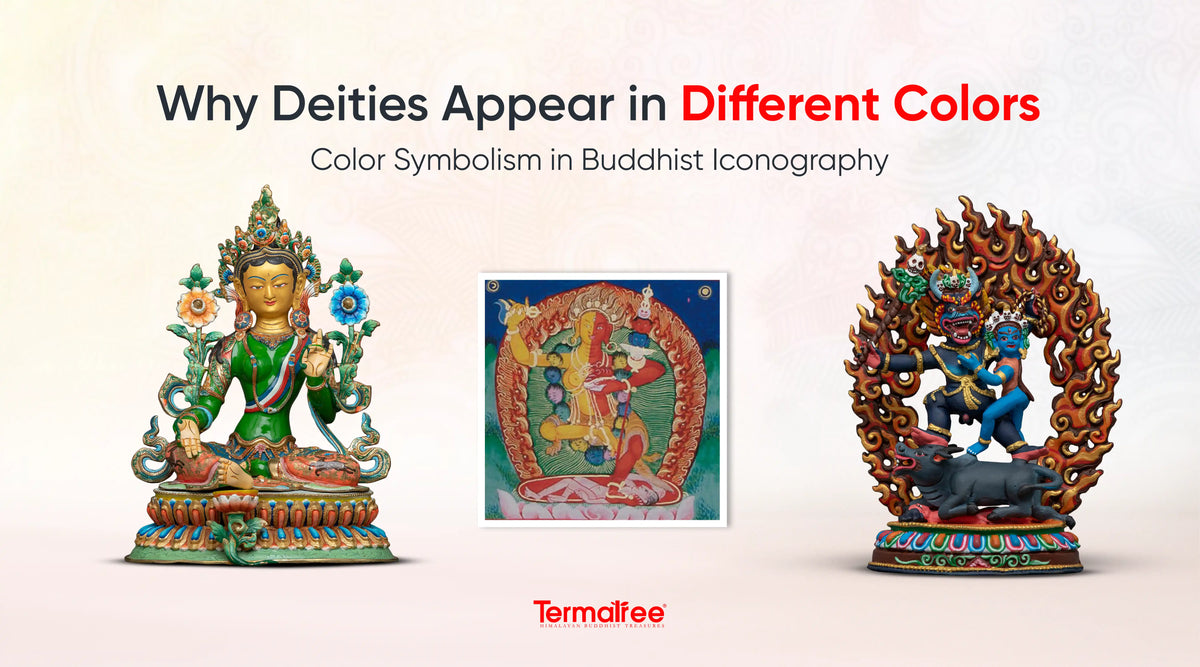
Semi-precious stones like turquoise, coral, lapis lazuli, and rock crystal are often inlaid into crowns and jewelry. Faces may be finished with "cold gold" paint and liturgical colors matched to the deity: blue or black for peaceful figures, red for wrathful ones, and always blue for the Medicine Buddha's body. For many Newar artisans, the craft has never been separate from its spiritual purpose; historical accounts describe ritual purity observed during sacred commissions. Once complete, statues are often formally consecrated, a step believed to transform sculpture into a living support for practice.
Lost-Wax Casting in the Kathmandu Valley and Buddhist Art
Nepal's Kathmandu Valley is particularly important in the history of Himalayan metal sculpture. The Newar artistic communities of the valley developed highly sophisticated traditions of metal casting, and Patan/Lalitpur remains strongly associated with this craft. The tradition encompasses both Buddhist and Hindu sculpture. Specialized hereditary communities, including Shakya and Tamarakar metalworkers, have historically played important roles in Nepalese metalcraft. What makes this tradition especially significant is its continuity. The same broad principle of wax modeling, mold-making, casting, and hand-finishing remains part of contemporary Himalayan sculpture.
Lost-wax casting has an especially important relationship with Buddhist sculpture because Buddhist images require a combination of technical precision and iconographic knowledge. A sculptor creating a Buddhist deity must consider much more than the general appearance of the figure. The number of arms, hand gestures, attributes, posture, ornaments, facial expression, and proportions can all contribute to the identification and meaning of the image. Lost-wax casting gives the artist the flexibility to model these complex forms before they become metal. This is particularly valuable for Himalayan sculptures with elaborate crowns, multiple arms, intricate jewelry, lotus bases, and finely detailed garments.
Why Traditional Lost-Wax Sculpture Still Matters Today

Modern manufacturing can reproduce objects quickly, but traditional lost-wax sculpture retains importance because the process preserves a relationship between artist, material, technique, and cultural tradition.
The method is particularly valuable in Himalayan Buddhist art because it allows contemporary artisans to continue producing sacred images using a technique that has deep historical roots in the region. Museums such as the Rubin Museum continue to document Nepal's lost-wax tradition precisely because it represents not only a method of making objects but also an important part of Himalayan artistic heritage.
More Than a Method
The traditional lost-wax process is often described in a single sentence: make a wax model, create a mold, melt the wax, and pour in metal. But the actual process is far more involved. The artist must first give form to the wax, build a mold capable of surviving intense heat, control the movement of molten metal, break away the mold, repair and refine the casting, and finally complete the surface through engraving, gilding, painting, or other techniques.
In Himalayan Buddhist sculpture, artists combine this technical process with an equally important understanding of sacred iconography. The result is not simply a metal object but a sculpture in which craftsmanship, tradition, and religious symbolism come together.
Conclusion
Traditional lost-wax casting is one of the most remarkable techniques in the history of metal sculpture. From the initial wax model to the final hand-finished statue, every stage requires careful preparation and specialized knowledge.
In Nepal, particularly within the Kathmandu Valley, Newar artisans have maintained and refined this technique as a living tradition. Its importance to Buddhist sculpture is especially clear in the intricate statues of Buddhas, Bodhisattvas, and deities whose complex iconography demands extraordinary precision. The beauty of a traditional lost-wax sculpture therefore lies not only in what can be seen on its finished surface. Behind every detailed crown, delicate ornament, expressive face, and carefully formed lotus is a long sequence of decisions, materials, techniques, and skilled hands. That hidden process is what makes traditional Himalayan metal sculpture such an important part of Nepal's artistic and cultural heritage.