A Buddhist Tale of Courage, Generosity, and The Ultimate Act of Compassion
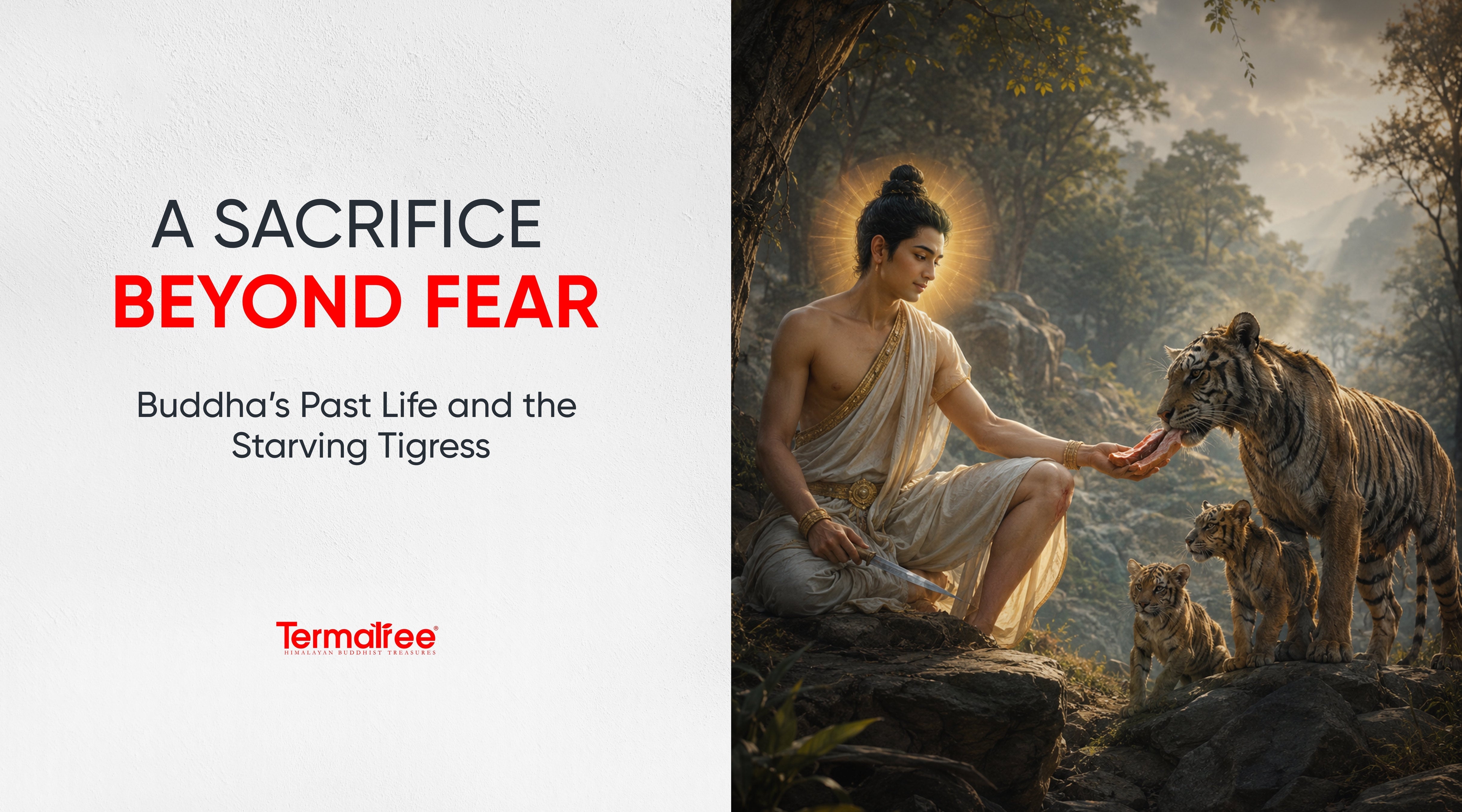
The story of one of the strongest acts of compassion in Buddhist tradition is that of the future Buddha known as Prince Mahasattva, who gave his body to a starving tigress who was so hungry that she ate her own cubs. The Starving Tigress is a Jataka story on sacrifice, which is beyond fear, self-interest, and even self-preservation. The prince felt extremely compassionate and realized that if he left her alone, the tigress would kill her cubs to feed and save herself, and she and her cubs would eventually die. He readily offered his life in exchange for the tigress and her cubs, and thus he showed that the greatest gift there is to give is one's life.
This story illustrates that the journey to enlightenment is a long one that takes many lives of giving but no taking. The sacrifice made by Prince Mahasattva is one of the most powerful examples of giving (dāna pāramitā) and limitless compassion that is taught in Buddhist teachings. It tells us that fear is overcome by love and compassion and that the story is the call for us to live courageously and to practice radical kindness towards the most vulnerable.
What Is a Jataka Tale?

Jataka tales are ancient tales speaking of the Buddha's previous lives in human form, animal form, or other forms, showing a particular virtue that the Bodhisattva acquired in the course of his path to enlightenment, such as generosity, patience, or compassion. By presenting the lessons of Buddhism in the form of these stories, the actions and sacrifices undertaken to develop moral qualities become more accessible. The tale of the starving tigress is one of the deepest and greatest examples of generosity and limitless compassion. Prince Mahasattva gives his life to save a tigress, starving for food, and her cubs, and teaches Buddhists everywhere that enlightenment is built upon acts of love and courage.
The Story of the Starving Tigress
The Bodhisattva was born long before he was the Buddha, as Prince Mahasattva, a noble and compassionate prince. On one day, when he was walking in the forest with his two brothers, he saw a terrifying sight. The gorge was filled with a hungry tigress who was weak and emaciated from the birth of her cubs. She only had a few cubs to raise, and she was going to eat her cubs to feed them! The tigress was so weak that she was unable to move much, and her hunger had become so acute that her instincts were being overcome by desperation.
At this sight, Prince Mahasattva was deeply moved with compassion. He realized.
“If I do nothing, the tigress will kill her cubs. If she eats them, both mother and cubs will eventually die. The only way to save them all is to offer my body.”
His brothers were nearby, but Mahasattva sent one of them away to search for food, ensuring he could make his sacrifice without interference. With no hesitation and no fear, the prince climbed to the top of a steep cliff overlooking the gorge where the tigress lay. He jumped off, throwing himself into cutting his own flesh and feeding it to the starving tigress to make himself accessible for the feeding, and prepared himself to offer her his flesh. The tigress, deprived of all rest and respite and being very hungry, ate his body. In this way, she and her cubs were spared death. The Primitive teaching is,
“Worse than sacrifice of one's flesh, there is nothing at all.”
Key Themes and Lessons of Buddha and Tigress

1. Compassion Beyond Fear
The phrase “A Sacrifice Beyond Fear” perfectly sums up this story. The greatest fear of any was death, and Prince Mahasattva chose the path of compassion. His act shows that compassion requires courage and the abandonment of ego and body. Overcoming even the deepest fear, the prince showed that love and empathy can triumph over all else, even in great danger, and that a brave man will risk his well-being for others.
2. Selfless Generosity (Dāna Pāramitā)
This story exemplifies the perfection of generosity, one of the Six Perfections (Pāramitās) in Buddhism. The Bodhisattva did not give aside material gifts but his very life, the greatest gift of all. In Buddhism, giving is not just about providing someone with money or property; it's about giving without expecting anything in return. Prince Mahasattva gives all his body demonstrating that giving everything, including oneself for the benefit of others, is the highest level of generosity.
3. Non-Harm and Interconnectedness
The story conveys the message that life is interdependent. The prince rescued the tigress from the act of killing her cubs and saved them all from the extreme act of killing. The prince saved the tigress from committing the serious karma of killing her cubs and saved them all from such a serious act of killing. The Buddhist concept of 'do not harm' (ahiṃsā) and demonstrates the power of a single kind act to interrupt a cycle of violence and suffering. Actions of kindness towards even the most desperate of lives create positive ripple effects for all life.
4. The Path to Enlightenment
This statement does not mean that Buddha was enlightened by a flash of inspiration. He was practicing the Pāramitās again and again in countless past lives. This was an important step on his path to enlightenment as the Buddha. It is a reminder of the fact that spiritual growth is a process that requires time, patience, and many meaningful actions. As more lives were added to his wisdom and compassion, the great sacrifice he made for the starving tigress was a significant step toward his ultimate enlightenment.
How does Namo Buddha Temple Shape this Story?

The Namo Buddha Temple also plays a significant role in the impact of the story, as it is now a place of pilgrimage and spirituality that can be experienced in a tangible way. Located in Nepal’s Kavre district, about 40 km southeast of Kathmandu, this holy site is believed to be the exact location where Prince Mahasattva offered his body to the starving tigress. The main stupa stands over the believed remains (bones and hair) of the prince, making the sacrifice tangible and real for visitors. It is the site that millions of pilgrims from Nepal, Tibet, and the rest of the world visit to pay respects, pray, and meditate, carrying forward the story over the ages. In the peaceful mountain environment, one can contemplate compassion on a personal level, with monasteries such as Thrangu Tashi Yangtse passing the message on to new generations. The story without Namo Buddha may be a legend, but with the temple, it becomes a living experience where pilgrims are moved to press their hands to the ground where the sacrifice took place and are also inspired to practice selflessness in their lives.
Artistic Approach in Thangka and Statue

The tale of Prince Mahasattva and the starving tigress is depicted as sacred and not violent in Buddhist art. It's about compassion, giving up, and the fearless giving of the Bodhisattva. His calm expression reveals that it is not fear but wisdom and love that impels him to offer the prince.
In Thangka Art
In Thangka painting, this Jataka story is frequently represented as a narrative scene, which depicts the forest, the cliff, the tigress, the cubs, and the Prince Mahasattva. The forest is the symbol of the suffering world, and the starving tigress with her little cubs is a symbol of helplessness and starvation. The prince is typically depicted with a serene expression, a gentle demeanor, and possibly a halo, symbolizing his benevolence and unwavering spirit.
In Statue Form
The story can be depicted in statue form as a three-dimensional composition of Prince Mahasattva close to the tigress and cubs. He may be bent forward in a gesture of giving, representing selfless giving. The wound or sacrifice should be presented in a respectful and symbolic way without being overly graphic so that it can be placed for devotional or altar worship.

Symbolic Meaning
Prince Mahasattva symbolizes the Bodhisattva ideal of giving oneself for the benefit of others. The tigress is in extreme suffering; the cubs are those who were born without any evil, and the forest is samsara. The overall message of the artwork is that through generosity and enlightenment, we can overcome fear, suffering, and death and that such transformation can happen as a community.
Conclusion
Prince Mahasattva and the starving tigress represent one of the most poignant examples of compassion in the Buddhist tradition. It teaches that giving isn't just about wealth, food, or comfort but can be the deepest form of giving, where another's suffering outweighs one's own fear. In this act, He makes visible the heart of the Bodhisattva path: one act of bravery, one act of compassion, one act of wisdom. This story is not just portrayed as a tragedy in thangka painting or statue making. It turns into a visionary instructional tool that is sacred. The prince's calmness, the starving tigress, the helpless cubs, and the forest scene all remind the viewer of the reality of suffering and the potential for its transformation through compassion. The painting reminds practitioners of the merits of generosity, interdependence, and the courage to respond when others need it.
The Tigress Jataka and the Buddha Jataka show that the path to enlightenment is paved with innumerable acts of kindness, patience, and selfless giving. In the end, Prince Mahasattva's sacrifice transcends mere history, serving as an enduring testament to how, in the midst of terror, compassion can be the most powerful of forces.