A Deep Journey Into the Spiritual, Artistic, and Cultural Significance of Himalayan Buddhist Sacred Objects
In the ancient courtyards of Patan, one of the three royal cities of Nepal's Kathmandu Valley, the sound of hammers tapping against metal has echoed for over a thousand years. Artisan families, the Shakya and Chitrakar communities, have passed down sacred knowledge from generation to generation: how to cast a deity's eyes; how to mix the precise mineral pigments that will survive centuries on a painted scroll; and how to consecrate a finished object so that it becomes not merely beautiful but spiritually alive.
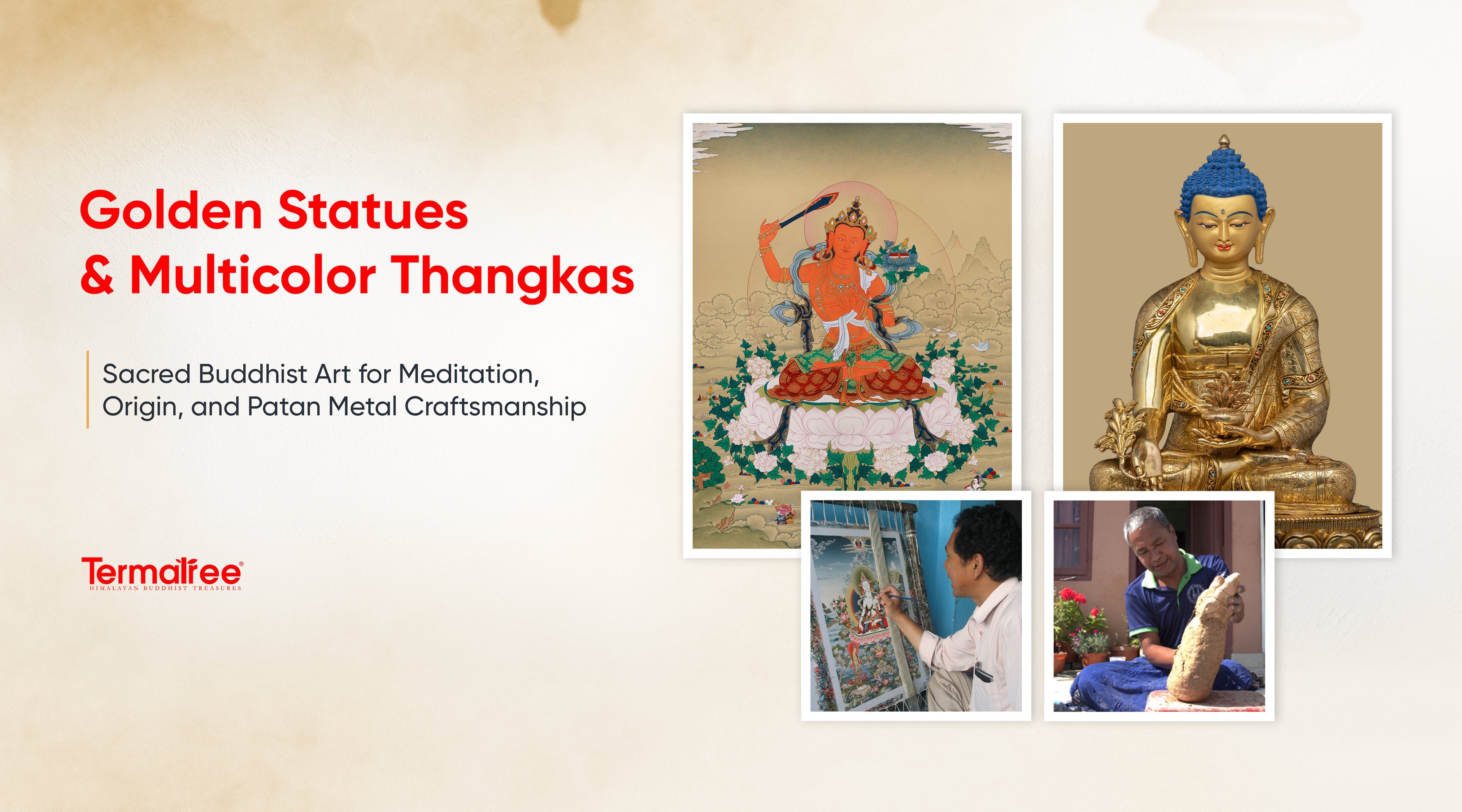
Buddhist sacred art encompassing golden deity statues, gilt-bronze Bodhisattvas, and multicolor Thangka scroll paintings is among the most sophisticated and spiritually intentional visual traditions on earth. These objects are not simply decorations. They are considered supports for awakening, portals between the ordinary mind and the enlightened state, and mirrors of the cosmos as understood within Vajrayana Buddhist philosophy.
Origins of Buddhist Sacred Art

The creation of sacred Buddhist imagery started centuries after the Buddha's passing into Parinirvana, specifically around 480 BCE. Early Buddhist communities were initially aniconic, abstaining from human depictions of the Buddha and, in their place, using symbols like footprints, an empty throne, the Dharma wheel, and the Bodhi tree. The first depictions of Buddha in human form can be dated back to the Kushan Empire (1st-3rd centuries CE) from areas such as Gandhara and Mathura. Gandharan art displayed Hellenistic characteristics, such as flowing robes that seemed like those of Apollo, but Mathuran art was distinctly Indian.
Artistic traditions blended and evolved as Buddhism traveled through Central Asia, China, Tibet, and Nepal along the Silk Road. Influential on the metalwork of Nepal was its advanced technique in the casting of bronze, as practiced by the Pala Empire of Bengal (8th–12th centuries). When the Malla dynasty came to power in the Kathmandu Valley (13th-18th centuries), the Newars had already developed their own artistic style, which was both unique and refined, blending Indian, Tibetan, and local traditions. Thangka painting has been done in Tibet since the 10th to 12th centuries and was inspired by the Buddhist paintings of India. In Tibetan, "thangka" translates to "thing that can be rolled up," reflecting its practical utility as a portable devotional item, suited to the nomadic lifestyle of Tibetans and the mobile monastic lifestyle.
Golden Statues: The Living Presence of the Divine

The figure of a golden Buddha, sitting in the prayer room of any monastery, temple, or shrine in the Himalayas, is immediately self-evident. These are not merely sculptures; they are considered supports for the enlightened mind, or in Sanskrit, "pratima." Once ritually consecrated through an elaborate ceremony called "prana pratishtha,” a statue is believed to become a living presence capable of receiving offerings, transmitting blessings, and serving as an object of meditation.
The principal materials and their symbolism
The most revered Buddhist statues are cast in copper alloys, typically a blend of copper, bronze, silver, and sometimes gold, with the finest examples fire-gilded using mercury-gilding techniques. The symbolism of gold is so strong that in Vajrayana Buddhism it symbolizes the changeless, radiant nature of the awakened mind, imperishable and untarnishable. The warm golden surface of a well-made image is meant to evoke the rupakaya, the "form body" of an enlightened being, which Buddhist philosophy describes as spontaneously radiant and adorned with the signs of perfection.
Copper is considered the ideal base metal because of its workability, durability, and its traditional association with the earth element. The venerable copper smithing lineages of Patan have historically used a copper-to-alloy ratio passed down orally within families, one of the many elements of sacred craft knowledge that resists documentation.
The 32 major marks and 80 minor characteristics

The creation of a Buddha image is not a matter of the artist's personal aesthetic judgment. Buddhist canonical texts, particularly the Mahapurusha-lakshana, specify exactly how an enlightened being appears in physical form, listing 32 major marks and 80 minor characteristics (anuvyanjana). These include the ushnisha, the urna, elongated earlobes, webbed fingers, and a body described as having the proportions of a banyan tree.
A master sculptor must know and apply all these proportional canons, which are encoded in texts called "pratimalakshana shastra." Sacred geometry governs the face width, body height, and precise curvature of the lips. This aspect is what separates a sacred image from a mere artwork: the intention, knowledge, and adherence to a living spiritual tradition behind every chisel mark.
Patan and the Ancient Craft of Lost-Wax Bronze Casting
Patan, known in Newari as Yala or in Sanskrit as Lalitpur, is not merely a historical city it is a living laboratory of sacred craft. The Mahaboudha area, the Oku Bahal neighborhood, and especially the lanes radiating from Durbar Square contain dozens of workshops where 4th- and 5th-generation artisans continue the same techniques their ancestors practiced during the Licchavi period (approximately 400–750 CE).
Lost-wax Casting

The principal method for creating metal Buddhist statues in Patan is lost-wax casting. This labor-intensive process can take months and begins with a master craftsman sculpting a detailed wax figure. This wax sculpture is then coated with clay mixed with natural materials. Once dried, the mold is warmed, causing the wax to melt and leaving a negative space inside the mold that is filled with molten metal, typically a copper alloy. The cast metal is then cast into a solid, which is then subjected to significant cold working to bring out the finer details of the statue, where the artisans demonstrated their skill and stood out from other casting techniques.
Fire-gilding
 Fire gilding is an ancient technique, which employs the process of mercury to apply the gilding to the key finishing process of Patan statues. The gold is mixed with mercury and then heated onto the perfect copper statues, which releases mercury and leaves the gold attached to the copper. Fire-gilded bronzes are rich in gold color and are very durable; many have survived in Nepalese temples and museums, including some from the Malla period. This technique offers a distinct quality compared to modern methods and is considered the pinnacle of Himalayan Buddhist metalwork.
The Shakya community and sacred knowledge transmission
The metalworking artisans of Patan, primarily from the Shakya community, claim a connection to the Buddha's Shakya clan, though this link is debated. Shakya workshops have excelled in Buddhist metalwork for over a millennium. The method will never be substituted by textbooks apprentices learn from watching the master craftsmen for many years before being given a tool to use.
Read More: Beneath the Chisel: The Hidden Spiritual World of Nepali Buddhist Statues
Thangka Paintings: The Cosmos on Silk
If golden statues represent the form of awakening in three dimensions, then Thangka paintings represent the map of awakening in two. These meticulously painted scrolls produced on cotton canvas, sometimes on silk, occasionally on paper, are among the most complex and information-dense devotional objects in any artistic tradition. A single large thangka depicting a mandala or the Wheel of Life may contain hundreds of individual figures, each precisely positioned according to iconographic rules and narrative logic that would take years to fully decode.
Structure and materials of a traditional Thangka

A traditional thangka is created on a cotton canvas that is stretched and coated with a chalk and animal-skin glue mixture and polished for a smooth painting surface. The composition's outline is drawn by a master artist or transferred from a template. The pigments used are mineral-based and include blue from lapis lazuli or azurite, green from malachite, red from vermillion or organic lac dyes, yellow from orpiment or yellow ochre, white from powdered conch shell or white lead, and black from lampblack. Gold is also employed extensively for decorative purposes.
Major types of Thangka paintings
Deity thangkas feature a central deity, such as Shakyamuni Buddha, surrounded by attendants and a hierarchy of figures. Mandala thangkas illustrate the sacred palace linked to a deity and serve as aids in tantric meditation. Narrative Thangkas depict scenes from the life of Buddha, great masters, or Jataka stories. The overall story is a complex Thangka that depicts the six realms of existence under the control of Yama, symbolizing the cycle of existence and its causes, the Wheel of Life (Bhavachakra).
The Newari Paubha vs. the Tibetan Thangka
Two distinct regional schools of Thangka painting dominate the Himalayan world. The Newari Paubha, centered in the Kathmandu Valley, especially Bhaktapur and Patan, is characterized by warmer color palettes with prominent use of red, orange, and gold; more pronounced ornamentation; and compositional influences from Indian Pala-period manuscript illuminations. The Tibetan Thangka, which itself encompasses regional sub-styles including Menri, Karma Gardri, and Khyenri, tends toward cooler blues and greens, larger landscape elements, and greater compositional space around central figures. Both traditions require years of dedicated training and a profound knowledge of Buddhist iconography.
 Vasudhara Paubha Artwork (Photo from Enlightenment Thangka)
Colors as spiritual qualities
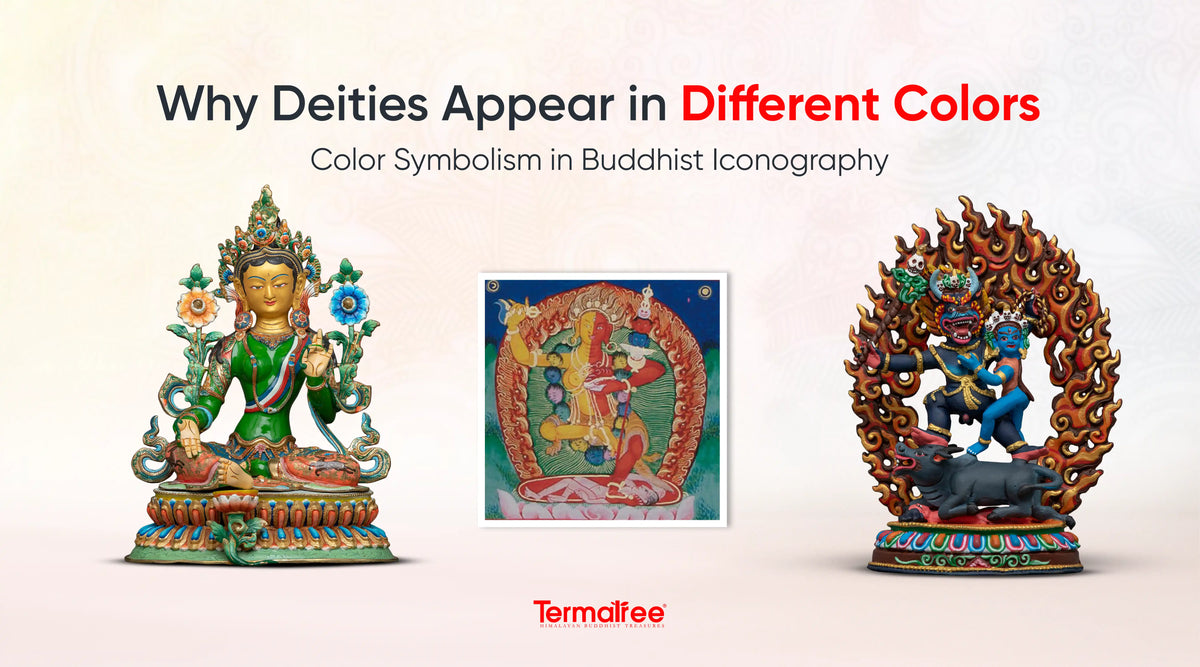
In Vajrayana iconography, body colors directly encode the nature and function of a deity. White Tara and white aspects of Avalokiteshvara are associated with longevity and the purification of ignorance. Green Tara embodies active compassion and swift action. Blue-black deities such as Vajrapani or certain wrathful protectors embody the transformation of anger into mirrorlike wisdom. Yellow deities such as Ratnasambhava and certain forms of Manjushri are associated with wealth, abundance, and the equanimity aspect of enlightened awareness. Red deities, including Amitabha and many tantric forms, embody the discriminating wisdom that transforms desire into compassionate action.
Sacred Objects and the Practice of Meditation
The deepest purpose of Buddhist sacred art is not aesthetic or anthropological; it is meditational. Within Vajrayana Buddhism, sacred images serve as the foundation for sophisticated contemplative practices called deity yoga. In these practices, the meditator does not merely gaze at the image of a deity; through a complex process of visualization, mantra recitation, and breathing practice, they gradually identify their own mind with the qualities the deity represents.
A golden statue of Tara placed on a shrine is, in this context, not a representation of an external goddess but a symbolic mirror of the practitioner's own compassionate potential. The practice is designed to dissolve the ordinary habit of seeing oneself as limited, confused, and self-centered and to gradually reveal through systematic training what the tradition calls the Buddha nature already present within.
For less advanced practitioners and lay devotees, sacred images serve as anchors for attention and devotion. Bowing before an image, offering incense or butter lamps, circumambulating a statue: these physical acts of devotion are understood in Buddhist thought as purifying the body, speech, and mind of habitual negative tendencies while accumulating the positive causes for future spiritual development. The beauty of the art is intentional: it is designed to naturally attract, to quiet the mind, and to invite a quality of attention that is itself a form of meditation.
Preserving a Living Tradition in the Modern World

The sacred art traditions of Patan and the Kathmandu Valley are under threat in the 21st century due to economic pressures that drive young artisans away from traditional, low-paying apprenticeships. The increased demand for factory-made statues, particularly in China and India, compounds the problem and diminishes the demand for handmade goods. Temples and monasteries, which are key in patronage and training the arts in these traditions, were also impacted by the 2015 Gorkha earthquake.
However, several positive signs exist; institutions such as the Craft Association of Nepal and various Tibetan cultural foundations have recognized and helped master artisans and sponsored apprenticeships, opening up new markets to the high-quality handcrafted sacred art. The Patan Museum dedicates itself to exhibiting and educating visitors about the importance of this art form. The visit to Kathmandu Valley and the observation of the artisans at their work in Patan workshops are spiritual experiences for the Buddhist practitioners, where the creations are considered living human wisdom and not just commercial products. This emphasizes the continuity of sacred knowledge and craftsmanship that has extended over more than a thousand years.
Read More: Why Thangkas are Multicolored, While Many Buddhist Statues Remain Monochrome
Conclusion
Golden statues and multicolored thangkas are indeed paintings of great artistry and wisdom, but they are also living vehicles of enlightened presence that have been travelling beings from one level of awakening to another for more than a millennium. The sacred techniques handed down from generation to generation are still being used in Patan's old workshops, where Shakya and Chitrakar craftsmen are still at work, connecting the past and the present. The objects are a tangible experience of meditation, their golden radiant quality, the iconographic accuracy, and the ritual consecration.
The real benefit of such sacred objects isn't that they have significant material value but that they can help to open the Buddha nature of each practitioner. A golden Tara turns into a mirror of one's compassionate potential, while a multicolored thangka turns into a map leading the mind through the Vajrayana philosophy. These practices are at risk from economic pressures and mass production, but their value as a part of spiritual practice, not just a product of commerce, is critical to their survival. While these customs remain, the light of compassion and wisdom shines through golden hands and colored scrolls, leading beings beyond fear to the luminous nature of awakening itself.