A Deep Dive into Its Meaning, History, Practice & Benefits
The Dharani of Noble Avalokiteśvara Simhanada is a remarkable and deeply compassionate expression of Buddhist tantra. Unlike many other dharanis that focus broadly on protection or liberation, this dharani is historically associated with healing, the removal of obstacles, and the powerful, fearless proclamation of the Dharma reflected in the name Simhanada, meaning “Lion’s Roar.” This blog explores its origins, symbolism, ritual context, practice benefits, and relevance today, combining authentic translations with respected scholarly and practitioner sources.
What Is a Dharani?

In Buddhist philosophy, dharanis are sacred phrases or sayings that capture the essence of a whole teaching. Dharanis are usually longer and have more layers of significance than a mantra and are utilized for protection, healing, and spiritual empowerment. The dharanis are different from the silent meditations in that they use sacred sound as vibrational medicine, recognizing that this sound can impact consciousness on several levels, subtle and manifest.
According to Buddhist studies scholars, dharanis function as condensed spiritual technology short enough to recite, yet rich enough to carry the power of complex teachings. They are featured across Mahayana and Vajrayana traditions and discussed in commentarial literature as both contemplative and practical methods for transformation.
Avalokiteśvara Siṃhanāda: The Lion’s Roar of Compassion

The Bodhisattva of Compassion, Avalokiteśvara, is one of the most popular deities of Mahayana and Vajrayana Buddhism. The means behind his name, "lion‑roar," the Simhanada form is the most active, fearless, and healing manifestation of compassion. There are numerous forms of Avalokiteśvara, but the Simhanada form brings together the compassionate intent and fearless action. The lion's roar represents the clarity and the authority of the Dharma, which shatters ignorance and negative energies.
From a historical perspective, this form has been used in long tantric tales where Avalokiteśvara encounters powerful beings or situations (like a nāgas-related disease) and proves his ability not only to represent compassion but to create its healing power.
Origin of the Dharani of Noble Avalokiteśvara Simhanada
The Dharani of Noble Avalokiteśvara Simhanada is rooted in the deep tantric roots of Mahayana Buddhism in India, where Avalokiteśvara is not only celebrated for his boundless compassion but also regarded as a formidable protector and healer. The title Simhanada, meaning “Lion’s Roar,” reflects this manifestation’s dual qualities: fearless authority and compassionate intervention, symbolizing a voice that dispels ignorance, suffering, and obstacles with unwavering clarity.
Traditionally, the dharani is written in the context of particular tantric practices and sādhanas, usually to heal disease, eliminate spiritual hurdles, or cleanse karmic obstacles. The full Sanskrit original text is no longer extant, but its teachings were carefully preserved in Tibetan translations and ritual manuals and are part of the canonical collection of the Buddha's words, the Kangyur. Such translations made the dharani available to future generations, especially as it was used in the ritual recitation and visualization of the daily practice in the Himalayan Buddhist traditions. These texts show that the dharani was both literary and a practical tool of the spirit, combining philosophy, ritual, and compassion for physical and subtle ailments.
The Simhanada dharani, which has passed on through generations of lamas and ritual specialists, continues to connect textual scholarship with living practice as a historical document and as a vehicle to connect with Avalokiteśvara's compassionate and transformative energy for contemporary practitioners.
Iconography of Siṃhanāda Avalokiteśvara

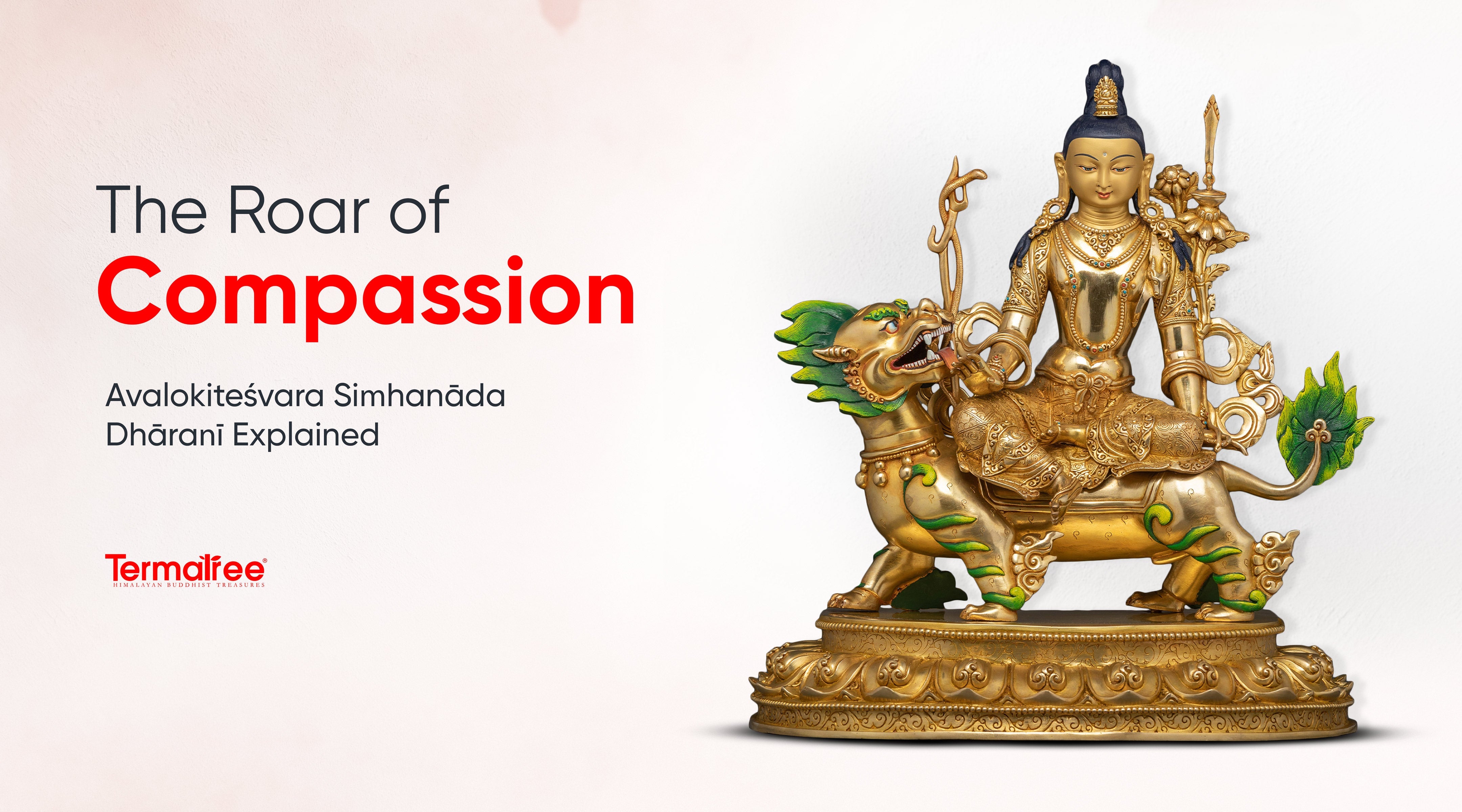
Hair and Unīsha: Hair is combed into a topknot (unīša) which symbolizes spiritual progress and enlightenment. The small Amitābha Buddha in the middle of the unīsha is a symbolic depiction of the lineage and source of Avalokiteśvara's spiritual lineage.
Deer on Shoulder: A small deer figurine or carving on the shoulder is a reference to the Buddha's first teachings in the Deer Park at Sarnath, representing gentleness, alertness and care for all beings.

Lotus: A fully bloomed lotus in one hand represents purity, spiritual development and the flowering of enlightenment in the midst of defilements in the world.
Sword Attribute: The sword symbolizes the capacity to sever ignorance, delusions, and attachments, embodying Avalokiteśvara's powerful and kindling wisdom in smashing obstacles to enlightenment.

Mount: Sitting on a mythical lion, representing fearlessness, protection and overcoming negative forces, the “lion's roar” quality of Avalokiteśvara's compassionate and fearless energy.

Snake (Naga): A snake coiled around one of the hands/arms represents the power to conquer all the negative forces, the ability to control negative energies, the power of the compassion of Avalokiteśvara. The snake is also a symbol of protection, fertility and wisdom energy in tantric symbolism.

Asana (Posture) and Hand Gestures: Seated in a cross-legged meditative posture, Avalokiteśvara balances stability and readiness for compassionate action. The right hand could be holding the sword, and the left hand is grasping the lotus or other sutra, representing the combination of method and wisdom.
Historical Transmission of the Dharani
The Simhanada dharani has not been preserved; however, its teachings have been passed down through Tibetan translations, where, through centuries of transmission, both textual accuracy and spiritual effectiveness were maintained. These translations allowed the dharani to be understood and practiced by generations of practitioners in the Himalayan Buddhist tradition. With contextual explanations, one can get a deeper knowledge of the ritual meaning. Shorter adaptations, often including practical instructions for healing and protection, highlight its historical value as a practical tool for spiritual transformation. In ancient settings, dharanis were chanted for their actual physical effects, such as the elimination of obstacles and the creation of protective energy. Preserving him through Tibetan transmission is essential, as it allows for its continued use by modern practitioners, offering a way to connect to ancient ceremonies and practice the compassion and transformative power of Avalokiteśvara.
Core Themes and Symbolism of the Simhanada Dharani

1. The Lion’s Roar as Fearless Compassion
Simhanada signifies an authoritative and liberating message that reveals the highest truth and emancipates from ignorance, fear, and delusion. In the context of Avalokiteśvara, this roar embodies a harmonious blend of compassionate gentleness and decisive action, reflecting the bodhisattva’s capacity to confront suffering while remaining committed to the welfare of all beings. The Simhanada dharani is used to overcome mental obstacles and to clear away doubt, anxiety, and karmic impediments. The recitation of this dharani is a devotional practice for practitioners, giving them fearlessness and connecting them with Avalokiteśvara's infinite compassion and transforming power. This power and compassion are recurring themes in tantric Buddhist art and practice, emphasizing the transformative potential of fierce energy in the service of compassion.
2. Healing: Physical, Energetic, and Karmic
The Simhanada dharani is uniquely associated with healing physical conditions caused by nāgas and subtle energetic imbalances. It is equally effective for psychological problems, transforming setbacks such as fear and anxiety into spiritual insight. Ritual manuals stress that the dharani should never be practiced alone, but with visualization, ritual implements, ethical intention, and offerings. The practitioner may visualize Avalokiteśvara as Simhanada and deepen the practice through meditation, ritual, and compassionate action, uniting textual knowledge with spiritual experience. Repeating this dharani, practitioners gain healing, protection, inner stability, emotional strength, and greater access to compassionate wisdom, exemplifying the unifying effect of the dharani in the practice of Vajrayana.
3. Sacred Sound as Spiritual Medicine
In Vajrayana Buddhism, mantras and dharanis are not simply symbols, but also the expressions of an enlightened mind, in which sound is filled with transformative power. The power of the Simhanada dharani is not in its meaning, but in its vibrations. This resonance clears the mind, balances the energies, and connects practitioners with the compassion of Avalokiteśvara. The dharani can work on various levels: it is a ritual of protection and healing, a transformation of mental and emotional states, creating clarity and equanimity, and an energetic connection to subtle energies through nāḍīs and prāṇa. The emphasis on sound, intention, and visualization underscores the Vajrayana understanding of mantras as tools for spiritual change and practice.
Practice & Benefits of the Simhanada Dharani

• Protection & Healing: The dharani Simhanada is believed to be particularly effective in dissolving afflictions that may not be the primary focus of traditional recitation (like Om Mani Padme Hum), such as stubborn illnesses, deep emotional blockages, or subtle energetic disturbances.
• Purification of Obstacles: Practitioners seek to clear away external obstacles and even internal forms of obstacles, such as doubt, attachment, mental obstructions, and obstructions to the mind, by reciting it with an intentional heart.
• Emotional & Spiritual Resilience: The dharani is related to cultivating the fearlessness, internal courage, and compassion qualities needed for meditation and engaged life.
• Avalokiteśvara vow: Chanting the Simhanada dharani is considered to align the practitioner's motivation with hearing the cries of the world and responding skillfully to alleviate suffering. This is the basis for all Mahayana aspiration.
Spiritual Significance of the Simhanada Dharani
In Vajrayana Buddhism, the Dharani of Noble Avalokiteśvara Simhanada is used as a meditative focus and a practice of protection. Through reciting or meditating on this dharani, the practitioner becomes a vessel of the limitless compassion and fearless energy of Avalokiteśvara, bringing courage, clarity, and stability to their mind. It is traditionally thought to be a way to remove negative karmas, clear obstacles, and stop suffering, whether physical, emotional, or subtle karmic.
The dharani does not just invoke practical benefits but also helps to embody compassionate action. The practitioner learns to merge wisdom with action, turning insight into moral and compassionate action, as Avalokiteśvara hears the screams of all beings. The dharanis a threefold spiritual tool, designed to harmonize the elements of visualization, recitation, and intention, that can be used to develop the practitioner's spiritual skill while linking them to a lineage of committed Avalokiteśvara practitioners.
Modern Interpretation

The Simhanada dharani is considered sacred and symbolic in modern usage. It is still used today in healing ceremonies and protective rituals among the Himalayan people, but is also seen as a meditative and psychological tool for modern users. The “Lion's roar” might symbolize the strength of character, the wisdom of understanding, and the courage to face personal and social obstacles with compassion and resolve.
Modern Buddhist teachers have taught that, even in the absence of elaborate ritual, recitation, or contemplation on the dharani, it can help build mindfulness, resilience, and cultivate empathy. Thus, the practice can be used by urban practitioners, scholars, and spiritual seekers around the world, who can include the dharani in their daily meditation, chanting, or mindful reflection. The essence of it is: whether in ritual, sound, or deliberate thought, compassion, clarity, and fearless wisdom are transformative.
Conclusion
The Dharani of Noble Avalokiteśvara Simhanada embodies compassion, protection, and transformative action in Vajrayana Buddhism. It has been passed down from India, where it was part of tantric rituals, and is preserved in Tibetan translations and spiritual teachings; as a ritual tool, it has survived for centuries. The “Lion’s Roar” captures the spirit of fearless truth and compassionate action, offering practitioners a way to clear blockages, ease suffering, and strengthen their hearts.
Whether used in a traditional context, through meditative visualization, or modern contemplative practice, the Simhanada dharani is a timeless source of devotion and personal transformation. It connects textual scholarship and living practice, helping those engaged in the discipline to remember that compassion, like the lion’s roar, can be both majestic and practical, able to protect, heal, and awaken the mind to the boundless possibilities of enlightened action.
Read More: A Complete History and Truth About Simhada Manjushri and Simhada Lokesvara