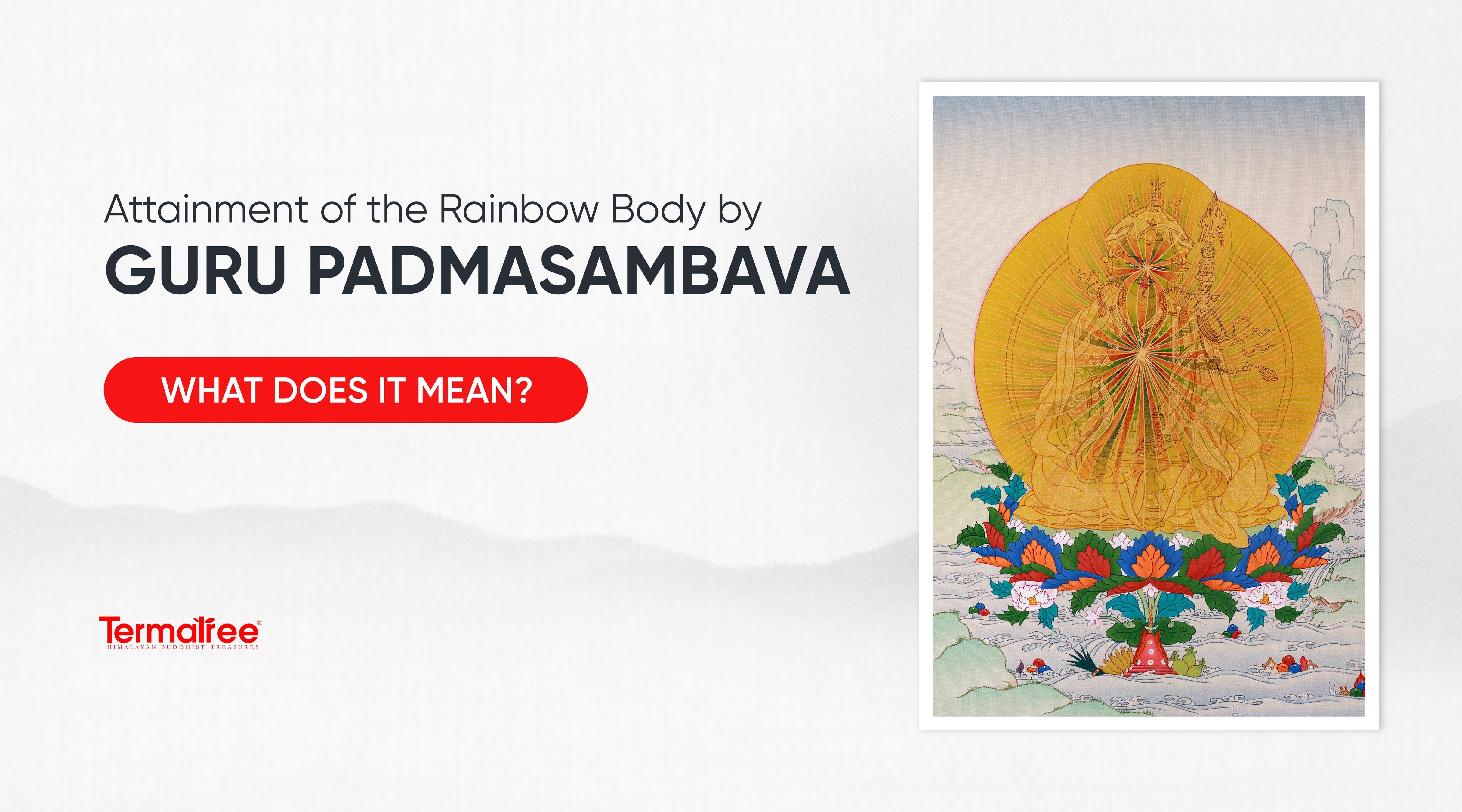
The Dzogchen Path of Transforming Body Into Light.
The term "Rainbow Body," or “Jalü” in Tibetan, is the ultimate spiritual attainment in Tibetan Buddhism: when the practitioner's physical body at the moment of death becomes pure light, and at the same time, the remains of the body are but hair and nails. The 8th-century Guru Padmasambhava, who brought Buddhism to Tibet, is credited with having been the master of the rarely attained state of the Rainbow Body of Great Transference, a deathless being.
This extraordinary accomplishment represents the highest attainment of the Dzogchen (Great Perfection) practice and signifies the complete fulfillment of enlightenment. This is a complete description of the meaning of the rainbow body, how it was achieved by Padmasambhava, and how it is still a crucial teaching for Buddhist practitioners today.
What Is the Rainbow Body? Definition and Core Meaning

In Dzogchen Tibetan Buddhism, the physical body of a practitioner turns into pure light at death, which is the highest spiritual attainment. The body turns into rainbow-colored light, leaving behind hair and fingernails or sometimes nothing. The five elements (earth, water, fire, air, and space) within the body manifest as five colored lights of the spectrum of light; the body shrinks to the size of a forearm; sweet smells are released rather than the smell of decomposition; and rainbows are seen in the sky as a witness to this miracle.
This attainment is full knowledge and total freedom from samsara, in which the physical body is a Sambhogakāya. It is the outcome of a long period of disciplined yoga meditation practice and is the proof that full enlightenment is possible in one lifetime without having to undergo a series of reincarnations. The Rainbow Body is very rare, only attained by very high-level Dzogchen masters, and Guru Padmasambhava had the rare "Great Transference" form, entering a deathless state without ordinary death.
The History and Origin of the Rainbow Body Concept
Pre-Buddhist Origins in Bon Religion
The origin of the rainbow body phenomenon is pre-Buddhist in nature and is connected to the indigenous Tibetan Bon religion that predates Buddhism when it first came to Tibet. This concept is centuries old in Tibet and is regarded seriously in the modern world as well, starting with the ancient Tibetan spiritual belief in the interplay of light, consciousness, and the physical body.
Guru Padmasambhava's Unique Achievement: The Rainbow Body of Great Transference

Many enlightened masters have been able to reach an ordinary Rainbow Body, but Guru Rinpoche, the 8th-century master who introduced Buddhism to Tibet, reached a special higher form, Jalu Powa Chemo. Normal Rainbow Body practitioners break down into light during their dying moments and leave behind hair and nails. This transformation was not the same for Padmasambhava, however, who attained it without dying while remaining quite alive. He didn't wait for death to achieve this transformation; he achieved it through his mastery of Dzogchen practices and now exists in a deathless, luminous state that can manifest wherever sentient beings need his guidance. Only Padmasambhava and Vimalamitra achieved this unique, extraordinary transference form in all of Buddhist history. This means Padmasambhava self-liberated his material body into pure radiance while still alive, completely transcending ordinary death, and continues to remain accessible through compassion to guide future generations of practitioners.
The Three main Levels of Rainbow Body
Dharmakaya: The Ultimate Nature of Reality
The highest of the Rainbow Body is the Dharmakaya which is the ultimate nature of reality. It is the eternal and infinite in all phenomena and the highest spiritual attainment. At this stage, practitioners have reached a level of understanding that goes beyond the physical and mental world. It is a state of complete liberation and transcendence, characterized by the practitioner's mastery over all negative emotions and attachments, and their state of great inner peace and wisdom.
Sambhogakaya: The Blissful Body of a Buddha
The Sambhogakaya is the second stage of the Rainbow Body, the blissful body of a Buddha. It displays the Dharmakaya and is filled with pure and radiant light. At this level, one can receive a lot of inner peace and bliss and can even communicate with other enlightened ones.
Nirmanakaya: The Physical Body
The Nirmanakaya is the lowest body of the Rainbow Body, that is the physical body. When you reach this stage, the physical body is transmuted into light and only the hair, nails and clothes remain. Buddhism's ultimate goal of spiritual practice is this level, called the Rainbow Body. It is the fruition of years of spiritual practice and the highest level of enlightenment and transcendence.
How Is the Rainbow Body Attained? The Dzogchen Path

1. Needs high-level practices of Dzogchen meditation, particularly tögal, direct crossing
2. Not easy meditation, but a full path that requires years of disciplined practice.
3. Starts with the distinction between ordinary mind and pure awareness (rigpa), the first step before the tögal.
4. Tögal Practice: The Key to Rainbow Body
-
First Vision: Direct perception of reality as light; the small spheres of light show in front of the eyes, and the reality of the mind is seen as a light.
-
Second Vision: The more one practices, the more complex the vision, mandalas, Buddha forms, and the experience of the luminous display become.
-
Third Vision: Awareness rises to its utmost expression, and the visions are firm and permanent, and the practitioner's body starts to radiate light.
-
Fourth Vision: All dualistic perception falls away; the practitioner attains complete enlightenment and the Rainbow Body.
5. Body gradually becomes increasingly luminous through practice
6. Five elements transform into primordial light nature
7. At culmination, its whole form is liberated; the freeing of the whole body is accomplished in Sambhogakāya, the pure light body.
8. Signs of advanced practitioners:
-
Prevention of shadow in sunlight or lamplight: body's luminosity prevents shadow formation, documented phenomenon backed by witnesses
-
The body emits light naturally, without the help of an artificial source of light, particularly when meditating.
-
Sweat emits a sweet smell; natural flower-like or incense fragrances flow out from the body rather than from the human body.
-
Exotic plants appear in their presence; plants that are not expected to grow in the season or location suddenly grow, suggesting how the practitioner's luminous energy impacts the environment.
The Five Elements and Five Rainbow Colors
 (Photo from Gaia)
The transformation is of the five elements of the five Buddha families and their colors:
|
Element |
Color |
Buddha Family |
Wisdom |
Poison Purified |
|
Earth |
Yellow |
Ratnasambhava |
Equality |
Pride |
|
Water |
White |
Vairocana |
Mirror-like |
Ignorance |
|
Fire |
Red |
Amitabha |
Discriminating |
Attachment |
|
Air |
Green |
Amogasiddhi |
All-accomplishing |
Jealousy |
|
Space |
Blue |
Akshobhya |
Dharmadhatu |
Anger |
These five elements manifest as the rainbow body at the practitioner's level when the practitioner reaches this level. The colors are not symbolic, but what they really are is the visible expression of the elemental energies returning to pure light.
Key Historical Masters Who Achieved Rainbow Body
Early Masters (8th-14th Centuries)
-
Garab Dorje: Legendary founder of Dzogchen who transmitted the teachings to humans
-
Mañjuśrīmitra: Indian master who received teachings from Garab Dorje
-
Śrī Siṅgha: Continued the lineage and transmitted to Padmasambhava
-
Vimalamitra: Achieved Great Transference alongside Padmasambhava, the only second master to do so
-
Longchenpa (14th century): A great Dzogchen master who wrote extensively on the practice
Modern Documented Cases (20th-21st Centuries)
-
Yilungpa Sonam Namgyel (1952): Achieved rainbow body as recounted by Chögyam Trungpa Rinpoche in his memoir, Born in Tibet.
-
Changchub Dorje: Medical doctor and leader of the Dzogchen community in the Nyarong region, eastern Tibet, documented by Chogyal Namkhai Norbu in The Crystal and the Way of Light.
-
16th Karmapa: Unusual physical state after death noted by witnesses.

-
2015-2022: Reports from inside Tibet of miraculous rays of light emanating from a temple when a practitioner achieved the rainbow body, with rainbows appearing in the sky.
Development in Tibetan Buddhist Texts
The concept appears in major texts, including the following:
-
The Tibetan Book of the Dead (Bardo Thödol): Describes elemental energy transformation
-
Dzogchen texts: Detail tögal practices leading to the rainbow body
-
Master biographies: Document dozens of cases between the 11th and 20th centuries
Nyingma School and Rainbow Body Tradition
The rainbow body practice became most prominent in the Nyingma school, where it was particularly common. The tradition maintains detailed records of practitioners who achieved this attainment, with dozens of documented cases throughout history. The practice requires direct transmission from qualified Dzogchen masters within the Nyingma lineage.
Common Misconceptions About Rainbow Body
-
"It's only a metaphor for enlightenment."
The Rainbow Body is not some symbol or metaphor for spiritual attainment, but has been observed by hundreds of witnesses throughout history in a physical way.
-
"Only Padmasambhava achieved it."
Many masters achieved the ordinary Rainbow Body throughout history. Padmasambhava uniquely achieved the Great Transference form, but dozens of other Dzogchen masters attained the standard rainbow body.
-
"It's magic or supernatural."
It comes with the knowledge and purity of God. It is the natural derivation of complete purification, such as ice melting into water. With the removal of all karmic pollutants, the body returns to its pristine, radiant state, according to the principle of realization of Dzogchen.
-
"It's only for Tibetan monks."
The practice is open to all qualified practitioners, anywhere, in any lifestyle, whether monastic or lay, as long as they have passed it on properly.
-
"It's superstition from ancient times."
Recent documented cases (2015-2022) confirm the phenomenon continues today, with eyewitness reports of rainbows, light emissions, and body shrinkage in modern Tibet.
-
"The body is destroyed or annihilated."
This is not destruction or vanishing into nothingness but self-liberation, whereby the body is transformed into its original pure state of light.
Why This Matters for Practitioners Today

The Rainbow Body teaching holds deep hope and inspiration for modern-day Buddhists, proof that complete enlightenment is possible in our time, encouragement to practice with a tangible objective, a revelation of the meaning of death, and a testament that enlightened beings are available to assist those in distress. The Rainbow Body of Padmasambhava is the final possibility in the Buddhist path, for the Nepali Buddhist community and practitioners around the world. The Rainbow Body is not a historical miracle; it is a promise of living here and now and being fully enlightened, and it continues to inspire those who are following the path now on the basis of visions, dreams, terma teachings and inner guidance.
Conclusion: The Ultimate Meaning
The Rainbow Body of Guru Padmasambhava is the highest level of Buddhist spiritual attainment, the full realization of what is called the complete transformation of physical substance into pure consciousness and light. Being a unique Great Transference, he is the only master to be in this state without dying and is accessible to him through a human sense of compassion to help sentient beings over several centuries. For practitioners of Dzogchen, this state is the ultimate possibility, the complete realization that the body and the cosmos are one brilliant manifestation of knowledge. The five colors of the rainbow symbolize the five wisdoms that have been removed from the five poisons, indicating that suffering itself can be turned to enlightenment. The Rainbow Body of Padmasambhava is not only a historical miracle, but it is also a living promise: that full enlightenment is possible here and now. His deathlessness shines through today in visions, dreams, Terma teachings, and inner guidance for practitioners.